SEER Rating Explained: What It Means for Your Texas Energy Bill
SEER and SEER2 ratings explained for North Texas homeowners. See how each SEER point affects your electric bill, what Texas requires, and which rating actually saves you money.
- What Is a SEER Rating?
- SEER vs. SEER2: What Changed in 2023
- Texas Minimum Requirements (They’re Higher Than You Think)
- SEER Rating Chart: What Each Level Costs You Per Year
- The Sweet Spot: What SEER Rating Is Actually Worth It in North Texas
- What Affects Your Real-World SEER Performance
- SEER Ratings by Brand: North Texas Pricing
- Tax Credits and Rebates That Change the Math
+ 3 more sections below...
- What Is a SEER Rating?
- SEER vs. SEER2: What Changed in 2023
- Texas Minimum Requirements (They’re Higher Than You Think)
- SEER Rating Chart: What Each Level Costs You Per Year
- The Sweet Spot: What SEER Rating Is Actually Worth It in North Texas
- What Affects Your Real-World SEER Performance
- SEER Ratings by Brand: North Texas Pricing
- Tax Credits and Rebates That Change the Math
+ 3 more sections below...
If you’re shopping for a new air conditioner in North Texas, you’ve probably seen the SEER rating on every quote. A 14, a 16, an 18, maybe a 20. The salesperson says higher is better and points to a bigger number on a more expensive unit. But what does that number actually mean for your electric bill? And is the jump from 16 to 20 worth $3,000 more?
I’ve installed thousands of AC systems across Frisco, Plano, McKinney, and Allen since 2008. I’ve watched homeowners overpay for efficiency they’ll never recoup and watched others cheap out and regret it by August. This guide breaks down exactly what SEER means, how the new SEER2 standard changed things, and where the real savings sweet spot is for North Texas homes.
What Is a SEER Rating?
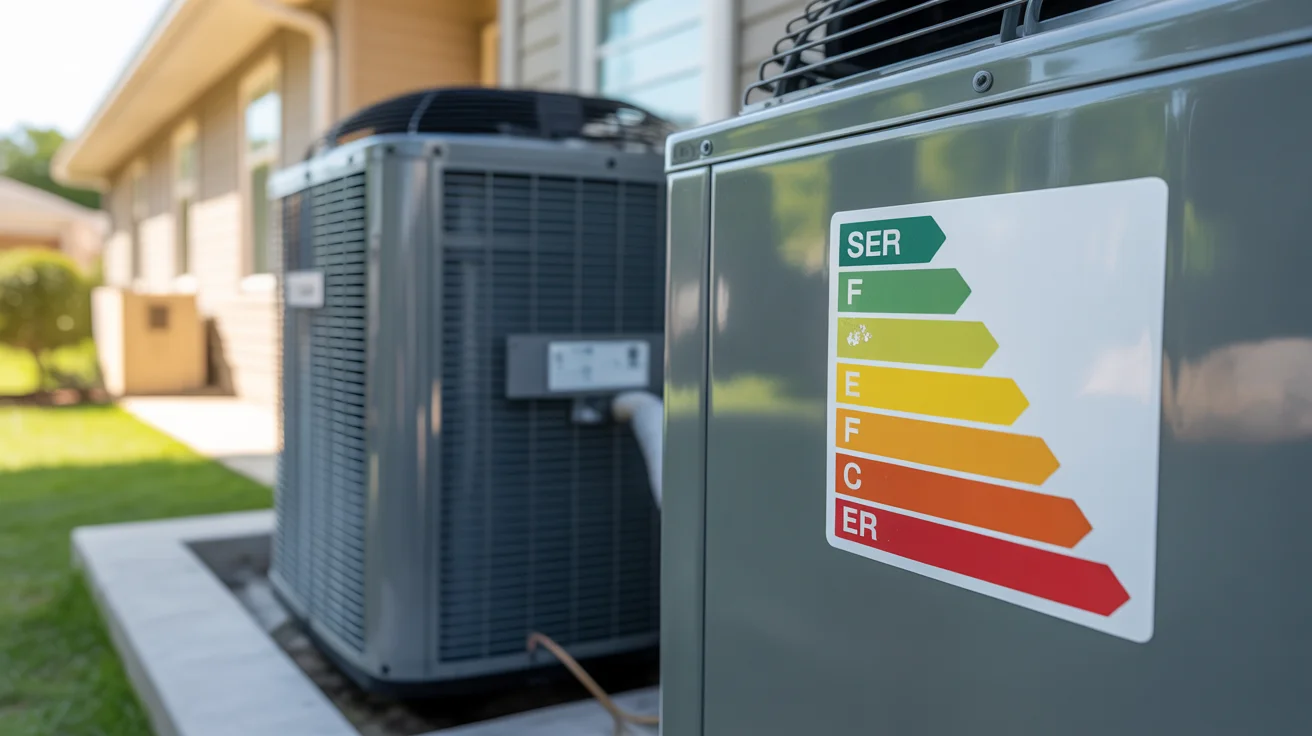
SEER stands for Seasonal Energy Efficiency Ratio. It measures how much cooling an air conditioner produces per watt of electricity over an entire cooling season. Think of it like miles per gallon for your car. A higher number means the unit uses less electricity to deliver the same amount of cooling.
The formula is straightforward: total cooling output (in BTUs) divided by total electrical energy input (in watt-hours) over a typical cooling season. A 16 SEER unit produces 16 BTUs of cooling for every watt-hour of electricity. A 20 SEER unit produces 20 BTUs for that same watt-hour.
One important detail most guides skip: SEER is a seasonal average, not a constant. Your AC might hit its rated efficiency at 82°F outdoor temperature but perform lower at 105°F. In North Texas, where we regularly see triple digits from June through September, your real-world efficiency runs below the rated number. That’s a big reason why the industry moved to SEER2.
SEER vs. SEER2: What Changed in 2023
The Department of Energy replaced SEER with SEER2 as the official efficiency standard on January 1, 2023. Every new residential AC system sold in the U.S. now uses SEER2 ratings instead of the old SEER numbers.
The key difference is how they test. The original SEER test used low static pressure (essentially ideal ductwork conditions that almost no real home has). SEER2 testing applies 0.5 inches of water column pressure, which better reflects typical ductwork resistance in actual homes.
What this means in practice: A system that was rated 16 SEER under the old standard now rates around 15.2 SEER2 under the new one. The unit didn’t get worse. The test got more honest.
For a ducted split system — which is what’s in most North Texas houses — the SEER2 number lands roughly 5% below the old SEER number. But that derate is not a universal constant, and this is where a lot of published conversion charts go wrong:
- Ducted split systems drop about 5%, because the new test finally makes the blower push against realistic duct resistance.
- Ductless mini-splits barely move at all. They don’t have ducts to push against, so there’s nothing for the harder test to penalize. A 20 SEER mini-split is about 20 SEER2.
- HSPF2 is the one to watch. Heating ratings fell much harder than cooling ratings — roughly 15% — so an old 8.8 HSPF heat pump is somewhere near 7.5 HSPF2. Applying “about 5%” to a heating number will leave you badly off.
Here’s a quick conversion reference for ducted split systems:
| Old SEER Rating | New SEER2 Rating | Efficiency Class |
|---|---|---|
| 14 | 13.4 | Minimum (Northern states) |
| 15 | 14.3 | Minimum for Texas |
| 16 | 15.2 | Good |
| 18 | 17.2 | Very Good |
| 20 | 19.0 | Excellent |
| 22+ | 21.0+ | Premium |
If you’re comparing a ducted quote that uses SEER to one using SEER2, multiplying by 0.95 gets you close enough to compare. But don’t convert when you don’t have to — every unit has an AHRI certificate with the actual rated numbers on it for the exact condenser-and-coil combination being quoted. Ask for it. A converted number is an estimate; the certificate is the rating.
Texas Minimum Requirements (They’re Higher Than You Think)
Texas falls in the DOE’s Southeast region, which carries stricter air conditioner minimums than northern states because our cooling loads are so much heavier. As of January 1, 2023, the minimum for a new split-system air conditioner installed in Texas is SEER2 14.3 (equivalent to the old 15 SEER).
That means you cannot install a 14 SEER split system in Texas. If someone quotes you a “14 SEER” unit, they’re either using the old rating scale or trying to put in equipment that won’t pass inspection.
Here’s what the minimums look like by system type:
| System Type | Minimum | Old SEER Equivalent | How it’s enforced |
|---|---|---|---|
| Split-system AC (under 45,000 BTU) | 14.3 SEER2 | 15 | Regional — where it’s installed |
| Split-system AC (45,000+ BTU) | 13.8 SEER2 | 14.5 | Regional — where it’s installed |
| Packaged AC system | 13.4 SEER2 | 14 | National — date of manufacture |
| Split-system heat pump | 14.3 SEER2 / 7.5 HSPF2 | 15 | National — date of manufacture |
That last column trips people up, so it’s worth being precise. The air conditioner standards are regional: they’re enforced on the installer, based on where the equipment goes in the ground, which is why a 13.4 SEER2 condenser is legal in Ohio and not here. Heat pump standards are national and enforced on the manufacturer, based on when the unit was built. Nobody has a Texas-specific heat pump rule — 14.3 SEER2 and 7.5 HSPF2 is the floor in all fifty states.
And note that heat pumps carry two numbers. HSPF2 is half the standard and it’s the half that gets left off spec sheets, because heating is an afterthought in the sales pitch down here. It shouldn’t be — that’s the number that decides your January bill.
These are minimums, not recommendations. Meeting minimum code is like getting a D on a test. You passed, but you’re not setting yourself up for success, especially in a climate where your AC runs the hours ours do.
SEER Rating Chart: What Each Level Costs You Per Year
This is the part everyone wants to see. I built this chart using real North Texas electricity rates and cooling hours. The assumptions: a 3-ton system (typical for 1,800 to 2,400 sq ft homes here), electricity at $0.13 per kWh (average DFW rate), and 2,400 cooling hours per year.
| SEER2 Rating | Annual Cooling Cost | Savings vs. Minimum (14.3) | Monthly Savings |
|---|---|---|---|
| 14.3 (minimum) | $785 | — | — |
| 15.2 (16 SEER) | $739 | $46/year | $4/month |
| 17.2 (18 SEER) | $653 | $132/year | $11/month |
| 19.0 (20 SEER) | $591 | $194/year | $16/month |
| 21.0 (22 SEER) | $535 | $250/year | $21/month |
| 24.0 (25 SEER) | $468 | $317/year | $26/month |
How I calculated this: Annual cooling cost = (BTU capacity x cooling hours) / (SEER2 x 1,000) x electricity rate. For a 3-ton (36,000 BTU) system: (36,000 x 2,400) / (SEER2 x 1,000) x $0.13. Run it yourself and you’ll land on the same numbers.
This is a model, not your bill. The 2,400 hours is full-load equivalent hours, not how long the unit hums — a system that cycles all summer racks up far more clock hours than that at partial capacity. A bigger house, a leakier one, or a rate above $0.13 moves every row up together, but the gaps between the rows hold, and the gaps are what you’re actually buying.
The numbers don’t lie, but they tell a nuanced story. Going from minimum to 16 SEER saves $46 per year. Going from 16 SEER to 20 SEER saves another $148. But going from 20 SEER to 25 SEER only saves $123 more, and that jump costs $4,000 to $6,000 extra at the register.
The Sweet Spot: What SEER Rating Is Actually Worth It in North Texas
Every SEER point saves you money. But the savings per point decrease as you go higher. This is the diminishing returns problem, and it’s where most homeowners get steered wrong.
Going from 14.3 to 17.2 SEER2 (old 15 to 18 SEER) saves about $132 per year and typically adds $1,500 to $2,500 to the equipment cost. Payback: 11 to 19 years. Most North Texas systems last 12 to 15 years, so on energy alone this one is a coin flip — you come out ahead if you land near the bottom of that price spread, and you don’t if you land at the top. What tips it for most of my customers isn’t the payback, it’s that the two-stage equipment in that range pulls humidity out far better than a single-stage unit does.
Going from 17.2 to 19.0 SEER2 (old 18 to 20 SEER) saves an additional $62 per year but usually adds $2,000 to $3,000 to the price. Payback: 32 to 48 years. Your system won’t last that long.
Going from 19.0 to 24.0 SEER2 (old 20 to 25 SEER) saves $123 per year but adds $4,000 to $6,000. Payback: 33 to 49 years. Same story.
For most North Texas homes, I recommend 16 to 18 SEER (15.2 to 17.2 SEER2) as the best balance of upfront cost, energy savings, and payback period. This is where you get the most value per dollar spent. I tell this to my customers in Frisco and Plano every week, even though I’d make more selling the 20+ SEER units.
The exception: if you plan to stay in your home 15+ years, have a large house (3,000+ sq ft), or your electricity rate is above $0.15/kWh, the jump to 20 SEER starts to make sense. For a smaller home or a house you might sell in 5 to 7 years, stick with the 16 to 18 range.
What Affects Your Real-World SEER Performance
Your AC’s rated SEER2 is a lab number. Your actual efficiency depends on several factors that can push performance 15% to 30% below the rated number.
Ductwork Condition
Leaky or poorly insulated ducts waste 20% to 30% of the air your system produces. I’ve tested brand-new 20 SEER systems that performed like 14 SEER units because the ductwork had gaps, crushed flex runs, and zero insulation in a 150°F attic. Before spending $3,000 extra on a higher SEER unit, spend $300 on a duct inspection. You might get more savings from sealing what you have.
Proper Sizing
An oversized AC short-cycles (turns on and off too quickly), which kills efficiency and humidity removal. An undersized unit runs nonstop and never reaches its rated performance. Proper Manual J load calculation is the foundation of real efficiency. If your contractor skips this step and sizes “by the old unit” or “by square footage,” find a different contractor.
Installation Quality
Refrigerant charge, airflow balance, electrical connections, and thermostat placement all affect performance. A study by the National Institute of Standards and Technology found that improper refrigerant charge alone can reduce efficiency by 5% to 20%. The best SEER rating in the world means nothing if the installation is sloppy.
Maintenance
Dirty coils, clogged filters, and worn capacitors force your system to work harder. Annual maintenance keeps your system running within 5% of its rated efficiency. Skip it for three years and you might lose 10% to 15% of your rated performance. Read more about efficiency maintenance tips.
SEER Ratings by Brand: North Texas Pricing
Based on systems I install regularly, here’s what you’ll see quoted across the major brands in the DFW area. These are installed prices for a 3-ton split system.
| Brand | Entry (14.3 SEER2) | Mid-Range (16-17 SEER2) | Premium (19+ SEER2) |
|---|---|---|---|
| Carrier | $7,500 - $8,500 | $9,500 - $11,500 | $12,000 - $15,000 |
| Trane | $7,000 - $8,200 | $9,000 - $11,000 | $11,500 - $14,500 |
| Lennox | $7,800 - $9,000 | $10,000 - $12,500 | $13,000 - $16,000 |
| York/Johnson Controls | $6,500 - $7,800 | $8,500 - $10,500 | $11,000 - $13,000 |
The price difference between a 14.3 and a 17 SEER2 system averages about $2,000 to $3,000 across all brands. The jump from 17 to 19+ SEER2 averages $2,500 to $4,000 more. For a deeper comparison of these brands, check out my guide to HVAC system types.
Tax Credits and Rebates That Change the Math
Federal tax credits used to shift this math a lot. They’re gone. The Energy Efficient Home Improvement Credit (25C) applied to equipment placed in service through December 31, 2025, and nothing replaced it. If you’re reading an older guide that promises you $600 on a condenser or $2,000 on a heat pump, that guide is out of date — and so is any payback number built on top of it.
What that means for the numbers above: the paybacks in this article are unsubsidized, which is the only honest way to run them now. An upgrade that penciled at 3 years with a $2,000 credit behind it is back to 11 to 19 years without one.
Utility rebates are still live and still worth chasing. Oncor (the main electricity delivery company in DFW) runs seasonal efficiency rebates through participating contractors, and some retail electric providers add their own. Those come off the install price directly rather than waiting for a tax return, which honestly makes them the more useful of the two.
How to Use SEER Ratings When Comparing Quotes
When you have two or three quotes sitting on your kitchen table, here’s how to use SEER ratings to make a smart decision.
Step 1: Make sure you’re comparing the same rating system. If one quote says “16 SEER” and another says “15.2 SEER2,” those are the same efficiency. Don’t assume the 16 is better.
Step 2: Calculate the annual savings difference. Use the chart above or this quick formula: take your current estimated annual cooling cost and multiply by (1 - old SEER2/new SEER2). For example, upgrading from 14.3 to 17.2 SEER2: $785 x (1 - 14.3/17.2) = $132 saved per year.
Step 3: Divide the price difference by annual savings. If the higher-efficiency unit costs $2,500 more and saves $132/year, the payback is 19 years. If it costs $1,500 more, it’s 11 years. That spread is why the install quote matters more than the sticker rating.
Step 4: Consider the whole system, not just the condenser. A high-SEER outdoor unit paired with a mismatched indoor coil or bad ductwork won’t deliver its rated efficiency. Ask your contractor about the matched system rating, not just the outdoor unit.
If you want help running these numbers for your specific home, call me at (940) 390-5676. I’ll walk you through the math on your actual quotes, even if they’re from other companies.
FAQ
What is a good SEER rating for an AC in Texas?
For North Texas, a good SEER rating is 16 to 18 SEER (15.2 to 17.2 SEER2). This range gives you meaningful energy savings over the minimum without the diminishing returns of 20+ SEER units. Given that our AC systems run 2,400+ hours per year, efficiency matters more here than in cooler states. But above 18 SEER, the extra savings rarely justify the extra cost for most homes.
Is SEER2 replacing SEER?
Yes. SEER2 became the official efficiency standard on January 1, 2023. All new residential HVAC equipment is now rated using SEER2. The old SEER numbers are still referenced for comparison, but SEER2 is what matters for code compliance and new purchases. On a ducted split system the SEER2 number sits about 5% below the old SEER number because the test uses realistic duct pressure. Ductless equipment barely shifts, and HSPF2 heating ratings dropped roughly 15% — so don’t apply the cooling derate to a heating number.
What SEER rating is required in Texas?
Texas requires a minimum of SEER2 14.3 (equivalent to the old 15 SEER) for split-system air conditioners under 45,000 BTU, and 13.8 SEER2 at 45,000 BTU and above. Northern states only require 13.4 SEER2. Texas sits in the DOE’s Southeast region, which carries the tighter number because our cooling demand is so much higher. Note this applies to air conditioners specifically — split-system heat pumps are held to 14.3 SEER2 and 7.5 HSPF2 nationwide, with no regional variation at all.
How much does each SEER point save per year?
Each SEER2 point cuts cooling cost by about 4% to 6%, and the dollar value shrinks as you climb. Down at the bottom of the range one point is worth roughly $45 a year on a 3-ton system; up at 21 SEER2 the same single point is worth about $25. That’s the whole diminishing-returns story in one sentence: you’re buying a percentage of a number that keeps getting smaller. See the savings chart above for specific figures at each level.
Is a 20 SEER AC worth the extra money?
For most North Texas homeowners, no — not on energy savings alone. The upgrade from 18 to 20 SEER typically costs $2,000 to $3,000 extra but only saves about $62 per year. That’s a 32 to 48 year payback on a system that will last 12 to 15. The federal tax credit that used to rescue this math expired at the end of 2025. Large homes (3,000+ sq ft) with high electricity rates close the gap somewhat, and if you want the unit for the quiet and the humidity control rather than the savings, that’s a legitimate reason to buy one — just buy it for the right reason.
Should I replace a working 10 SEER system?
If your current system is 10 SEER and still functioning, upgrading to a 16 SEER (15.2 SEER2) unit would save approximately $440 per year in cooling costs — old equipment is where the real savings live, because you’re closing a huge efficiency gap rather than a marginal one. At a replacement cost of $7,000 to $9,000, that’s a 16 to 20 year payback on energy alone. But factor in that a 10 SEER system is likely 15+ years old and approaching the end of its lifespan. The efficiency gains make replacement more attractive than a major repair on the old unit. Learn about your installation options.
The Bottom Line
SEER rating is the single most important efficiency number on your AC system, and it matters more in North Texas than almost anywhere else in the country because of our extreme cooling hours. The new SEER2 standard made the numbers more honest by testing under realistic conditions.
For most North Texas homes, the 16 to 18 SEER range (15.2 to 17.2 SEER2) delivers the best return on investment. Don’t let anyone upsell you to a 22+ SEER unit unless you’ve done the payback math and it works for your situation. And remember: the best SEER rating in the world won’t help if your ductwork leaks, your system is oversized, or the installation is rushed.
If you’re comparing AC quotes and want a straight answer on which SEER rating makes sense for your home, give me a call at (940) 390-5676. I’ll help you sort through the numbers, no sales pitch, just honest advice.
Gary Musaraj, Owner & EPA-Certified HVAC Professional, Jupitair HVAC. Serving Frisco, Plano, McKinney, Allen, Prosper, The Colony, Little Elm, and Addison since 2008.