Emergency AC Repair: What to Do When Your AC Dies in a Texas Heat Wave
Your AC just died and it's 105°F outside. Here's exactly what to do: safety steps, DIY checks, when to call for emergency repair, and what it costs ($250-$5,000). From a North Texas HVAC tech who handles these calls every summer.
- Step 1: Protect Your Family First
- Step 2: Five Quick Checks Before You Call Anyone
- Step 3: When It’s a Real Emergency (Call Now)
- Step 4: How to Choose an Emergency HVAC Company (Without Getting Ripped Off)
- Step 5: Survive the Wait (Cooling Your Home Without AC)
- The Most Common Emergency Repairs I See in North Texas
- How to Prevent Emergency Breakdowns Next Summer
- FAQ
- Step 1: Protect Your Family First
- Step 2: Five Quick Checks Before You Call Anyone
- Step 3: When It’s a Real Emergency (Call Now)
- Step 4: How to Choose an Emergency HVAC Company (Without Getting Ripped Off)
- Step 5: Survive the Wait (Cooling Your Home Without AC)
- The Most Common Emergency Repairs I See in North Texas
- How to Prevent Emergency Breakdowns Next Summer
- FAQ
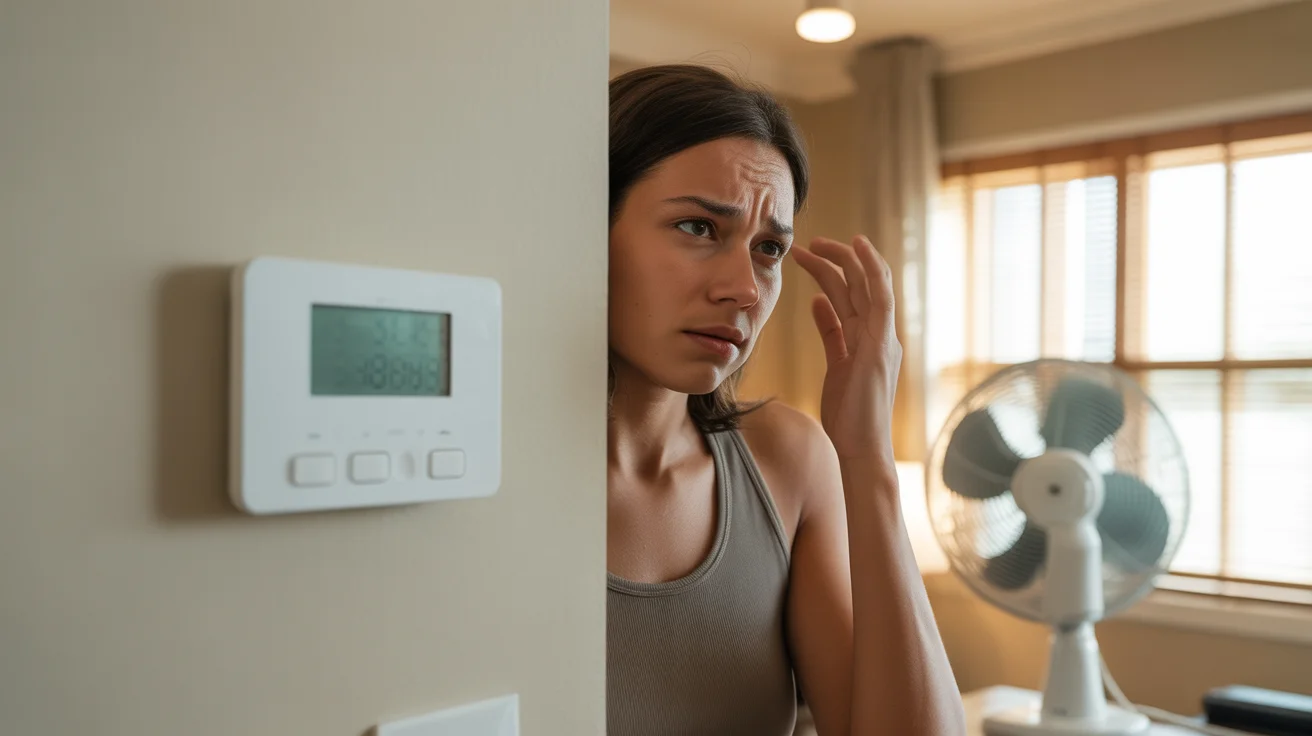
It’s 4:30 PM on a Saturday in July. Your thermostat reads 87 degrees and climbing. The outdoor unit is silent. Your kids are getting cranky, the dogs are panting, and you’re Googling “emergency AC repair” from your phone while sweat runs down your back. I know exactly how this feels because I get these calls every single day from June through September.
Before you panic and agree to whatever price someone throws at you, take 10 minutes to read this guide. I’ll walk you through safety steps, quick checks that fix the problem about 25% of the time, and what to expect when you do need 24 hour AC repair. This could save you hundreds of dollars or, at minimum, help you make a calm decision during a stressful moment.
Step 1: Protect Your Family First
This is not about your AC. This is about safety. When your home temperature climbs above 90 degrees with no air conditioning, heat-related illness becomes a real risk within hours, especially for children under 4, adults over 65, anyone on medications, and pets.
Immediate actions (do these right now):
- Move everyone to the lowest floor. Heat rises. Your downstairs or basement will be 5 to 10 degrees cooler than upstairs.
- Close all blinds and curtains. Solar heat gain through windows can add 10 to 15 degrees to a room. Block it.
- Open windows only if it’s cooler outside than inside. In a North Texas heat wave, it probably isn’t. If it’s 105 outside and 90 inside, keep the windows closed.
- Turn on every ceiling fan and box fan you have. Fans don’t cool the air, but moving air helps your body regulate temperature through evaporation.
- Hydrate aggressively. Water and sports drinks. No alcohol, no excessive caffeine.
- Wet towels on the back of the neck. This is surprisingly effective at lowering core body temperature.
Know when to leave. If your home hits 95 degrees indoors with no AC coming, go somewhere air-conditioned. A neighbor’s house, library, or hotel. This is especially critical if anyone in the house is elderly, very young, or has a medical condition. Heat stroke is a medical emergency.
Step 2: Five Quick Checks Before You Call Anyone
About 1 in 4 emergency AC calls I respond to turn out to be something the homeowner could have fixed in 5 minutes. That’s not a knock on anyone. When it’s 105 degrees and your AC stops, your brain goes straight to worst-case scenario. But try these five things first. See my full troubleshooting checklist here.
Check the Thermostat
Verify it’s set to COOL (not HEAT, not OFF, not FAN ONLY). Make sure the set temperature is at least 3 degrees below the current room temperature. If your thermostat uses batteries, replace them right now. Dead thermostat batteries are the number one false alarm I respond to.
Check the Circuit Breakers
Go to your electrical panel and look at the breakers labeled “AC,” “HVAC,” “Air Handler,” or “Condenser.” If one is tripped (in the middle position, not fully ON or OFF), flip it all the way OFF, then back ON. Wait 5 minutes before trying the system. If it trips again immediately, do not reset it again. That’s a sign of an electrical problem that needs a technician.
Check the Air Filter
Pull out your filter and look at it. If it’s dark gray, matted, or you can’t see light through it, replace it. A completely clogged filter can cause the system to overheat and shut down on safety controls. I’ve driven to emergency calls in Allen and Frisco only to find a filter that hadn’t been changed since winter.
Check the Outdoor Unit
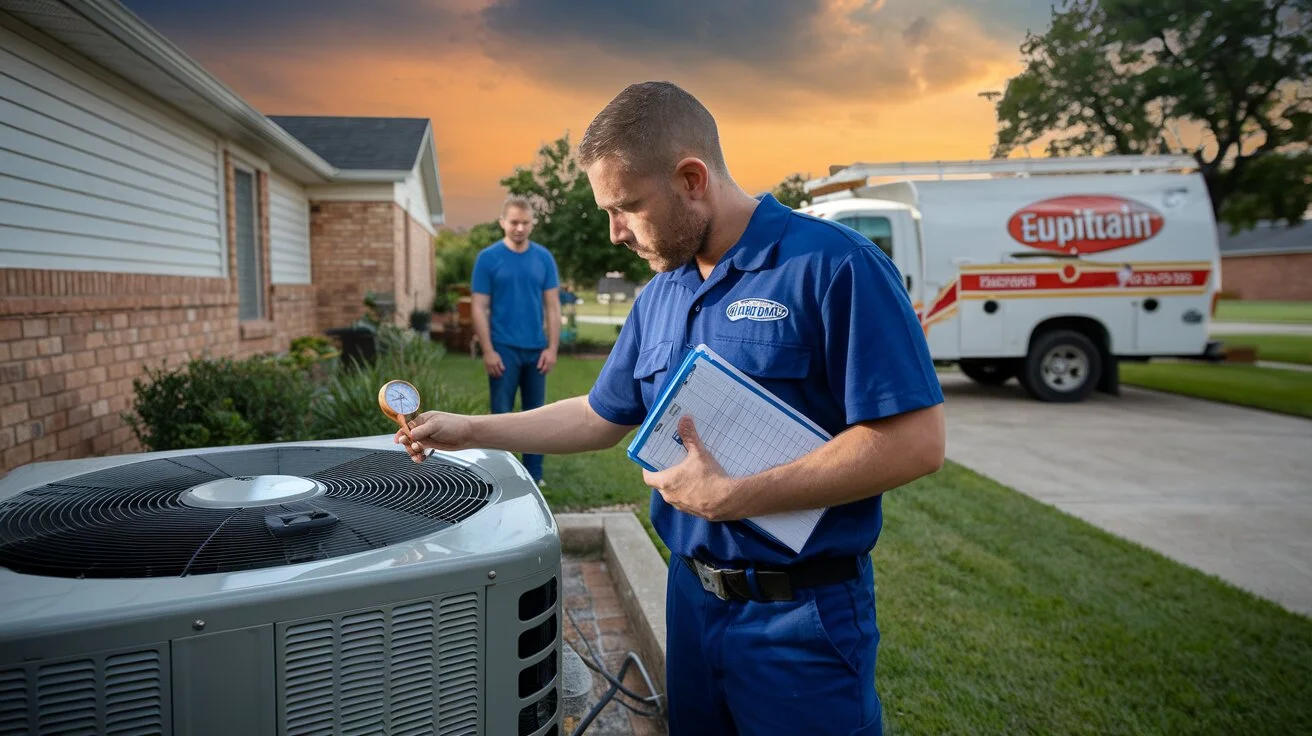
Go outside and look at your condenser unit. Is it running? Is the fan spinning? Is there anything obviously wrong like ice on the refrigerant lines, standing water around the base, or debris blocking the unit? Cottonwood seeds and grass clippings can choke airflow to the point that the system overheats and shuts down. If the unit is caked with debris, gently rinse it with a garden hose (with the system turned off at the thermostat first).
Check the Drain Line
Your AC produces condensation that drains through a PVC pipe, usually near the indoor unit. If that drain clogs (algae and slime are common in North Texas humidity), a safety float switch shuts the system off to prevent water damage. Find the drain line and check for standing water or a full drain pan. You can sometimes clear a clog by pouring a cup of white vinegar down the drain opening.
If any of these fixes get your system running again: Great. But watch it closely for the next few hours. If it starts and stops repeatedly (short cycling), there’s still an underlying problem that needs professional attention.
Step 3: When It’s a Real Emergency (Call Now)
If none of those quick checks worked, or if you see any of these signs, it’s time for emergency HVAC service:
- Burning or electrical smell from the indoor or outdoor unit. Turn the system off immediately at the breaker, not just the thermostat. This could indicate a wiring issue or motor failure.
- Indoor temperature above 90 degrees with vulnerable people (children, elderly, pets) and no alternative cooling available.
- Visible sparking or smoke from any HVAC component. Call 911 first, then your HVAC company.
- Water actively flooding from the indoor unit. Turn off the system and find towels. This is usually a drain issue, but the water damage gets worse by the minute.
- Breaker trips repeatedly when the AC tries to start. Do not keep resetting it. Something is drawing excessive current and forcing the reset could cause a fire.
For same day AC repair in North Texas, call (940) 390-5676. I offer 2-hour response times across Frisco, Plano, McKinney, Allen, Prosper, The Colony, Little Elm, and Addison. Yes, even on weekends. Yes, even after 5 PM.
Step 4: How to Choose an Emergency HVAC Company (Without Getting Ripped Off)
This is where I need to be honest with you about the industry. Some companies love emergency calls because panicking homeowners agree to anything. I’ve seen people sign $8,000 replacement contracts at 10 PM without getting a second opinion, only to find out the real problem was a $200 capacitor.
Before you call anyone, know these things:
What a Legitimate Emergency Call Should Cost
| Component | Cost Range (North Texas, 2026) |
|---|---|
| After-hours diagnostic fee | $150-$250 |
| Capacitor replacement | $180-$400 |
| Contactor replacement | $150-$350 |
| Refrigerant recharge (per lb) | $50-$150 |
| Blower motor replacement | $300-$800 |
| Compressor replacement | $1,800-$3,500 |
| Full system replacement | $5,000-$12,000 |
My after-hours fee is $250, which covers the diagnostic and the trip. If the repair is straightforward (capacitor, contactor, wiring fix), I can often complete it that same visit. The $250 applies toward the repair cost, so you’re not paying twice.
Red Flags to Watch For
- “Your whole system needs to be replaced” as a first response, without testing individual components. Most emergency failures are single-part problems.
- No diagnostic before quoting. If someone quotes you a price over the phone without seeing the system, they’re guessing or padding.
- Pressure to sign right now. “This price is only good tonight” is a sales tactic. A legitimate repair quote is good for at least a few days.
- Cash only, no receipt. Any professional company provides written invoices and accepts multiple payment methods.
Questions to Ask Before They Start Work
- What exactly is the diagnosis?
- How much is the part and how much is labor?
- Is there a warranty on the repair?
- If it turns out to be more expensive than quoted, will you call me before proceeding?
You have the right to ask these questions at 11 PM on a Saturday. Any technician who gets defensive about transparency is someone you don’t want working on your system.
Step 5: Survive the Wait (Cooling Your Home Without AC)
If you’ve called for emergency AC repair and you’re waiting for the tech, here’s how to keep your home as cool as possible:
Cross-ventilation: Place a box fan in a window on the shaded side, blowing inward. Open a window on the opposite side. This can drop the temperature 5 to 8 degrees on a breezy evening.
Reduce heat sources: Don’t use the oven or stove. Turn off unnecessary lights and unplug heat-generating electronics. Don’t run the dryer.
Cool bath: A lukewarm (not cold) bath or shower lowers your core temperature effectively. Cold water constricts blood vessels and actually traps heat. Lukewarm is better.
For pets: Put their bed in the coolest room. Watch for excessive panting, drooling, or lethargy. Brachycephalic breeds (bulldogs, pugs, boxers) are especially vulnerable in the heat.
The Most Common Emergency Repairs I See in North Texas
After 15+ years of emergency calls in the DFW area, these are the breakdowns I see most often during heat waves:
Failed Capacitor (35% of Emergency Calls)
The most common failure and the cheapest to fix. Capacitors store the electrical charge that starts your compressor and fan motors. North Texas heat degrades them years ahead of schedule. Replacement takes 20 to 30 minutes and costs $180 to $400. Learn more about capacitor failures.
Locked-Up Compressor (20% of Emergency Calls)
The compressor overheats during peak afternoon temperatures and locks out on thermal protection. Sometimes it restarts after cooling down (short cycling pattern). Sometimes it doesn’t restart at all. If a hard-start kit can get it going, that’s a $150 to $300 temporary fix. If the compressor is truly dead, you’re looking at $1,800 to $3,500 for replacement, or a full system if the unit is over 10 years old.
Frozen Evaporator Coil (15% of Emergency Calls)
Low refrigerant or restricted airflow causes the coil to freeze solid. Ice blocks all airflow and the system shuts down. The fix depends on the cause: a new filter ($5 to $25), refrigerant recharge ($200 to $600), or coil replacement ($800 to $2,500) in severe cases.
Failed Contactor (10% of Emergency Calls)
The contactor is the electrical switch that sends power to the compressor. When it fails, the outdoor unit won’t start at all, even though you can hear the indoor blower running. Replacement costs $150 to $350 and takes about 30 minutes.
Blown Fuse or Drain Line Clog (20% of Emergency Calls)
Many outdoor units have a dedicated disconnect box with fuses. A power surge or lightning strike blows the fuse ($20 to $50 part). Drain line clogs trigger the safety float switch and shut the system down ($100 to $200 fix). Both feel like emergencies when your house is 90 degrees.
How to Prevent Emergency Breakdowns Next Summer
The best emergency repair is the one that never happens:
- Spring tune-up (March or April). Refrigerant check, capacitor test, coil cleaning, drain clearing. Cost: $89 to $150. This catches 80% of problems before they strand you in July.
- Change filters monthly during summer. Set a phone reminder.
- Keep 2 feet of clearance around the outdoor unit. Trim bushes, clear debris.
- Don’t set your thermostat below 72 in extreme heat. When it’s 107 outside, maintaining 68 pushes the system past its design limits. Set it to 74 or 76 and use fans.
- Install a surge protector. Lightning during North Texas thunderstorms kills capacitors and control boards. A dedicated HVAC surge protector costs $150 to $300 installed.
FAQ
What qualifies as an AC emergency?
Any situation where you have no cooling and vulnerable people (children, elderly, pets) are at risk from heat exposure. Also any situation involving burning smells, visible smoke, electrical sparking, or active water flooding. A system that’s running but not cooling well is urgent but not an emergency. A system that won’t start at all during a 105-degree day with a baby in the house is an emergency.
How much does emergency AC repair cost in North Texas?
Emergency and after-hours repairs in the DFW area typically add $150 to $250 to the base repair cost. My after-hours diagnostic fee is $250, which applies toward the repair. Most emergency repairs (capacitors, contactors, fuses) cost $250 to $500 total including the after-hours fee. Major repairs like compressor replacement run $2,000 to $4,000 with the emergency surcharge. See full pricing breakdown.
Should I replace my AC if it dies during a heat wave?
Not during the heat wave. Get the emergency repair done to restore cooling, then schedule a consultation to discuss replacement when you’re not sweating and desperate. Making a $10,000 decision at 11 PM when your house is 95 degrees is exactly how people end up overpaying. The only exception: if the compressor is dead and the system is 15+ years old, replacement is likely the right call.
How fast can an emergency HVAC tech get to my house?
Response times vary. I commit to 2-hour response times across my service area (Frisco, Plano, McKinney, Allen, Prosper, The Colony, Little Elm, Addison). During peak heat wave periods in July and August, even the best companies get stretched thin. Call early in the day if you notice problems developing. Don’t wait until 9 PM to call about an issue you noticed at noon.
Can I run just the fan while waiting for a repair?
Yes. Set the thermostat to FAN ON. This circulates air through your home, which helps, even without cooling. It also helps prevent moisture buildup in the ductwork. The one exception: if you see ice on the system, running the fan helps melt it faster, which is actually a good thing. Just put towels under the indoor unit to catch the melt water.
Is it safe to sleep in a house with no AC in Texas?
For healthy adults, yes, though it will be uncomfortable. Use fans, wear minimal clothing, and stay hydrated. For infants, elderly adults, or people with heart conditions, a house above 85 degrees is potentially dangerous overnight. Move these individuals to an air-conditioned location.
When your AC dies in the middle of a North Texas heat wave, call (940) 390-5676. I answer emergency calls 24/7, respond within 2 hours, and I’ll give you an honest diagnosis before I touch a single tool. Serving Frisco, Plano, McKinney, Allen, Prosper, The Colony, Little Elm, and Addison. If it can be fixed tonight, I’ll fix it tonight.
Need Professional HVAC Service?
Our certified technicians are ready to help with any HVAC needs in North Texas