HVAC for New Construction: What to Know Before Your North Texas Home Is Built
Planning HVAC for a new build in North Texas? Learn about system sizing, ductwork, zoning, builder-grade equipment traps, and what to demand from your builder before drywall goes up.
- Why New Construction Is Your Best (and Cheapest) HVAC Opportunity
- The Builder-Grade HVAC Trap
- Getting the Size Right: Manual J Load Calculations
- Ductwork: Where Most New Construction HVAC Problems Start
- Zoning: Essential for Multi-Story North Texas Homes
- Choosing the Right System Type for North Texas
- The New Construction HVAC Timeline
- Questions to Ask Your Builder About HVAC
+ 1 more sections below...
- Why New Construction Is Your Best (and Cheapest) HVAC Opportunity
- The Builder-Grade HVAC Trap
- Getting the Size Right: Manual J Load Calculations
- Ductwork: Where Most New Construction HVAC Problems Start
- Zoning: Essential for Multi-Story North Texas Homes
- Choosing the Right System Type for North Texas
- The New Construction HVAC Timeline
- Questions to Ask Your Builder About HVAC
+ 1 more sections below...
HVAC for New Construction: What to Know Before Your North Texas Home Is Built
Building a new home in North Texas is exciting until you realize your builder’s HVAC plan is an afterthought. I’ve walked through brand-new homes in Frisco, Prosper, and McKinney where the thermostat reads 74 downstairs and the master bedroom upstairs hits 82 by 3 PM. The house is 6 months old. The AC runs constantly. And the homeowner is told “that’s normal for a two-story.”
It’s not normal. It’s poor HVAC new construction planning, and it happens more often than you’d think in the DFW building boom. The good news is that new construction gives you the single best opportunity to get your HVAC system right. The walls are open. The ductwork hasn’t been installed yet. Every decision you make now costs a fraction of what it would to fix after drywall goes up.
This guide covers everything you need to know before your builder installs a single piece of ductwork.
Why New Construction Is Your Best (and Cheapest) HVAC Opportunity
Installing HVAC during new construction costs $1.75 to $2.50 per square foot. Replacing or retrofitting an HVAC system in an existing home costs $3 to $6 per square foot. That’s nearly double, and the reason is simple: open walls.
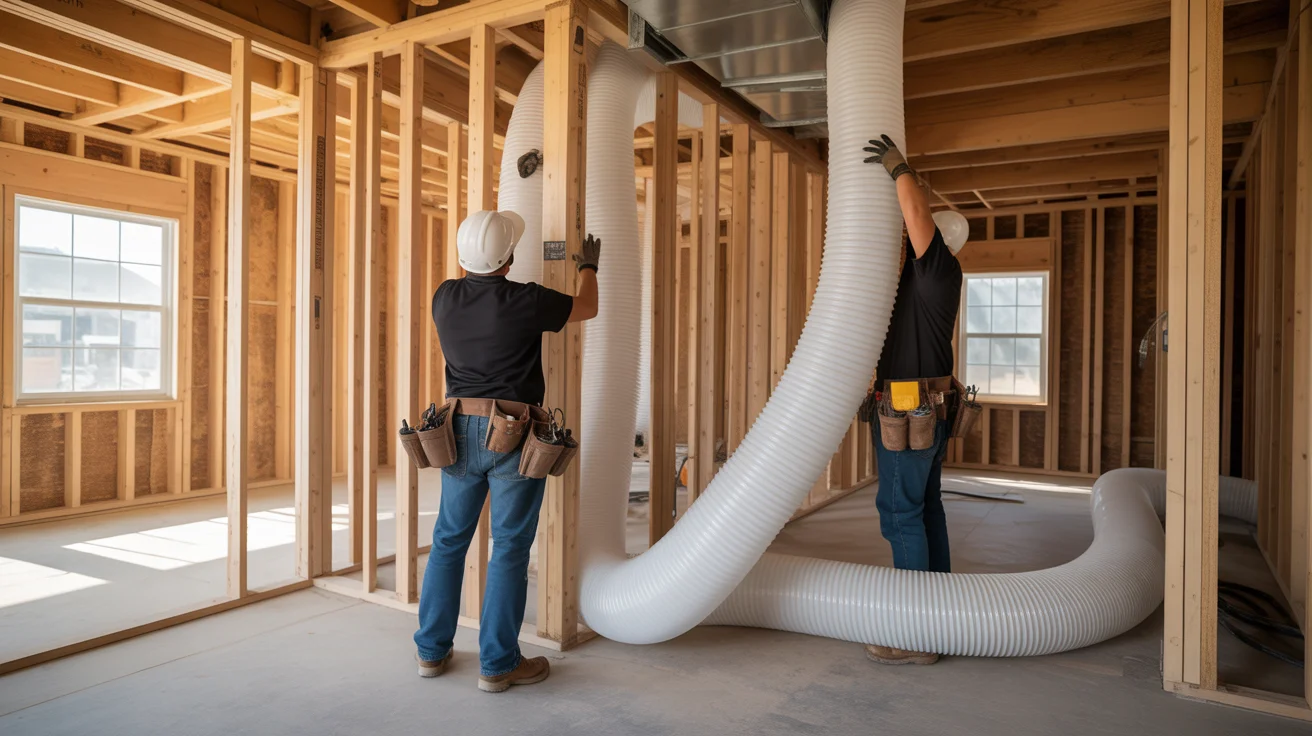
During construction, your HVAC contractor has full access to wall cavities, ceiling joists, and floor spaces. Ductwork can be routed through the most efficient paths. Equipment can be positioned for best airflow and serviceability. Supply and return vents can be placed exactly where they need to be, not wherever there happens to be room.
Once drywall goes up, every change becomes exponentially more expensive. Moving a supply vent from one wall to another might cost $50 during construction. After the house is finished, that same change could run $300 to $500 because someone has to cut drywall, reroute ductwork, patch, and repaint.
For a typical 2,500 square foot new home in the DFW area, here’s what the HVAC investment looks like:
| Component | Cost Range |
|---|---|
| AC unit + furnace (or heat pump) | $5,000 - $12,000 |
| Ductwork installation | $3,000 - $7,000 |
| Thermostat and controls | $200 - $500 |
| Zoning system (if applicable) | $2,000 - $3,500 |
| Total typical range | $8,000 - $20,000 |
The wide range depends on equipment quality, system complexity, and whether you go with builder-grade equipment or choose your own.
The Builder-Grade HVAC Trap
This is the single biggest mistake I see new construction homeowners make in North Texas: accepting whatever HVAC system the builder includes in the base price without questioning it.
Builder-grade HVAC equipment is the cheapest, least efficient equipment available to the contractor. Builders buy in bulk from the lowest-cost manufacturer and install the minimum that meets code. There’s nothing illegal about this. But there’s a reason builder-grade systems have earned their reputation.
| Feature | Builder-Grade | Quality System |
|---|---|---|
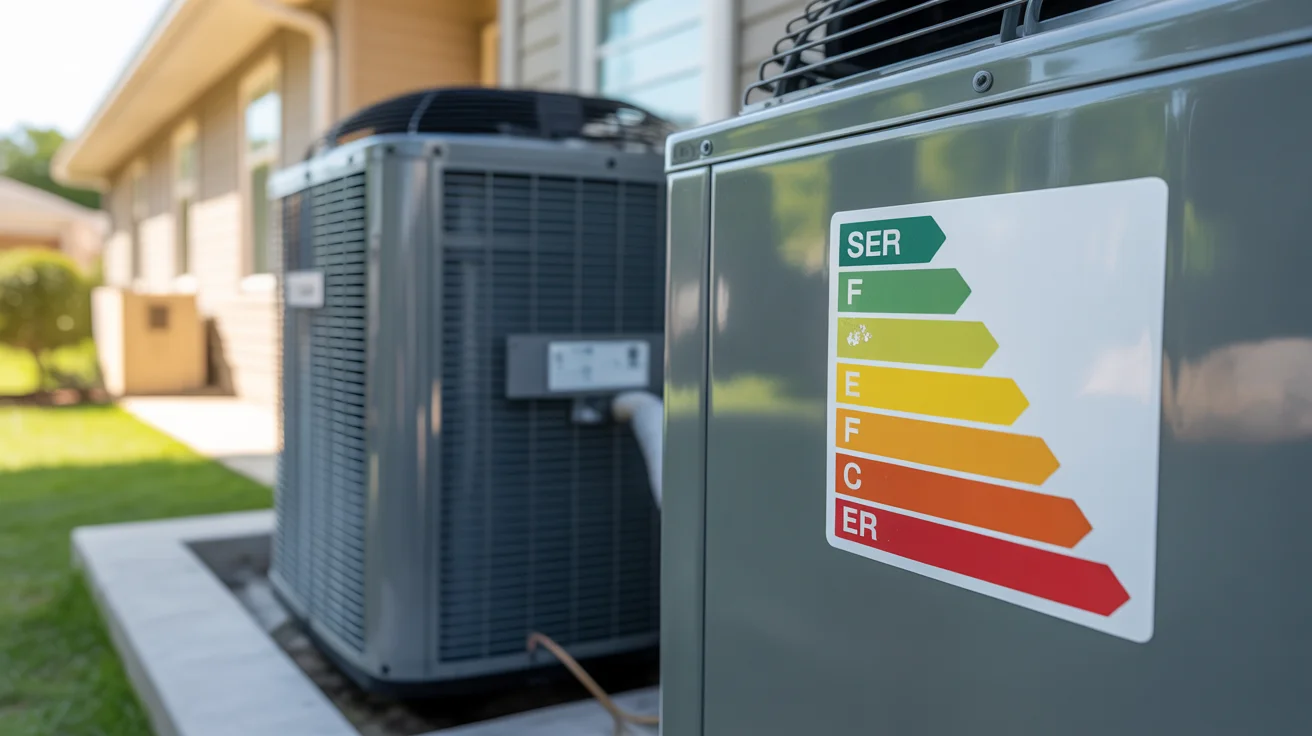
| Efficiency | 14-15 SEER (bare minimum) | 16-20+ SEER |
| Compressor | Single-stage (100% or off) | Two-stage or variable-speed |
| Blower motor | Single-speed | Variable-speed ECM (75% less electricity) |
| Thermostat | Basic programmable | Wi-Fi with humidity sensing |
| Expected lifespan | 5-7 years before major repairs | 15-20 years |
The upgrade from builder-grade to mid-tier costs $3,000 to $6,000. A 16-SEER system uses roughly 15% less energy than 14-SEER. On a $300 summer electric bill, that’s $45 per month in savings. Over 15 years, the investment pays for itself and then some.
Before signing your building contract, ask: “What brand, model, and SEER rating HVAC equipment are you installing?” If the answer is vague, push for specifics. Better yet, negotiate the right to choose your own HVAC contractor.
Getting the Size Right: Manual J Load Calculations
Proper system sizing is the foundation of everything else. An oversized system is just as problematic as an undersized one, and in North Texas, oversizing is the more common mistake.
A Manual J load calculation is the industry-standard method (developed by ACCA, the Air Conditioning Contractors of America) for determining exactly how much heating and cooling capacity your home needs. It accounts for:
- Square footage and ceiling heights
- Insulation type and R-values
- Window count, size, orientation, and glazing type
- Number of stories
- Roof color and material
- Air infiltration rates
- Number of occupants
- Internal heat loads (appliances, lighting)
- Local climate data (critical for North Texas)
Some builders still size systems using “one ton per 500 square feet.” That rule was never accurate, and it’s especially wrong for modern homes with better insulation and low-E windows. A well-insulated 2,500 square foot home might only need 3.5 tons, but the rule of thumb would call for 5.
An oversized system cools too quickly, shutting off before removing enough humidity. It short-cycles (wearing out the compressor faster), keeps indoor humidity at 55 to 65% instead of the ideal 45 to 50%, and wastes 15 to 30% more energy. In North Texas, where Gulf Coast moisture pushes summer humidity to 60 to 80% outdoors, that means a brand-new home that feels clammy despite the thermostat reading 74.
Demand a Manual J from your builder. If your builder or HVAC contractor can’t produce a room-by-room Manual J calculation for your specific floor plan, that’s a red flag. Any qualified HVAC contractor can run one using software like Wrightsoft or Manual J Elite. It takes 2 to 4 hours and costs $150 to $400 when done independently. For new construction, it should be included in the HVAC installation price.
Ductwork: Where Most New Construction HVAC Problems Start
Even with the right equipment and proper sizing, bad ductwork will ruin your comfort. I’ve diagnosed more comfort complaints in new North Texas homes caused by ductwork problems than by equipment failures. Ductwork is the circulatory system of your home. If it’s designed wrong, nothing else matters.
Duct Location Matters More Than You Think
Production builders in North Texas default to running ductwork through the attic, where temperatures hit 140 to 160 degrees in July. Even with insulated ducts, you lose 15 to 25% of cooling capacity before air reaches your rooms.
Better options: (1) ducts inside conditioned space (between floors, in soffits) for zero heat gain, (2) a conditioned attic with spray foam on the roof deck, or (3) at minimum, R-8 insulated attic ducts with all joints sealed using mastic, not duct tape (which fails within 2 to 3 years in attic heat).
Return Air: The Most Overlooked Element
Every room with a supply vent needs a path for air to return to the system. Builders rely on the gap under bedroom doors for this. That 1-inch gap is not enough. When doors close at night, the room pressurizes, the AC can’t pull air back efficiently, and the room gets warm while other areas overcool.
Insist on dedicated return ducts in every bedroom (best) or transfer grilles/jumper ducts between bedrooms and the hallway (good). Door undercuts alone cause the “my upstairs bedrooms are always hot” complaint I hear constantly.
Duct Sizing and Design
Proper duct design follows ACCA Manual D calculations, which determine the exact size and configuration of every duct run based on equipment capacity and each room’s airflow requirements. Undersized ducts restrict airflow, make the system work harder, and starve far rooms of conditioned air. Ask your builder’s HVAC contractor if they perform Manual D calculations. If no, that’s your second red flag.
Zoning: Essential for Multi-Story North Texas Homes
If you’re building a two-story home in North Texas (and most new construction here is two stories), a zoning system isn’t a luxury. It’s practically a necessity.
Heat rises. That’s basic physics. In a North Texas summer, your second floor absorbs direct solar radiation through the roof while hot air from the first floor migrates upward. Without zoning, your thermostat (usually located on the first floor) reads 74 degrees while the master bedroom upstairs sits at 80 to 82 degrees.
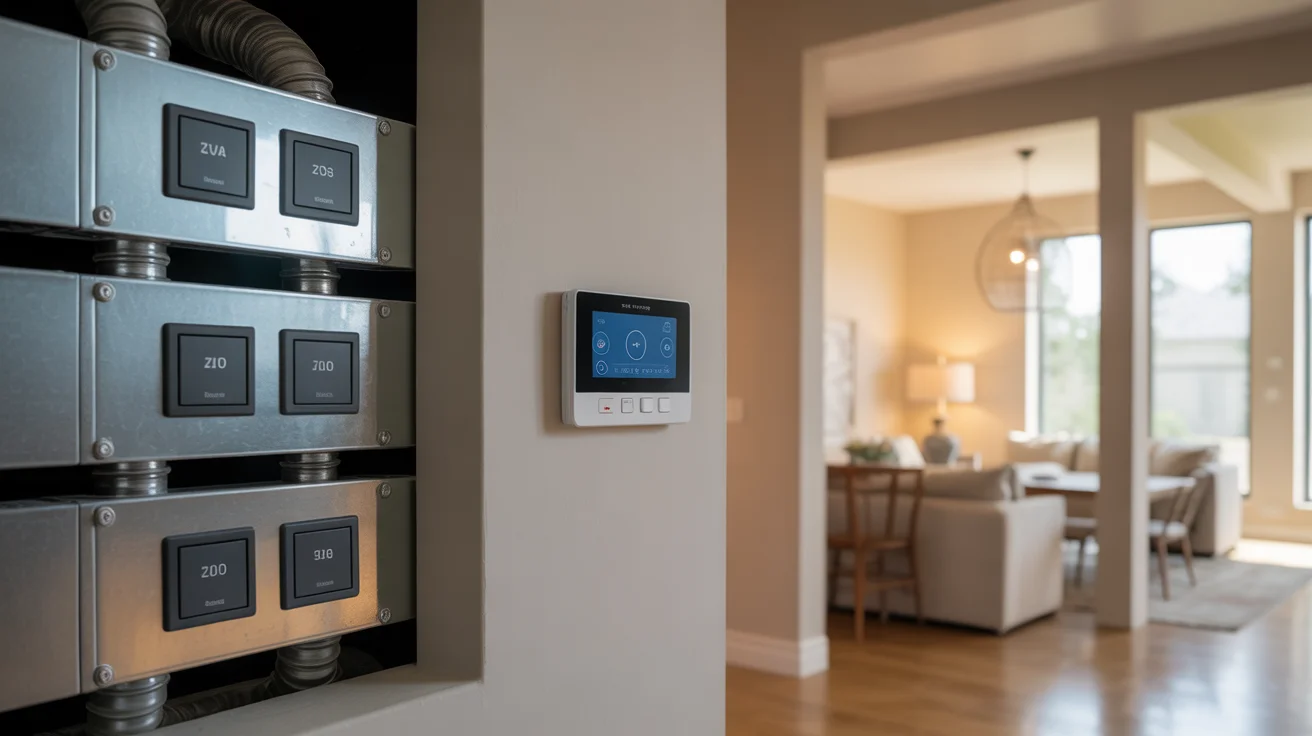
A zoning system uses motorized dampers in the ductwork and multiple thermostats to control different areas independently. Your first floor and second floor each get their own thermostat and operate as separate zones. Some systems support 3 to 4 zones for even more precise control.
Cost during new construction: $2,000 to $3,500 for a two-zone system. Cost to retrofit after construction: $3,500 to $6,000 (plus drywall repair). This is one of the biggest savings you get by planning during the build.
For larger homes or homes with distinct wings, I recommend at minimum:
- Zone 1: First floor living areas
- Zone 2: Second floor bedrooms
- Zone 3 (optional): Bonus room, media room, or home office that has different use patterns
If a full zoning system isn’t in the budget, at minimum insist on a two-system setup for homes over 3,000 square feet: one system serving the first floor and a separate system serving the second floor. This is standard practice for quality builders in Frisco and Prosper but not always included in production homes.
Choosing the Right System Type for North Texas
New construction gives you the flexibility to choose any type of HVAC system. Here’s what makes sense for our climate:
| System Type | Best For | New Construction Cost |
|---|---|---|
| AC + Gas Furnace | Most North Texas homes. Gas is cheap here, handles extremes well. | $5,000 - $12,000 |
| Heat Pump | All-electric homes, solar panel owners, mild-winter optimization | $6,000 - $14,000 |
| Dual Fuel (Heat Pump + Gas) | Maximum efficiency year-round with gas backup for deep freezes | $8,000 - $16,000 |
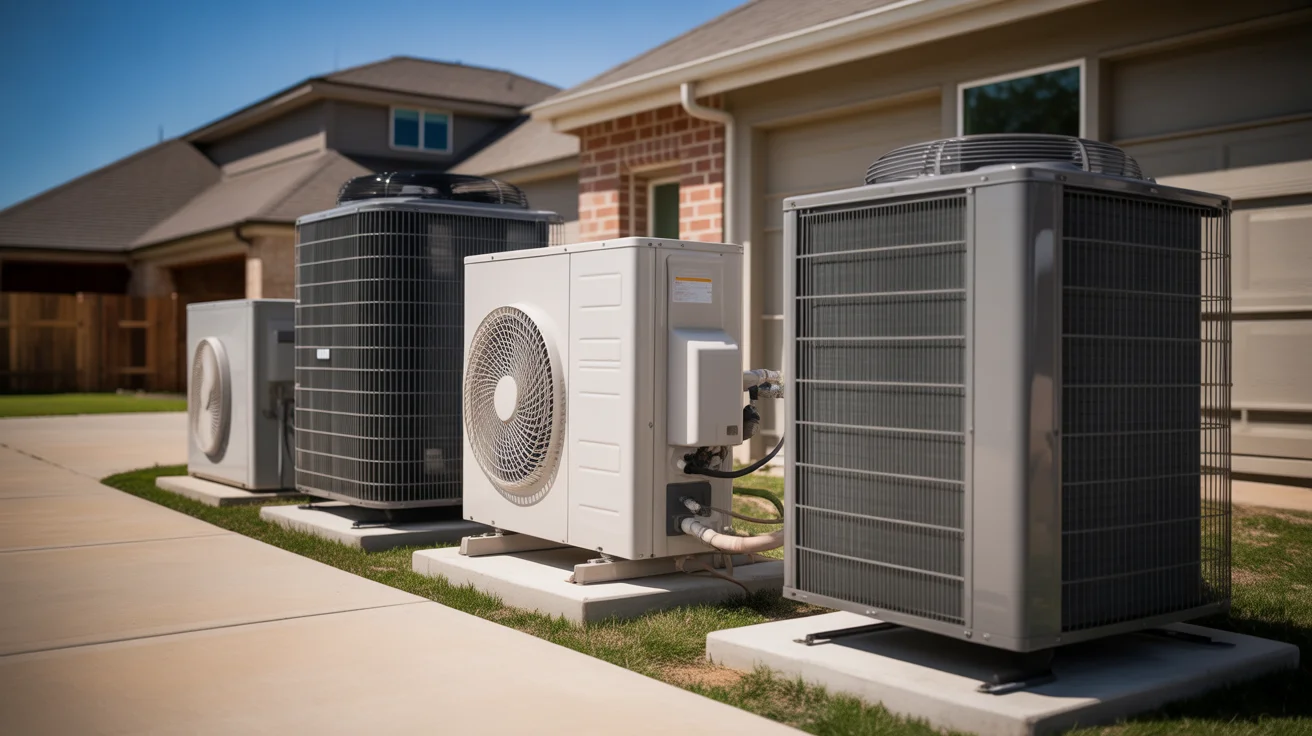
The traditional split system (AC plus gas furnace) remains the most popular choice in DFW. A heat pump is a strong option if you’re building an all-electric home or want to avoid running a gas line. The dual fuel system gives you the best of both worlds: heat pump efficiency for 90% of the year and gas furnace reliability for those rare sub-20-degree nights. That’s what I run in my own home.
Regardless of system type, target a minimum SEER rating of 16 for new construction in North Texas. The energy savings over 15 years more than offset the upfront cost difference versus a 14-SEER minimum-code system.
The New Construction HVAC Timeline
HVAC decisions happen at specific points during construction. Miss one window and the cost to fix it multiplies.
| Construction Phase | HVAC Milestone |
|---|---|
| Design (before breaking ground) | Choose HVAC contractor, complete Manual J, select system type and brand, design ductwork layout |
| After framing, before insulation | HVAC rough-in: ductwork, refrigerant lines, electrical, gas lines, thermostat wiring. This is the critical window. |
| After insulation, before drywall | Duct pressure testing and municipal rough-in inspection |
| After drywall and paint | Equipment installation, register trim-out, system startup and refrigerant charge |
| Before closing | Final city inspection, full commissioning (airflow measurements at every register, zone testing) |
The rough-in phase is the most important. Once insulation and drywall go up, moving a duct run or adding a return vent goes from a $50 change to a $500 ordeal. Make every HVAC decision before the framing crew finishes.
Critical reminder: Register your equipment with the manufacturer within 60 days of installation. Your builder’s HVAC contractor should handle this, but verify. Missing this deadline can cut your warranty from 10 years to 5 years.
Questions to Ask Your Builder About HVAC
Print this list and bring it to your next meeting with your builder. These questions separate builders who take HVAC seriously from those who treat it as a box to check.
- What brand and model equipment are you installing? (If they can’t give you specifics, push back.)
- What SEER rating is the AC or heat pump? (Minimum 14 meets code. You want 16+.)
- Will you perform a Manual J load calculation for my specific floor plan? (If no, that’s a red flag.)
- Where will the ductwork be routed? (Attic is standard but worst. Inside conditioned space is best.)
- What insulation value (R-value) is on the ductwork? (R-6 is minimum code. R-8 is better.)
- How are you handling return air for bedrooms? (Dedicated returns are best. Door undercuts alone are not enough.)
- Is a zoning system included for my two-story home? (If not, get a quote for adding one.)
- Who is the HVAC subcontractor, and are they licensed and insured? (You want to verify independently.)
- What labor warranty does the HVAC subcontractor provide? (1 year is typical for production builders. Push for 5+.)
- Will the system be registered with the manufacturer before closing? (Critical for full warranty coverage.)
FAQ
Can I choose my own HVAC contractor for a new construction home?
Custom builders usually allow it. Production builders (Lennar, DR Horton, Perry Homes) are less flexible, but many offer upgrade packages or credits. Get any HVAC arrangements in writing before signing the building contract.
How much more does a high-efficiency system cost versus builder-grade?
Upgrading from 14-SEER to 16-18 SEER adds $3,000 to $6,000. Over 15 years in North Texas, the energy savings typically range from $5,000 to $9,000, making it a net positive investment.
Should I get a heat pump or traditional AC with gas furnace in North Texas?
Both work well. Gas furnaces handle rare extreme cold (below 20 degrees) better. Heat pumps are more efficient for typical mild winters and eliminate gas line needs. For homes over 2,500 square feet, I recommend dual fuel (heat pump plus gas furnace backup) for maximum flexibility.
What SEER rating should I choose for new construction?
Minimum Texas code is 14 SEER. For new construction, I recommend 16 SEER as the starting point, with a 4 to 6 year payback period in our climate. If budget allows, 18 to 20 SEER variable-speed systems offer the best long-term value.
How do I know if my builder’s HVAC installation was done correctly?
Before closing, hire an independent HVAC contractor to inspect the installation ($150 to $300). They’ll check refrigerant charge, airflow at each register, duct sealing, and electrical connections. Think of it as a home inspection specifically for HVAC.
Building a new home in North Texas and want HVAC done right the first time? Call Jupitair HVAC at (940) 390-5676 for new construction HVAC installation in Frisco, Plano, McKinney, Prosper, Allen, The Colony, Little Elm, and Addison. I’ll review your builder’s plan, run a proper Manual J, and make sure you don’t end up with a builder-grade system that fails in 5 years.