HVAC Filter Selection Guide: North Texas Air Quality
HVAC filter selection guide for North Texas. Compare MERV ratings, filter types, allergen control, and system compatibility.
- Your Complete HVAC Filter Selection Guide for North Texas Air Quality
- Why North Texas Air is Different
- Making Sense of Filter Ratings
- Professional Filter Selection Process
- Advanced Air Quality Solutions for North Texas
- Filter Maintenance and Replacement Strategy
- What Works Best Around North Texas
- Emergency Filter Situations and Solutions
+ 5 more sections below...
- Your Complete HVAC Filter Selection Guide for North Texas Air Quality
- Why North Texas Air is Different
- Making Sense of Filter Ratings
- Professional Filter Selection Process
- Advanced Air Quality Solutions for North Texas
- Filter Maintenance and Replacement Strategy
- What Works Best Around North Texas
- Emergency Filter Situations and Solutions
+ 5 more sections below...
For most North Texas homes, MERV 11 filters ($8-$25 each) give you the best bang for your buck. You’re looking at 85-90% particle capture without strangling your airflow. During cedar season (December through February) and ragweed season (August through October), check them every 2-3 weeks. Pollen counts out here regularly blow past 10,000 particles per cubic meter. Here’s the thing most people don’t realize: your indoor air is 2-5x dirtier than what’s outside. A cheap fiberglass filter catches maybe 15-20% of particles. A pleated MERV 11? It grabs 85-90% and actually saves you $108+ a year because your coils stay cleaner and your system runs more efficiently. Just don’t jump to MERV 13+ without having someone check that your system can handle it.
Your Complete HVAC Filter Selection Guide for North Texas Air Quality
I walked into a house in McKinney last month and figured out their problem before I even opened the air handler. Family had spent over $4,200 on allergy doctors. Inhalers, prescriptions, specialist visits. Meanwhile, that sad little fiberglass filter in their return was catching maybe 15% of the garbage floating through their air.
We swapped in a MERV 11 pleated filter and set them up with an [indoor air quality system](/services/indoor-air-quality/). Two months later, their allergy symptoms were basically gone. Energy bills dropped $45 a month. System started running the way it was supposed to. The upgrade cost $180 total. How much did they spend at the allergist again?
This is the stuff that keeps me up at night. Fifteen years in this business, and roughly 9 out of 10 North Texas homeowners I visit have the wrong filter. Either they bought something way too restrictive because it sounded fancy, or they grabbed the cheapest thing on the shelf and called it a day.
Need professional air quality assessment for your North Texas home? Call Jupitair HVAC at (940) 390-5676 for expert filter recommendations and complete indoor air quality solutions.
Why North Texas Air is Different
I’ve been working in this area for over a decade now, and I’ll tell you: our air quality is a different animal. Most of the country doesn’t deal with what we deal with.
Why Our Air Wants to Kill You
Cedar season in winter is something else. I’ve had customers in Frisco go through three filters in January alone. Just completely packed. Then spring rolls around and it’s oak, elm, grass pollen. That yellow-green film on your car? That’s getting into your house too.
Summer’s when West Texas sends us those dust storms. Fine particles that slip right through a cheap filter like it’s a screen door. And with all the construction going on around Plano and McKinney, plus the exhaust from 75, 121, and the Tollway, you’ve got layers of junk in the air that most people never think about.
Something most homeowners don’t realize: your indoor air is usually 2 to 5 times worse than what’s outside. All that outdoor pollen and dust gets pulled in, then it mixes with cooking fumes, cleaning product residue, off-gassing from new furniture, pet dander. Your HVAC system just recirculates all of it, over and over.
I tested a home once where the family had zero pets. No dog, no cat, nothing. They were still breathing pet dander. Turns out it was coming from the neighbors through gaps in the ductwork. Stuff like that is more common than you’d think.
Making Sense of Filter Ratings
The MERV Scale (and Why It Matters)
MERV stands for Minimum Efficiency Reporting Value. It’s basically a scorecard for how well your filter catches particles. Scale goes from 1 to 16, and higher means it catches smaller stuff.
MERV 1-4 (The Barely-There Filters) These grab maybe 20-60% of big particles. Lint, carpet fuzz, that kind of thing. For North Texas air? Practically worthless. The only time I’d recommend one is if your system is ancient and can barely push air through anything thicker.
MERV 5-8 (Your Basic House Filters) Better. You’re catching 60-85% of particles now, including most pollen and dust mites. I consider this the bare minimum for our area, and honestly, only during the calm months. Once cedar season kicks in, you’ll wish you had more.
MERV 9-12 (The Sweet Spot for Most Homes) This is where I land with probably 80% of my customers. You’re catching 85-95% of particles at this level, including the fine dust and pet dander that makes people miserable. MERV 11 is my go-to recommendation. Tough enough for our pollen, gentle enough on your system.
MERV 13-16 (The Heavy Hitters) Now you’re at 95-99% particle capture. Getting close to hospital-grade filtration. If you’ve got serious respiratory issues, this might be where you need to be. But I always, always test the system first. I see homeowners buying MERV 13 filters and wondering why their airflow tanked. Because their system wasn’t built for that kind of restriction. That’s why.
What’s Actually Available Out There
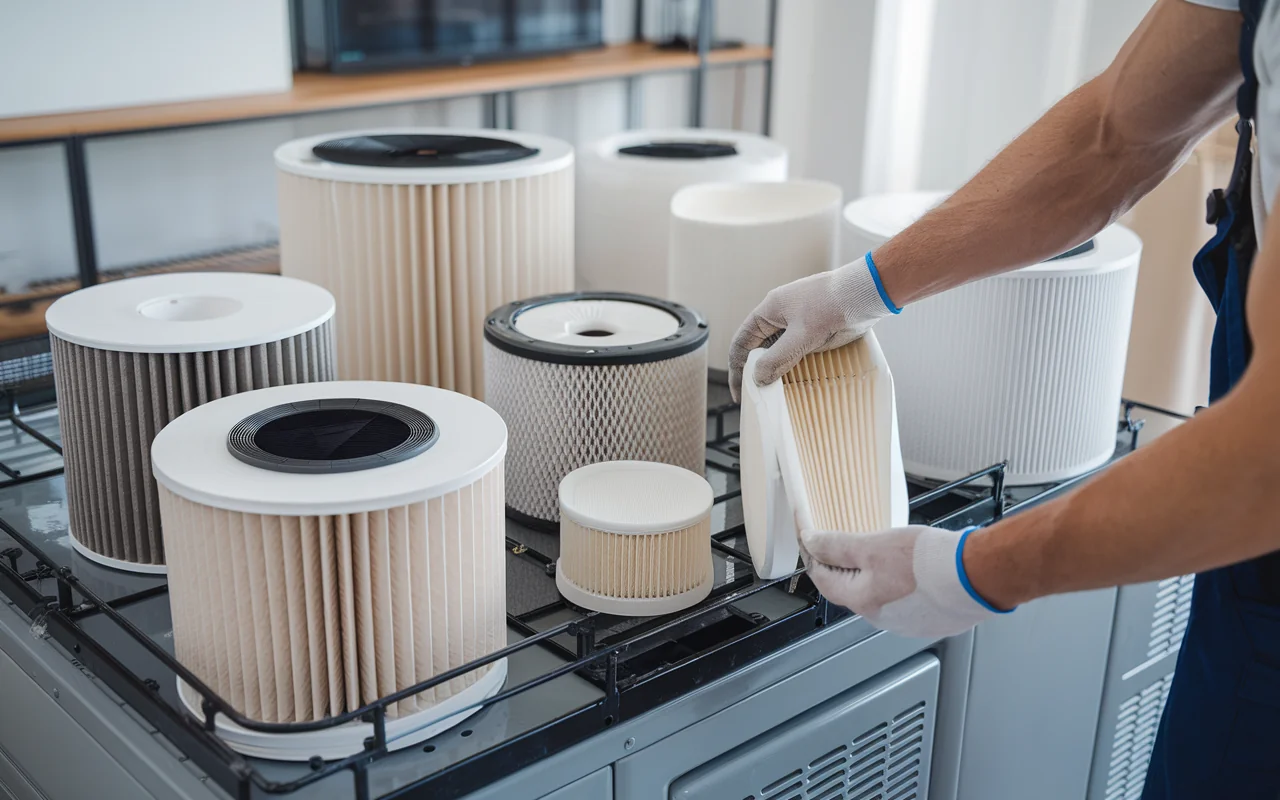
Fiberglass Panel Filters (The $2 Specials) Every hardware store has these. $1-5, spun glass in a cardboard frame. They let air through great because they barely catch anything. I’ve had customers use these for years and then ask me why there’s always a layer of dust on everything. Well…
Pleated Paper/Polyester Filters (The Workhorses) This is where most of my customers end up, and for good reason. $8-25 gets you something that actually does its job. The pleated design means more surface area, which means more particles captured. Good for 2-3 months in most homes, maybe less if you’ve got a golden retriever shedding everywhere. These are your bread and butter for North Texas.
Electrostatically Charged Filters (The Magnets) A little pricier at $15-35, but they use static charge to pull particles out of the air. I like these for homes with three cats or families where everyone has allergies. The catch? They lose their charge gradually, so don’t push them past 3-4 months or you’re just running a regular pleated filter.
HEPA and Near-HEPA Filters (The Superstars) $25-85 a pop. They catch pretty much everything. But most residential systems weren’t designed to push air through something this dense. I’ve seen people install these and then call me because their system’s running nonstop and their electric bill jumped $40 in a month. Call us before going this route. Seriously.
My Year-Round Filter Game Plan
Winter (Cedar Season is Brutal) December through February is my busiest time for air quality calls. Cedar pollen out here is relentless. I bump customers up to MERV 11-13 and we change filters monthly instead of quarterly.
I had a customer in Allen going through a filter every two weeks in January. That seemed nuts until I saw what she was pulling out of her air handler. Packed solid, almost looked like felt. She had a row of cedar trees about 30 feet from her outdoor unit. Problem solved once we addressed the source too.
Spring (Everything’s Blooming) March through May is oak, elm, and grass pollen season. Pretty outside, rough on your sinuses. MERV 9-11 handles it for most people. If you’re still struggling, bump up a rating or two. I usually time this with spring startup so we’re ready for cooling season.
Summer (Dust and Long Runtime) June through August is an endurance test for your filter. AC’s running 14-16 hours a day, pulling air through that filter constantly. MERV 8-11 works well because you need good airflow when the system’s working that hard. Check monthly, expect 2-3 month life if it’s a normal summer. (“Normal” is relative in Texas.)
Fall (Ragweed is the Enemy) September through November brings ragweed, which is basically cedar’s evil cousin. MERV 10-12 with antimicrobial treatment helps with both the pollen and mold spores that start popping up as temperatures shift. Stock up before ragweed hits because you’ll be changing filters every month or so.
Professional Filter Selection Process
Step 1: System Compatibility Assessment
Determine Your System’s Filter Requirements:
- Locate existing filter in return air duct or air handler
- Record exact dimensions (length x width x thickness)
- Check manufacturer specs for maximum MERV rating
- Document current filter type and how happy you are with performance
- Assess system age and condition - this matters more than people think
System Capacity Evaluation: Older systems (10+ years) usually need lower MERV ratings, something in the 6-8 range. Their blower motors and ductwork weren’t designed for much resistance. Standard efficiency systems do well with MERV 8-11. Good air quality, reasonable airflow. High-efficiency equipment can typically handle MERV 11-13 since they’ve got better airflow design and stronger motors. Variable-speed systems are the most flexible because the motor adjusts speed to compensate when the filter adds resistance. If you’re considering MERV 12 or above, get a professional to check your system first. I can’t stress this enough.
Step 2: Air Quality Needs Analysis
Household Assessment Factors: Start with allergies. Are they seasonal (pollen) or year-round (dust mites, pet dander)? That changes the approach. If you’ve got pets, factor them in heavily. A house with two dogs needs a completely different filter strategy than a house without any animals. Think about what you do inside too. Do you cook a lot? Use cleaning chemicals regularly? Have new furniture or carpet that’s still off-gassing? All of that matters. Then consider your surroundings. How close are you to a highway? Any construction nearby? Agricultural land upwind? I’ve seen houses half a mile apart need different filters because one faces a construction site.
Health Priority Matrix: If nobody in the house has specific air quality issues, MERV 8-9 gives you solid basic protection and keeps your system clean. Mild allergy sufferers should look at MERV 10-11 for better capture of pollen and dust mites. If you’ve got moderate allergies or asthma in the household, MERV 11-12 makes a real difference in day-to-day comfort. Severe respiratory issues call for MERV 13+, but only with professional guidance on system compatibility. And if chemical sensitivities are the problem, you need activated carbon filters. Regular particle filters won’t touch VOCs and odors.
Step 3: Cost-Benefit Optimization
Total Cost of Ownership Analysis:
Annual Filter Cost = (Filter Price x Replacement Frequency)
System Impact = ([Energy Efficiency](/blog/energy-efficient-hvac-systems-north-texas/) Change + Maintenance Costs)
Health Benefits = (Reduced Medical Costs + Productivity Gains)
Example Calculations (2,500 sq ft home):
Basic Fiberglass (MERV 2):
- Annual filter cost: $24 (12 filters x $2)
- Energy impact: Baseline
- Health impact: Minimal protection
- Total annual cost: $24 plus whatever you’re spending at the doctor because your filter isn’t doing its job
Quality Pleated (MERV 11):
- Annual filter cost: $72 (6 filters x $12)
- Energy impact: +5-10% efficiency from cleaner coils
- Health impact: 85-90% particle capture
- Total annual value: $72 investment - $180 energy savings = $108 net benefit
Premium HEPA-Type (MERV 13):
- Annual filter cost: $180 (4 filters x $45)
- Energy impact: Could increase bills 5-15% if your system’s borderline
- Health impact: 95%+ particle capture
- Note: Don’t go this route without a professional system evaluation
Advanced Air Quality Solutions for North Texas
Whole-House Air Purification Systems
Electronic Air Cleaners: These use electrostatic precipitation to zap particles out of the air. 95-99% capture rate, and the collectors are washable so you’re not buying replacement filters every few months. I recommend these for homes with heavy pollution exposure, multiple pets, or anyone who wants long-term value over ongoing filter costs. They need professional installation, but once they’re in, they’re pretty low maintenance.
UV Light Systems: UV lights sit inside your air handler and kill bacteria, mold, and other biological contaminants. We’re talking 99% kill rate on the stuff that flows past them. If you’ve had mold problems, or if someone in the house has a compromised immune system, these are worth looking at. They handle odors from biological sources too. Not a replacement for a good filter, but a powerful addition to one.
Activated Carbon Filters: Carbon filtration is its own thing. It doesn’t catch particles like a regular filter. Instead, it absorbs chemicals, VOCs, cooking odors, and the kind of stuff that makes your house smell “off.” If you’re sensitive to chemicals or your home just always seems to have a lingering smell, carbon filtration combined with a good particle filter covers all your bases.
Smart Air Quality Monitoring
Integration with Smart Thermostats: A smart thermostat can track your air quality in real time and adjust your system accordingly. Instead of guessing when your filter needs changing, the system tells you based on actual usage. Runs more, filter loads faster, you get an alert sooner. You can monitor and adjust everything remotely too. If you’ve already got a smart thermostat, adding air quality monitoring is a natural next step.
Air Quality Sensors: Dedicated sensors give you specific readings on PM2.5 and PM10 particle levels, VOC concentrations, humidity, and CO2. Humidity monitoring alone is worth it since keeping the right moisture level prevents mold growth. And CO2 tracking tells you whether your ventilation is adequate. These aren’t strictly necessary for everyone, but if you’re the type who likes data, they’ll show you exactly what you’re breathing.
Filter Maintenance and Replacement Strategy
Best Replacement Scheduling
Visual Inspection Method: Once a month, pull your filter out and hold it up to a light. If light barely comes through, it’s time. You’ll see the surface loading, the dust building up across the face of the filter. While you’ve got it out, check the edges. If air’s leaking around the frame, you’ve got a sizing problem and your filter isn’t catching what it should.
Performance-Based Replacement: Pay attention to your house. If airflow at the vents feels weaker than usual, check the filter. If your energy bills creep up for no obvious reason, check the filter. Hot and cold spots you didn’t used to have? Check the filter. If the system starts making noises it didn’t make before, or it’s cycling on and off more frequently, your filter is probably restricting airflow too much.
Calendar-Based Replacement:
Standard Schedule by Filter Type:
- Fiberglass (MERV 1-4): 30-60 days
- Basic pleated (MERV 5-8): 60-90 days
- Premium pleated (MERV 9-12): 90-120 days
- HEPA-type (MERV 13+): 6-12 months

North Texas Adjustments:
- Cedar season (Dec-Feb): Reduce schedule by 25%
- Ragweed season (Aug-Oct): Reduce schedule by 25%
- High pollen days: Weekly inspection
- Dust storm events: Immediate post-storm check
Professional Maintenance Integration
Coordinate with HVAC Service: When we do your spring startup, filter replacement is part of the deal. Gets your system ready for cooling season with a fresh filter in place. Summer maintenance includes a filter check during peak season service since your system is working harder than any other time of year. Fall preparation means upgrading to a higher-efficiency filter for ragweed and preparing for cedar. Winter service is all about making sure your filter can keep up with the worst pollen season in North Texas.
System Performance Monitoring: During a professional visit, we measure airflow to make sure you’re getting proper ventilation throughout the house. We inspect your coils too. Clean filters keep coils clean, and clean coils save you money. I track energy efficiency changes for customers over time, and the difference between good and bad filtration shows up fast in the numbers. Also worth mentioning: a lot of manufacturers require documented filter maintenance to honor warranties. Skip it and you might be on your own when something breaks.
What Works Best Around North Texas
Frisco Homes (Newer Construction, Different Challenges)
Frisco is mostly newer builds. Tight house wraps, modern HVAC systems, good insulation. Great for your electric bill, but all that tightness means indoor air has fewer ways to escape. Without proper filtration, you’re just sealing all that junk inside with you.
New neighborhoods also mean fresh landscaping. Different trees and plants than what was growing here five years ago. Plus Frisco is close enough to DFW metro traffic that urban pollution gets blown in on the regular.
For most Frisco homes I recommend MERV 11 pleated filters. If allergies are an issue, we can usually step up to MERV 13 because the newer systems can handle it. Larger homes sometimes benefit from whole-house air purification on top of that.
Our Frisco indoor air quality team knows exactly what works in your area.
Plano Areas (Mix of Old and New)
Plano’s interesting because the housing stock ranges from 1970s ranch homes to brand new construction. Those older neighborhoods with the big mature trees? Gorgeous. But those trees dump pollen like nobody’s business in spring, and the HVAC systems in those houses might not handle a high-MERV filter well.
Highway proximity matters too. If you live within a mile or two of 75, 121, or the Bush Turnpike, your air quality has an extra layer of challenge.
For older Plano homes, I stick with MERV 8-10 after verifying the system can handle it. Modern systems can take MERV 11-12 no problem. For allergy sufferers, I’ll sometimes do a seasonal strategy. Higher MERV during pollen seasons, drop back to standard during summer when the system needs all the airflow it can get.
Our Plano air quality team has been working these neighborhoods for years and knows what each pocket of the city needs.
McKinney, Allen, and the Outer Areas
Out here, you’re at the edge where suburbs meet farmland. That means crop dust in season, construction dust from all the new development, and natural areas with higher mold counts and organic particles.
The lake effects around Lewisville Lake create their own microclimate. More humidity, different wind patterns. I’ve noticed homes near the lake tend to need filters with antimicrobial treatment more than homes further inland.
For these areas, I usually suggest a multi-stage approach. MERV 11 most of the year, bump to MERV 13 during crop seasons or when a new subdivision is going up a quarter mile away. Some customers do well with combination filters that handle both particles and chemical odors.
We service all these areas regularly. Every neighborhood is a little different depending on what’s upwind.
Emergency Filter Situations and Solutions
Filter Failure Scenarios
Complete Filter Collapse: If your filter caves in, shut the system off. Right away. Running your HVAC without filtration sends debris straight into your coils, your blower, everything. Throw a basic fiberglass filter in temporarily so you can at least run the system while you get the right replacement. Then call for an inspection, because if unfiltered air was circulating, there may be buildup on your coils that needs cleaning. Going forward, use quality filters rated for your system so this doesn’t happen again.
Bypass and Air Leakage: Here’s one that drives me crazy. Customer installs a brand new filter, house is still dusty. They call, I come out, and the filter is the wrong size. Air is just going around it. Wrong filter dimensions, a damaged housing, a filter that’s not seated right. All of these let unfiltered air into your system. You get reduced efficiency, extra wear on your equipment, and you’re breathing everything the filter was supposed to catch. A professional ductwork inspection sorts this out fast.
System Overload from High MERV Filters: Weak airflow at the vents. Higher electric bills. System cycling on and off more than usual. These are signs your filter is too restrictive for your equipment. Swap in a lower MERV filter temporarily to take the strain off. Then get a professional evaluation to figure out what your system can actually handle. If you really need higher filtration, there are options. Variable-speed motor upgrades, larger ductwork, whole-house purifiers that work differently than filters. But forcing a MERV 13 onto a system that tops out at MERV 8 is just buying yourself an expensive repair.
Emergency Filter Sources
24/7 Availability: Home Depot, Lowe’s, and Walmart stock most standard sizes if you need something right now. In a pinch, even a convenience store might have a basic fiberglass filter that’ll keep you running until you can get the right one. HVAC supply houses carry the professional-grade stuff, but they’re usually weekday only. Online ordering through Amazon works for specific sizes, though you’re waiting on shipping.
Professional Emergency Service: If your filter situation has turned into a system problem, we do after-hours emergency calls. Same-day assessment, temporary fix to protect your equipment, then the right permanent solution. The main goal is preventing expensive damage. A $12 filter problem shouldn’t turn into a $1,200 repair bill. For emergencies anywhere in North Texas, call (940) 390-5676.
Cost Analysis and Long-Term Value
Investment Comparison
Annual Filtration Costs (Average 2,500 sq ft Home):
Economy Approach (MERV 6):
- Filter cost: $48/year (12 x $4)
- System impact: Your coils get dirtier, energy bills creep up
- Health impact: Catches the big stuff. That’s about it. Total cost consideration: $48 on filters plus whatever you’re losing in efficiency and health.
Balanced Approach (MERV 11):
- Filter cost: $72/year (6 x $12)
- System impact: Cleaner coils, 5-10% energy savings
- Health impact: 85% particle capture, noticeable allergy relief Net cost: $72 - $180 energy savings = $108 annual benefit. You’re actually making money.
Premium Approach (MERV 13 + Upgrades):
- Filter cost: $180/year (4 x $45)
- System modifications: $800-2,400 (one-time upgrade)
- Health impact: 95%+ particle capture, serious allergy relief ROI timeline: 2-4 years through health and energy savings. Worth it for the right household.
Professional Service Value
Jupitair Air Quality Assessment ($150-250): We do a full system evaluation. Measure airflow, test air quality, look at your equipment, your ductwork, your home’s characteristics. Then we tell you exactly what filter to use and why. No guessing. Indoor air quality testing identifies the specific stuff you’re dealing with so we’re not just throwing solutions at the wall. And we factor in North Texas seasonal patterns because what works in August won’t necessarily work in January.
Return on Investment: The assessment pays for itself by preventing the mistakes I see constantly. Wrong filter selection that damages equipment. Running a system too hard because the filter’s too restrictive. Missing a simple fix that would’ve solved the problem for $12. Performance optimization means your system runs efficiently while actually cleaning your air. And the equipment protection angle is real. Proper filtration extends your system’s life by years. That’s thousands of dollars in the long run.
Questions I Get All the Time
What MERV rating should I use for my North Texas home?
For most homes out here, MERV 8-11 is the right range. Good air quality, your system can breathe, everybody’s happy. If allergies are really making life difficult, MERV 11-13 can help, but let me test your system first. I need to know it can handle the restriction before I tell you to go buy a higher-rated filter.
Think seasonal too. You might want MERV 12 during cedar season but MERV 10 the rest of the year. There’s nothing wrong with adjusting.
How often should I change my air filter during allergy season?
Forget the 3-month rule when pollen is heavy. During cedar season in winter and ragweed in fall, check your filter every two weeks. When it looks loaded, swap it out. Simple as that.
I had a customer in McKinney changing filters every two weeks through February. She thought she was going overboard. Then she showed me the filter she’d just pulled. Packed so tight with cedar it was basically cardboard. She wasn’t being excessive. She was being smart.
Can I use HEPA filters in my existing HVAC system?
Probably not. True HEPA filters were designed for clean rooms and hospitals with industrial blower systems. Most residential HVAC equipment doesn’t have the muscle to push air through that kind of restriction. HEPA-type or MERV 13 filters get you close to HEPA performance without killing your system.
If you really want to try, let me test your airflow first. I’ve cleaned up too many messes from homeowners who installed HEPA filters and then couldn’t figure out why their compressor was struggling.
What’s the difference between expensive and cheap air filters?
You generally get what you pay for. A $2 fiberglass filter is basically a screen door for particles. An $85 HEPA-type filter has dense media, more surface area, and actually traps the stuff you don’t want to breathe.
But here’s the nuance: the most expensive filter isn’t automatically the best choice for your house. It depends on what your system can handle. A $12 MERV 11 in a system designed for it will outperform an $85 MERV 13 in a system that’s choking on it.
Should I upgrade my HVAC system to handle better filters?
Sometimes it’s worth it. If you genuinely need MERV 12+ filtration but your system can’t handle it, there are options. Variable-speed blower motors are one. They adjust speed automatically to compensate for filter resistance. Larger ductwork helps too. Or you could go a different direction entirely with a whole-house air purifier.
What you shouldn’t do is just cram a high-MERV filter into a system that can’t handle it and hope for the best. That path ends at my repair truck.
How do I know if my filter is working properly?
Look around your house. Less dust on the furniture? Good sign. Filter getting dirty on schedule instead of immediately? That means it’s catching stuff without being overloaded. Energy bills stable or lower? Your system’s not fighting the filter.
If you want actual data, we do professional air quality testing. We can measure exactly what’s in your air before and after a filter change and show you the difference in real numbers.
Transform Your North Texas Indoor Air Quality Today
Filters aren’t glamorous. Nobody’s excited about buying one. But after 15 years of doing this work, I can tell you that the single easiest thing most homeowners can do to improve their comfort, their health, and their energy bills is to put the right filter in their system and change it on time.
Why Choose Jupitair for Air Quality Solutions: We’ve been working North Texas for over 15 years. We know cedar season, we know ragweed season, we know what the construction dust in your specific neighborhood is doing to your air. Professional assessments take the guesswork out of filter selection. We evaluate your system, your home, your needs, and then recommend exactly what’ll work. No upselling, no one-size-fits-all answers. And our seasonal maintenance programs adjust your filtration strategy throughout the year because January and July are two completely different battles out here.
Ready to breathe cleaner air? Call (940) 390-5676 or contact us online for your complete air quality assessment and professional filter recommendations.
Stop guessing about air filter selection. Get professional guidance and the right air quality solutions from North Texas’s trusted HVAC and indoor air quality experts.
Continue Reading
Complete Your Air Quality System: Our [Smart Thermostat Installation Guide North Texas](/blog/smart-thermostat-installation-guide-north-texas/) shows how to integrate air quality monitoring with intelligent HVAC control systems. The Energy-Efficient HVAC Systems North Texas guide explains combining superior filtration with high-efficiency equipment for peak performance. The [Summer AC Maintenance Schedule: Texas Heat](/blog/summer-ac-maintenance-schedule-texas-heat/) helps coordinate filter maintenance with seasonal system care requirements.
System Preparation and Maintenance: The Spring AC Startup Checklist North Texas includes proper filter selection as part of complete seasonal preparation. Our [HVAC System Sizing Calculator: Texas Homes](/blog/hvac-system-sizing-calculator-texas-homes/) helps ensure your system can handle advanced filtration needs without performance compromise.
Need Professional Air Quality Solutions? Call (940) 390-5676 for complete air quality assessment. Get Indoor Air Quality Service → - professional filtration and air purification solutions. [Schedule AC Maintenance →](/services/ac-maintenance/) - include filter optimization in regular service.
Sources & References
The air filtration standards and indoor air quality guidelines in this article are based on the following authoritative sources:
- EPA - Indoor Air Quality - IAQ standards and guidance
- ASHRAE - Filtration and Air Cleaning - MERV rating standards
- U.S. Department of Energy - Air Filters - Filter efficiency and maintenance
- ENERGY STAR - Indoor Air Quality - Certified air quality products
- American Lung Association - Indoor Air - Health impacts of air quality
- Texas Commission on Environmental Quality - Regional air quality data
- Texas Department of Licensing - HVAC - State contractor licensing
Last Updated: January 2026
Need Professional HVAC Service?
Our certified technicians are ready to help with any HVAC needs in North Texas