Home Insulation Guide: How It Affects Your HVAC and Energy Bills in Texas
A North Texas HVAC tech explains how home insulation impacts your AC performance and electric bill. R-value requirements, spray foam vs blown-in comparison, attic insulation costs, and what actually saves money in Texas heat.
- How Insulation and HVAC Efficiency Are Connected
- What Is R-Value and Why Does It Matter in Texas?
- Types of Insulation: What Works Best for Texas Homes
- The Attic Problem: Why It’s the #1 Priority in Texas
- How Poor Insulation Forces HVAC Oversizing (and Costs You More)
- Beyond the Attic: Other Insulation Priorities for Texas Homes
- Insulation and Your HVAC: The Maintenance Connection
- Tax Credits and Rebates for Insulation in 2026
+ 2 more sections below...
- How Insulation and HVAC Efficiency Are Connected
- What Is R-Value and Why Does It Matter in Texas?
- Types of Insulation: What Works Best for Texas Homes
- The Attic Problem: Why It’s the #1 Priority in Texas
- How Poor Insulation Forces HVAC Oversizing (and Costs You More)
- Beyond the Attic: Other Insulation Priorities for Texas Homes
- Insulation and Your HVAC: The Maintenance Connection
- Tax Credits and Rebates for Insulation in 2026
+ 2 more sections below...
Home Insulation Guide: How It Affects Your HVAC and Energy Bills in Texas
Your air conditioner doesn’t work in a vacuum. It works inside a building envelope, and the quality of your home insulation determines whether that envelope helps your AC or fights against it. I see this disconnect constantly. A homeowner spends $8,000 on a brand new high-efficiency system, then wonders why their July electric bill barely dropped.
I’ve been servicing HVAC systems across Frisco, Plano, McKinney, and Allen since 2008. Over those 15+ years, I’ve crawled through hundreds of North Texas attics. Some are insulated properly. Most are not. The difference shows up in two places: your comfort and your electric bill.
This guide covers how insulation affects your HVAC performance, which types work best for Texas homes, what R-values you actually need, and where your money gets the best return. I’ll include real costs and specific numbers because vague advice doesn’t help you make a decision.
How Insulation and HVAC Efficiency Are Connected
Your HVAC system creates conditioned air. Insulation keeps that conditioned air where it belongs. When insulation is thin, damaged, or missing entirely, your cooled air escapes into the attic, walls, and outdoors. Your AC then works harder and runs longer to maintain the same temperature.
Here’s what that looks like in numbers. The Department of Energy estimates that a poorly insulated home wastes about 20% of the energy used for heating and cooling. In North Texas, where air conditioning accounts for 50% to 60% of your electric bill during summer, that 20% waste translates to $40 to $60 per month in wasted electricity from June through September alone.
The relationship is straightforward. Better insulation means your AC cycles less frequently, runs for shorter periods, and maintains temperature more consistently. Less cycling also means less wear on your compressor, contactor, and capacitor, which are the three components I replace most often in this climate.
I’ve tested this relationship directly. One McKinney homeowner had a 3-ton system running 18 hours per day in July with R-19 attic insulation (below code). After upgrading to R-38, that same system ran 12 to 13 hours per day. Same thermostat setting. Same outdoor temperature. The only variable was insulation.
What Is R-Value and Why Does It Matter in Texas?
R-value measures insulation’s resistance to heat flow. A higher number means more resistance, which means less heat transfer. Think of it as a rating for how well insulation blocks heat from moving through your walls, ceiling, or floor.
Insulation R-value is cumulative. If you have R-19 batts already and add R-19 blown-in on top, you get R-38 total. That’s important because upgrading doesn’t always mean ripping out what you have. Sometimes you just add more on top.
R-Value Requirements for North Texas
Texas follows the 2018 International Energy Conservation Code (IECC), and local jurisdictions can enforce stricter standards. North Texas falls in Climate Zone 3, which requires:
| Location | Attic/Ceiling | Walls | Floor |
|---|---|---|---|
| North Texas (Zone 3) | R-38 | R-13 to R-20 | R-19 |
| Central Texas (Zone 2) | R-38 | R-13 | R-13 |
| South Texas (Zone 1) | R-30 | R-13 | R-13 |
R-38 is the minimum for attics in our area. That’s roughly 10 to 14 inches of blown-in insulation or 12 inches of fiberglass batts. When I inspect homes built before 2000 in Frisco and Plano, I regularly find R-19 or R-22 in the attic. That was code-compliant when the house was built but falls short of current standards by almost half.
The Diminishing Returns Problem
Adding insulation from R-0 to R-19 cuts heat transfer dramatically. Going from R-19 to R-38 cuts it further, but not by the same amount. The improvements get smaller as you go higher.
For North Texas specifically, R-38 to R-49 is the sweet spot for attic insulation. Going beyond R-49 costs more per square foot than you’ll recover in energy savings over 10 years. I’ve run the numbers on this for customers and the payback period past R-49 stretches to 15+ years, which doesn’t make financial sense for most homeowners.
Types of Insulation: What Works Best for Texas Homes
Not all insulation performs equally in our climate. North Texas presents a specific challenge: extreme heat (107°F summers), high humidity from Gulf moisture, and homes that run AC for 2,400+ hours per year. The best insulation for Texas homes needs to handle all three.
Blown-In Fiberglass
R-value per inch: 2.2 to 2.7 Cost installed: $1.50 to $2.50 per square foot
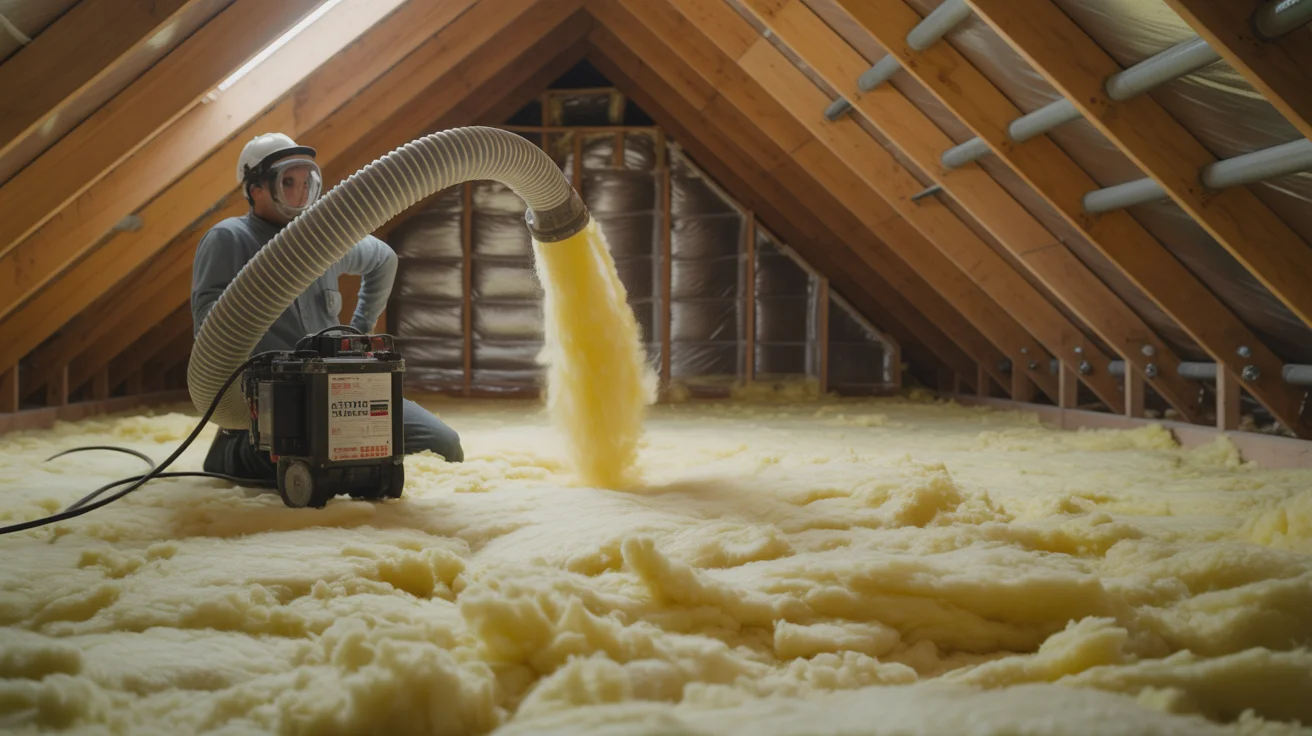
Blown-in fiberglass is the most common attic insulation I see in North Texas. Installers use a machine to blow loose fiberglass into the attic space, where it settles between joists and covers irregular areas. It’s affordable, non-combustible, and doesn’t absorb moisture.
The downside: it settles over time. Insulation rated R-38 at installation can compress to R-30 within 5 to 10 years. That’s why I recommend installing to R-44 or higher if you’re using blown-in fiberglass, so you still meet code after settling.
Blown-In Cellulose
R-value per inch: 3.2 to 3.8 Cost installed: $1.60 to $2.50 per square foot
Cellulose is made from recycled paper treated with fire retardant. It packs more R-value per inch than fiberglass, meaning you need less depth to hit the same rating. It also does a better job filling gaps and small cavities.
The downside: cellulose absorbs moisture. In a North Texas attic with a roof leak or poor ventilation, wet cellulose loses R-value and can grow mold. If your attic ventilation is questionable, fiberglass is the safer choice.
Open-Cell Spray Foam
R-value per inch: 3.5 to 3.7 Cost installed: $1.50 to $2.50 per square foot
Open-cell spray foam expands to fill cavities and creates a partial air seal. It’s lighter and less expensive than closed-cell. For attic floor applications (between joists), it works well as a cost-effective upgrade.
The downside: open-cell foam absorbs water. It’s not a vapor barrier, so it still needs proper attic ventilation. Some homeowners assume “spray foam” means waterproof, but that only applies to closed-cell.
Closed-Cell Spray Foam
R-value per inch: 6.0 to 6.7 Cost installed: $3.00 to $5.00 per square foot
Closed-cell spray foam is the premium option. It delivers the highest R-value per inch, acts as a vapor barrier, adds structural rigidity, and creates a complete air seal. For roofline applications (sprayed to the underside of the roof deck), closed-cell is the gold standard.
The downside: cost. Insulating a 1,500 sq ft attic with closed-cell spray foam runs $4,500 to $7,500. That’s two to three times the cost of blown-in options.
Comparison Table: Spray Foam vs Blown-In Insulation
| Feature | Blown-In Fiberglass | Blown-In Cellulose | Open-Cell Spray Foam | Closed-Cell Spray Foam |
|---|---|---|---|---|
| R-value per inch | 2.2 to 2.7 | 3.2 to 3.8 | 3.5 to 3.7 | 6.0 to 6.7 |
| Cost per sq ft | $1.50 to $2.50 | $1.60 to $2.50 | $1.50 to $2.50 | $3.00 to $5.00 |
| Air sealing | No | Partial | Partial | Complete |
| Moisture resistance | Good | Poor | Poor | Excellent |
| Lifespan | 15 to 25 years | 20 to 30 years | 25+ years | 50+ years |
| DIY possible | Yes (machine rental) | Yes (machine rental) | No | No |
| Best for | Attic floors | Attic floors, walls | Attic floors, crawlspaces | Rooflines, walls, crawlspaces |
The Attic Problem: Why It’s the #1 Priority in Texas
If you can only insulate one area of your home, choose the attic. In North Texas, the attic is the single largest source of heat gain during summer. On a 100°F day, your attic can reach 140°F to 160°F. That superheated air radiates down through the ceiling into your living space, and your AC has to fight all of it.
Attic insulation in Texas delivers the highest return on investment of any insulation upgrade. The EPA estimates that proper attic insulation saves 15% or more on heating and cooling costs. For a North Texas home spending $200 per month on electricity in summer, that’s $30 or more per month in savings.
Signs Your Attic Insulation Needs Attention
- Uneven temperatures room to room. If upstairs bedrooms are 5°F or more warmer than downstairs, your attic insulation is likely inadequate.
- AC runs constantly. Your system should cycle on and off, not run nonstop. Continuous operation in moderate weather (85°F to 90°F outside) points to heat gain from above.
- High electric bills compared to neighbors. If your home is similar size and age but your bill is $50+ higher, insulation is a likely culprit.
- Visible insulation below the top of ceiling joists. If you can see the joists in your attic, the insulation is too thin. Properly insulated attics should have insulation level with or above the joists.
- Ice dams in winter (rare in North Texas, but it happens). Poor insulation lets heat escape upward, melting snow on the roof that refreezes at the edges.
Attic Insulation Costs in North Texas
For a typical 1,500 sq ft attic in the DFW area:
| Insulation Type | Total Cost Range | R-Value Achieved | Estimated Annual Savings |
|---|---|---|---|
| Blown-in fiberglass (R-38) | $2,250 to $3,750 | R-38 | $200 to $400 |
| Blown-in cellulose (R-38) | $2,400 to $3,750 | R-38 | $220 to $420 |
| Open-cell spray foam (R-38) | $2,250 to $3,750 | R-38 | $250 to $450 |
| Closed-cell spray foam (R-38) | $4,500 to $7,500 | R-38 | $350 to $550 |
The payback period for blown-in attic insulation is typically 3 to 5 years. Closed-cell spray foam takes 7 to 10 years to pay back but lasts significantly longer. For most North Texas homeowners, blown-in fiberglass or cellulose at R-38 to R-49 offers the best balance of cost and performance.
How Poor Insulation Forces HVAC Oversizing (and Costs You More)
Here’s something most insulation articles don’t cover. When I do a Manual J load calculation for a new AC installation, insulation quality directly affects the tonnage I recommend. A well-insulated 2,000 sq ft home might need a 3-ton system. That same home with R-19 attic insulation might calculate out to 3.5 or even 4 tons.
A bigger AC costs more to buy, more to install, and more to operate. A 4-ton system uses roughly 25% more electricity than a 3-ton system. Over a 15-year lifespan, that’s thousands of dollars in extra electricity.
Worse, an oversized system short-cycles. It cools the air quickly but shuts off before removing enough humidity. You end up with a house that hits the thermostat temperature but still feels clammy. Then you lower the thermostat to compensate, which drives the bill up further.
Improving insulation before replacing your AC can save you money twice. First, you reduce your cooling load so you can install a smaller (cheaper) system. Second, the properly sized system runs more efficiently for its entire lifespan. If you’re planning an AC installation in the next year or two, insulate first.
Beyond the Attic: Other Insulation Priorities for Texas Homes
The attic is priority one, but it’s not the only place heat sneaks in. Here’s where to focus after your attic is handled.
Exterior Walls
Older North Texas homes (pre-2000) often have R-11 or R-13 wall insulation. Current code calls for R-13 to R-20, depending on the wall construction. Upgrading wall insulation is expensive because it requires either removing drywall from the inside or drilling holes from the outside to blow in insulation.
My recommendation: if you’re already doing a major renovation that involves opening walls, upgrade the insulation while the walls are open. As a standalone project, wall insulation rarely pencils out financially unless your walls are completely uninsulated.
Ductwork Insulation
This one surprises homeowners. Your attic ducts carry 55°F air through a 150°F attic. If the duct insulation is thin, damaged, or missing, that air gains 10°F to 15°F before it reaches your vents. I test supply air temperature at registers regularly, and I’ve measured 65°F air coming out of vents that should be delivering 55°F. That’s a 20% efficiency loss from ductwork alone.
Duct insulation should be R-8 minimum in unconditioned attics. Many homes built before 2005 have R-4 or R-6 duct wrap. Upgrading duct insulation costs $1,000 to $2,500 for a typical home and delivers noticeable comfort improvements immediately.
Garage Walls (Shared with Living Space)
If your garage shares a wall with a bedroom or living area, that wall needs insulation. Garages in North Texas hit 120°F+ in summer. An uninsulated shared wall transfers that heat directly into your home. Adding R-13 batt insulation to a garage wall is a weekend DIY project that costs $200 to $400 in materials.
Insulation and Your HVAC: The Maintenance Connection
Good insulation doesn’t just save you on electricity. It extends the life of your HVAC equipment. Here’s the direct link.
Less runtime means less wear. A system that runs 12 hours per day instead of 18 hours per day accumulates 2,190 fewer hours of operation per year. That’s nearly a full year of extra life over a decade. Components like capacitors, contactors, and fan motors all have finite operational lifespans measured in hours.
More consistent temperatures mean fewer hard starts. When insulation is poor, the temperature swings wider between cycles. The compressor has to work harder to pull the temperature back down from 78°F instead of 75°F. Hard starts stress the compressor and draw high amperage through electrical components.
Reduced humidity load improves coil longevity. A well-insulated home maintains lower humidity, which means less moisture on the evaporator coil. Less moisture means less biological growth, fewer drain clogs, and better airflow across the coil. I clean fewer clogged drain lines in well-insulated homes. That’s not a coincidence.
If you want to understand more about how system efficiency compounds with insulation, I go deeper in my HVAC energy efficiency guide. And if you’re comparing AC units by efficiency ratings, my SEER rating explainer covers what those numbers actually mean for your Texas electric bill.
Tax Credits and Rebates for Insulation in 2026
The federal 25C Energy Efficient Home Improvement Tax Credit covers insulation upgrades. In 2026, you can claim 30% of insulation costs up to a $1,200 annual cap (this cap is shared with other qualifying improvements like AC units and windows).
What qualifies:
- Attic insulation (blown-in, batts, or spray foam)
- Wall insulation
- Floor insulation
- Air sealing materials and labor
Important detail: the $1,200 cap is per year, and it resets annually. If you’re planning both insulation and a new AC, consider splitting the projects across two tax years to maximize your credits. Insulation this year, new AC next year, and you can claim up to $1,200 for each.
Some local utilities also offer rebates. Oncor (serving most of the DFW area) has historically offered rebates for insulation upgrades, though programs change year to year. Check with your utility provider before starting the project.
What I Recommend for Most North Texas Homeowners
After 15+ years of seeing the connection between insulation and HVAC performance firsthand, here’s my standard advice.
If your attic has less than R-30: upgrade immediately. This is the highest-return improvement you can make for your home’s comfort and energy costs. Blown-in fiberglass to R-38 costs $2,250 to $3,750 for a typical home and pays for itself in 3 to 5 years.
If your attic is at R-30 to R-38: you’re in decent shape. Consider topping off to R-49 if you’re planning to stay in the home for 5+ years. The incremental cost is low since the installers just add more material on top of what’s there.
If you’re building or doing a major renovation: closed-cell spray foam on the roofline is the best long-term investment. It eliminates the attic heat problem entirely by bringing the attic inside the building envelope. Yes, it costs more upfront. Over 20 years, it outperforms every other option.
If your ducts run through the attic: check duct insulation before anything else. Poorly insulated ducts can waste more energy than thin attic insulation. R-8 duct wrap is relatively inexpensive and makes an immediate difference.
Always insulate before replacing your HVAC. The insulation upgrade reduces your cooling load, which may allow a smaller, less expensive system. That’s money saved twice.
FAQ
How much does attic insulation cost in North Texas?
For a typical 1,500 sq ft attic, blown-in fiberglass costs $2,250 to $3,750, blown-in cellulose costs $2,400 to $3,750, and closed-cell spray foam costs $4,500 to $7,500. Prices vary by insulation depth, attic accessibility, and whether old insulation needs removal.
What R-value do I need for my attic in Texas?
North Texas (Climate Zone 3) requires a minimum of R-38 per current building code. For best energy savings, I recommend R-38 to R-49. Going above R-49 delivers diminishing returns that don’t justify the additional cost for most homeowners.
Is spray foam insulation worth the extra cost in Texas?
For attic floors, blown-in fiberglass or cellulose delivers comparable performance at 40% to 60% lower cost. Closed-cell spray foam makes the most sense for roofline applications, crawlspaces, or situations where moisture resistance and air sealing are critical. The higher cost of spray foam is justified when you need both insulation and a vapor barrier.
How much can insulation save on my electric bill?
The EPA estimates proper insulation saves 15% or more on heating and cooling costs. For a North Texas home spending $200 per month on electricity in summer, that’s $30 to $40 per month. Homes upgrading from significantly under-insulated attics (R-11 or R-19) to R-38 often see savings of $40 to $60 per month during peak cooling season.
Can I add insulation on top of existing insulation?
Yes, as long as the existing insulation is dry, free of mold, and in reasonable condition. R-values are additive, so R-19 existing plus R-19 added equals R-38 total. Don’t compress the existing insulation when adding new material on top, as compression reduces R-value.
Should I insulate my attic before or after replacing my AC?
Before. Insulation reduces your home’s cooling load, which affects what size AC you need. Insulating first may allow you to install a smaller, less expensive system that runs more efficiently. If you install the AC first, you might end up with an oversized unit that short-cycles and creates humidity problems.
Need help figuring out how your home’s insulation is affecting your HVAC performance? I do insulation assessments as part of every AC installation consultation. Call me at (940) 390-5676 and I’ll tell you what I find in your attic, no sales pitch attached.