AC Short Cycling: Why Your AC Keeps Turning On and Off (And How to Fix It)
Your AC turns on and off every few minutes? That's short cycling, and it's burning out your system. Learn the 7 most common causes, what repairs cost ($150-$2,500), and which ones you can fix yourself. North Texas HVAC pro explains.
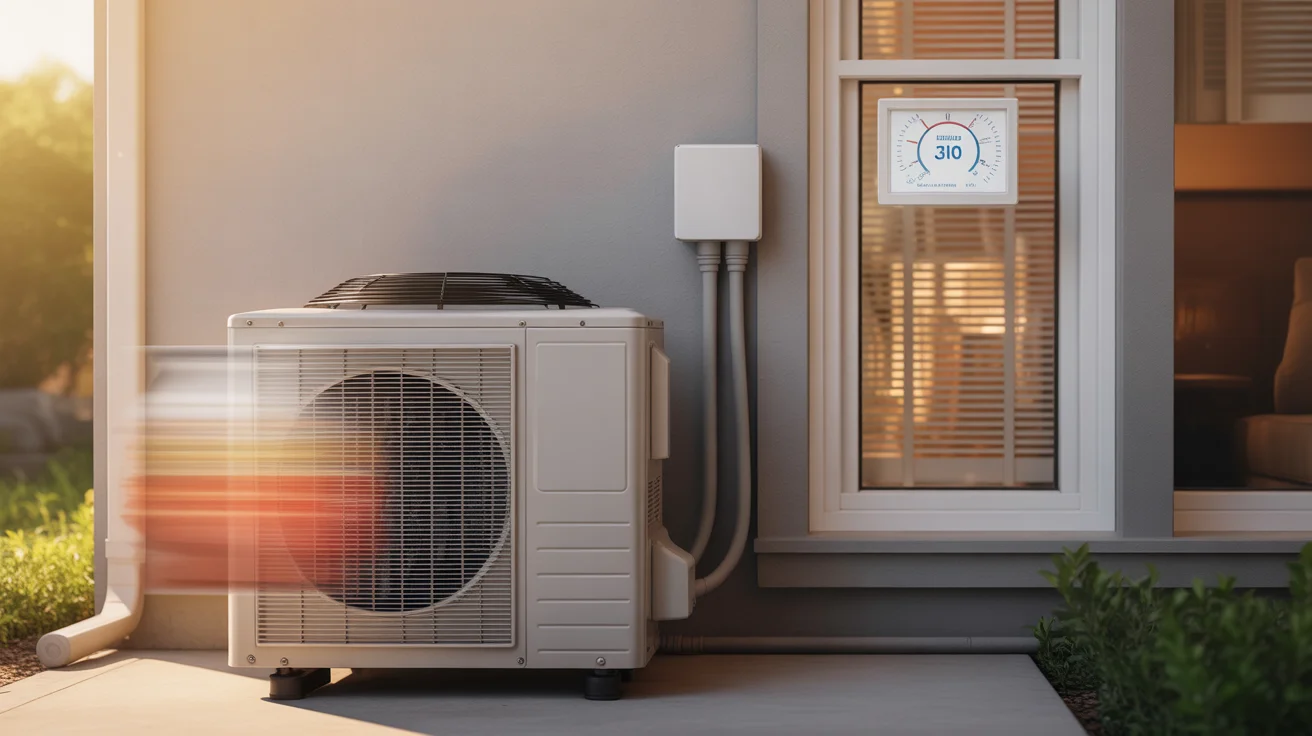
- What AC Short Cycling Actually Looks Like
- Why Short Cycling Destroys Your AC (And Your Electric Bill)
- Cause 1: Dirty Air Filter (The 5-Minute Fix)
- Cause 2: Refrigerant Leak
- Cause 3: Failing Capacitor
- Cause 4: Oversized AC Unit
- Cause 5: Thermostat Problems
- Cause 6: Frozen Evaporator Coil
+ 5 more sections below...
- What AC Short Cycling Actually Looks Like
- Why Short Cycling Destroys Your AC (And Your Electric Bill)
- Cause 1: Dirty Air Filter (The 5-Minute Fix)
- Cause 2: Refrigerant Leak
- Cause 3: Failing Capacitor
- Cause 4: Oversized AC Unit
- Cause 5: Thermostat Problems
- Cause 6: Frozen Evaporator Coil
+ 5 more sections below...
Your AC kicks on, runs for three or four minutes, shuts off, then starts up again. Over and over. That pattern has a name: AC short cycling. And if your system is doing it right now in the middle of a North Texas summer, you’re burning through electricity, wearing out your compressor, and not actually cooling your house.
I see this problem at least two or three times a week between May and September. The good news is that most causes of short cycling are fixable, and some of them you can check yourself before calling anyone. The bad news is that ignoring it will turn a $200 repair into a $2,500 one. This guide covers the seven most common reasons your AC turns on and off repeatedly, what each fix costs in the DFW area, and exactly when you need a technician.
What AC Short Cycling Actually Looks Like
A healthy AC cycle in North Texas lasts 10 to 20 minutes. Your system kicks on, runs steadily, brings the temperature down to the thermostat setting, and shuts off. On a 100-degree day, you might get three or four cycles per hour, and that’s completely normal.
AC short cycling looks different. The system runs for only 2 to 7 minutes, shuts off, then restarts a few minutes later. You can hear it: that constant click-hum-click from the outdoor unit, over and over.
| Cycle Type | Run Time | Cycles Per Hour | What It Means |
|---|---|---|---|
| Normal | 10-20 minutes | 2-4 | System working correctly |
| Borderline | 7-10 minutes | 4-6 | Worth monitoring |
| Short cycling | Under 7 minutes | 6+ | Problem that needs attention |
Why Short Cycling Destroys Your AC (And Your Electric Bill)
Your compressor draws the most electricity during startup, pulling 4 to 8 times more power than steady-state running. When your system short cycles 10 times per hour instead of running 3 normal cycles, you’re paying for 10 startup surges instead of 3. I’ve seen electric bills jump $80 to $150 per month from short cycling alone during a Frisco summer.
The mechanical damage is worse. Every startup stresses the compressor bearings, windings, and electrical connections. A compressor rated for 15 years of normal cycling might last 7 or 8 under constant short cycling. Compressor replacement runs $1,800 to $3,500 in North Texas. That’s the real cost of ignoring this problem.
Cause 1: Dirty Air Filter (The 5-Minute Fix)
This is the number one cause I find, and it’s the easiest to fix yourself.
When your air filter is clogged with dust, pet hair, and North Texas pollen, airflow across the evaporator coil drops. The coil gets too cold, the system detects the abnormal temperature, and the safety controls shut the compressor down to prevent freezing. A few minutes later, the coil warms up, the system tries again, and the cycle repeats.
How to check: Pull out your filter and hold it up to a light. If you can’t see light through it, that’s your problem.
The fix: Replace the filter. Use MERV 8 to MERV 11 for most North Texas homes. In summer, replace every 30 to 45 days, not every 90 days like the package says. North Texas dust and pollen loads are brutal on filters.
Cost: $5 to $25 for a new filter.
Cause 2: Refrigerant Leak
Low refrigerant is the second most common cause of AC short cycling I deal with in the DFW area. When refrigerant levels drop below the designed charge, the system’s low-pressure switch trips to protect the compressor. The system shuts down, pressure equalizes, the switch resets, and the system starts again. On, off, on, off.
Signs it’s refrigerant:
- Ice forming on the refrigerant lines or evaporator coil
- Hissing or bubbling sounds near the indoor or outdoor unit
- The air from your vents feels cool but not cold
- Your system ran fine last summer but started short cycling this year
Refrigerant doesn’t “use up” like gasoline. If you’re low, you have a leak somewhere. Adding more refrigerant without finding and fixing the leak is pouring money into a bucket with a hole.
Cost: $200 to $600 for leak detection and refrigerant recharge. If the leak is in the evaporator coil, you’re looking at $800 to $2,500 for coil replacement. Read more about AC repair costs in North Texas.
Cause 3: Failing Capacitor
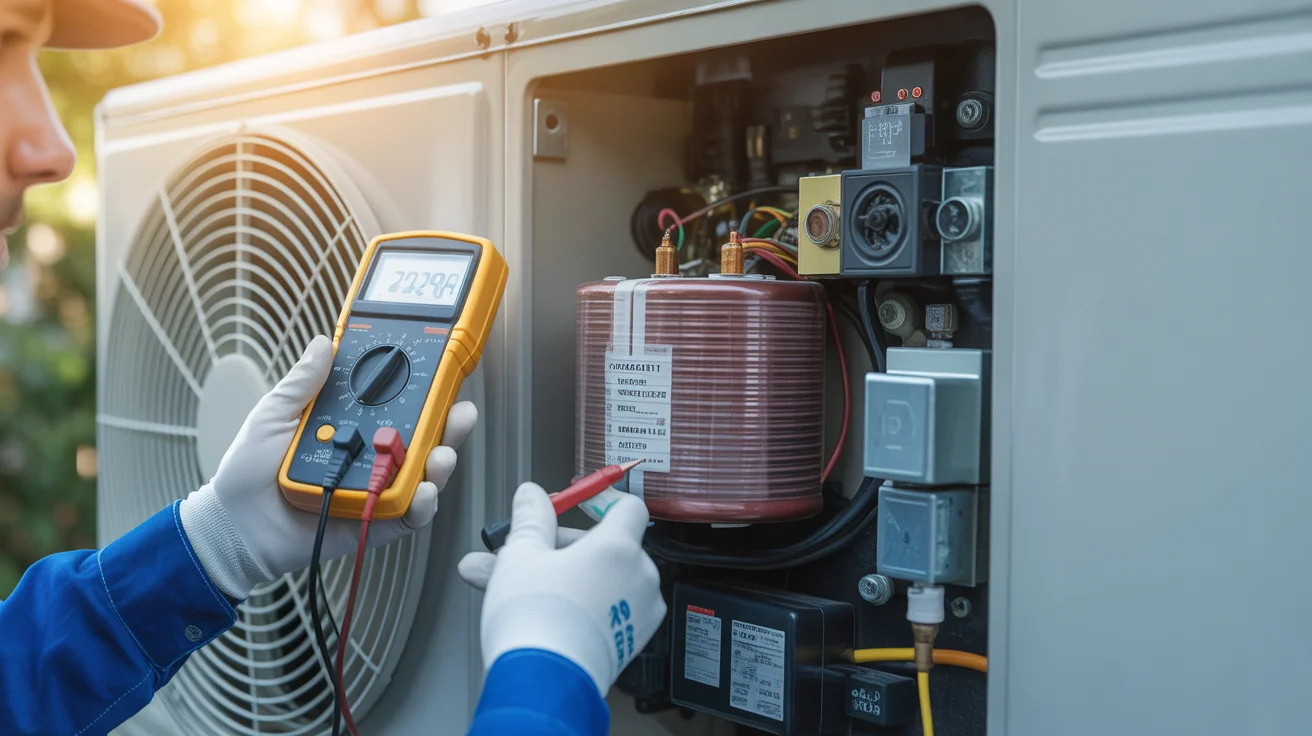
The capacitor stores and delivers the electrical charge your compressor and fan motors need to start and run. When a capacitor starts failing, it can deliver enough power to start the compressor but not enough to keep it running smoothly. The system starts, struggles, and the overload protector shuts it down.
I replace capacitors more than any other AC part in North Texas. They’re rated for 8 to 10 years nationally, but our sustained 105-degree days cook them in 3 to 5 years. Here’s my full guide on AC capacitor failure.
Signs it’s the capacitor:
- Outdoor unit hums but the fan doesn’t spin (or spins slowly)
- System starts then shuts off within 1 to 2 minutes
- You can hear a clicking sound at the outdoor unit during startup
Cost: $180 to $400 for diagnosis and replacement. This is one of the most cost-effective AC repairs you’ll ever pay for.
Cause 4: Oversized AC Unit
This one is painful because the fix isn’t cheap. An oversized AC cools your house too fast. It blasts cold air, the thermostat hits the target temperature in 5 minutes, and the system shuts off. But because it ran so briefly, it never removed the humidity. Your house hits 72 degrees but feels clammy and uncomfortable. The temperature drifts up quickly, and the system kicks on again.
How to know if your system is oversized:
- Your house cools fast but feels humid and sticky
- Short cycling started the day the system was installed (not gradually)
- You got a new system installed without a Manual J load calculation
- The tonnage is significantly larger than the previous system
I see this in Plano and McKinney neighborhoods where homeowners got a 5-ton system installed in a home that needs 3.5 tons. The installer either didn’t do a load calculation or went bigger “just to be safe.” Bigger is not better in HVAC. It’s worse.
Cost: If you just installed it, talk to your installer about downsizing under warranty. Otherwise, a properly sized replacement runs $5,000 to $12,000 depending on the system. But this is rare compared to the other causes on this list.
Cause 5: Thermostat Problems
A malfunctioning thermostat can cause AC short cycling in several ways. If the temperature sensor is off by even a few degrees, the system thinks the house is cooler than it actually is and shuts off early. If the thermostat is located in direct sunlight, near a kitchen, or directly under a supply vent, it reads false temperatures and sends erratic signals.
Quick checks:
- Make sure the thermostat is set to COOL (not AUTO heat/cool, which can cause switching)
- Check the batteries if it’s a battery-powered unit
- Look at the temperature reading and compare it to another thermometer in the same room
- Check the thermostat location: is it near a window with sun exposure, a kitchen, or a supply vent?
Cost: Thermostat replacement runs $150 to $350 installed. If it’s a location issue, relocating the thermostat costs $200 to $400 for the wiring work.
Cause 6: Frozen Evaporator Coil
When your evaporator coil freezes, ice blocks airflow and the system shuts down on a safety switch. The ice melts, the system restarts, the coil freezes again. This creates a short cycling pattern that gets progressively worse.
Frozen coils are usually a symptom of another problem: a dirty filter (cause 1), low refrigerant (cause 2), or a failing blower motor that isn’t pushing enough air across the coil. Fix the root cause and the freezing stops.
If you see ice on your system right now: Turn the AC off and set the fan to ON (not AUTO). Let the ice melt completely, which takes 2 to 4 hours. Then check the filter and call a tech if it’s clean but the coil is still freezing after you restart.
Cost: $0 if it’s just a dirty filter. $200 to $600 if it’s a refrigerant issue. $300 to $800 for a blower motor replacement.
Cause 7: Compressor Overheating
When the compressor itself overheats, the internal thermal overload switch shuts it down to prevent permanent damage. Once it cools, it restarts. This is the most serious cause of short cycling because it usually means the compressor is failing.
Signs it’s the compressor:
- The outdoor unit is hot to the touch (hotter than normal)
- Short cycling gets worse as the day gets hotter
- The system ran fine in the morning but starts cycling in the afternoon
- You hear a hard, labored sound during the brief run cycles
Compressor overheating can be caused by dirty condenser coils (the outdoor coils caked with cottonwood fluff and dirt), a failing condenser fan motor, or internal compressor wear. Read more about AC compressor issues.
Cost: Condenser coil cleaning is $150 to $300. Condenser fan motor replacement runs $250 to $500. If the compressor itself is failing, you’re looking at $1,800 to $3,500 for the part, or a full system replacement if the unit is over 10 years old.
What You Can Fix Yourself vs. What Needs a Pro
| Issue | DIY? | What to Do |
|---|---|---|
| Dirty air filter | Yes | Replace the filter ($5-$25) |
| Thermostat batteries | Yes | Replace batteries |
| Thermostat settings | Yes | Verify COOL mode, correct temp |
| Blocked vents | Yes | Open all supply and return vents |
| Dirty outdoor coils | Maybe | Gently rinse with garden hose (power off first) |
| Frozen coil (thaw) | Yes | Turn off AC, fan to ON, wait 2-4 hours |
| Refrigerant leak | No | Requires EPA-certified technician |
| Capacitor replacement | No | High voltage, dangerous for DIY |
| Compressor issues | No | Requires professional diagnosis |
| Oversized system | No | Requires load calculation and replacement |
If you’ve checked the filter, thermostat, and vents and the system is still short cycling, it’s time to call a professional. Continuing to run a short-cycling system causes compounding damage with every cycle.
How Much Does It Cost to Fix AC Short Cycling?
| Repair | Cost Range |
|---|---|
| Air filter replacement | $5-$25 (DIY) |
| Thermostat replacement | $150-$350 |
| Capacitor replacement | $180-$400 |
| Refrigerant recharge + leak repair | $200-$600 |
| Condenser coil cleaning | $150-$300 |
| Condenser fan motor | $250-$500 |
| Evaporator coil replacement | $800-$2,500 |
| Compressor replacement | $1,800-$3,500 |
Most short cycling repairs fall in the $150 to $600 range. The expensive repairs happen when the problem gets ignored for weeks.
When to Call for Emergency Service
Short cycling is urgent but usually not an emergency unless you smell burning or electrical odors, the breaker keeps tripping, ice is spreading rapidly, or your home has reached dangerous temperatures with vulnerable people present.
For emergency AC repair in North Texas, call (940) 390-5676. I offer 2-hour response times and $250 after-hours service. For non-emergency short cycling, get it diagnosed within a day or two. Every cycle of damage is cumulative.
FAQ
How long should an AC cycle last?
A normal AC cycle in North Texas lasts 10 to 20 minutes during summer. On extremely hot days (105 degrees or higher), cycles might run longer as the system works harder to reach the thermostat setting. If your cycles are consistently under 7 minutes, your system is short cycling and needs attention.
Can a dirty filter really cause short cycling?
Yes, and it’s the most common cause I find. A clogged filter restricts airflow so severely that the evaporator coil temperature drops below freezing. The safety switch shuts the system down. Once the coil warms slightly, the system tries again. Replace your filter every 30 to 45 days during North Texas summers to prevent this.
Will short cycling damage my AC permanently?
It can, and it will if you let it continue. Each startup cycle puts maximum stress on the compressor motor. A system short cycling 10 times per hour instead of running 3 normal cycles is experiencing over three times the mechanical stress. The compressor, which costs $1,800 to $3,500 to replace, is the component most at risk.
My AC is brand new and it’s short cycling. What’s wrong?
If short cycling started the day the system was installed, it’s probably oversized. An AC that’s too large cools the space so quickly that it shuts off before completing a full dehumidification cycle. Ask your installer whether they performed a Manual J load calculation. If they didn’t, the system may be the wrong size for your home.
Should I keep running my AC if it’s short cycling?
Turn it off if the system is tripping breakers, making burning smells, or if you see ice forming. For other causes, you can keep it running while you schedule a repair, but understand that every short cycle adds wear. Get it looked at within 1 to 2 days, not next week.
AC short cycling is one of those problems that starts small and gets expensive fast. If your system is turning on and off every few minutes, check the filter and thermostat first. If that doesn’t fix it, call (940) 390-5676 and I’ll diagnose the real cause before it turns into a compressor replacement. I serve Frisco, Plano, McKinney, Allen, Prosper, The Colony, Little Elm, and Addison with same-day and emergency appointments available.
Need Professional HVAC Service?
Our certified technicians are ready to help with any HVAC needs in North Texas