HVAC Zoning Systems: Room-by-Room Temperature Control for Texas Homes
HVAC zoning lets you control temperatures room by room. Learn how zoning works, what it costs ($2,000-$5,000), which Texas homes benefit most, and whether it's worth the investment. Real pricing from a North Texas HVAC pro.
- How an HVAC Zoning System Works
- Why North Texas Homes Need Zoning More Than Most
- What HVAC Zoning Costs in North Texas (2026 Pricing)
- Types of Zoning Systems
- The Energy Savings (Real Numbers, Not Marketing Claims)
- Which Homes Benefit Most from Zoning
- The Installation Process (What to Expect)
- Common Zoning Mistakes (And How to Avoid Them)
+ 2 more sections below...
- How an HVAC Zoning System Works
- Why North Texas Homes Need Zoning More Than Most
- What HVAC Zoning Costs in North Texas (2026 Pricing)
- Types of Zoning Systems
- The Energy Savings (Real Numbers, Not Marketing Claims)
- Which Homes Benefit Most from Zoning
- The Installation Process (What to Expect)
- Common Zoning Mistakes (And How to Avoid Them)
+ 2 more sections below...
Every two-story home in North Texas has the same argument. The downstairs is comfortable at 74 degrees. The upstairs bedrooms are 82. Someone cranks the thermostat down to 70 to cool the bedrooms, and now the living room feels like a refrigerator. The kids are roasting upstairs, the adults are freezing downstairs, and the electric bill is climbing because the system is fighting an impossible battle.
An HVAC zoning system solves this by dividing your home into independent temperature zones, each with its own thermostat. Instead of one thermostat trying to average the temperature for your entire house, each zone gets exactly the cooling (or heating) it needs. The upstairs stays at 74 without turning the downstairs into a meat locker. I’ve installed zoning systems in homes across Frisco, Plano, and McKinney, and the reaction is almost always the same: “Why didn’t we do this years ago?”
This guide covers how zone control HVAC actually works, what it costs to install in North Texas, which homes benefit the most, and whether the energy savings justify the investment.
How an HVAC Zoning System Works
The concept is straightforward, even though the engineering behind it is precise. A standard HVAC system has one thermostat that controls your entire house. When that thermostat calls for cooling, the system delivers cold air to every room equally through your ductwork. The problem is that not every room needs the same amount of cooling at the same time.
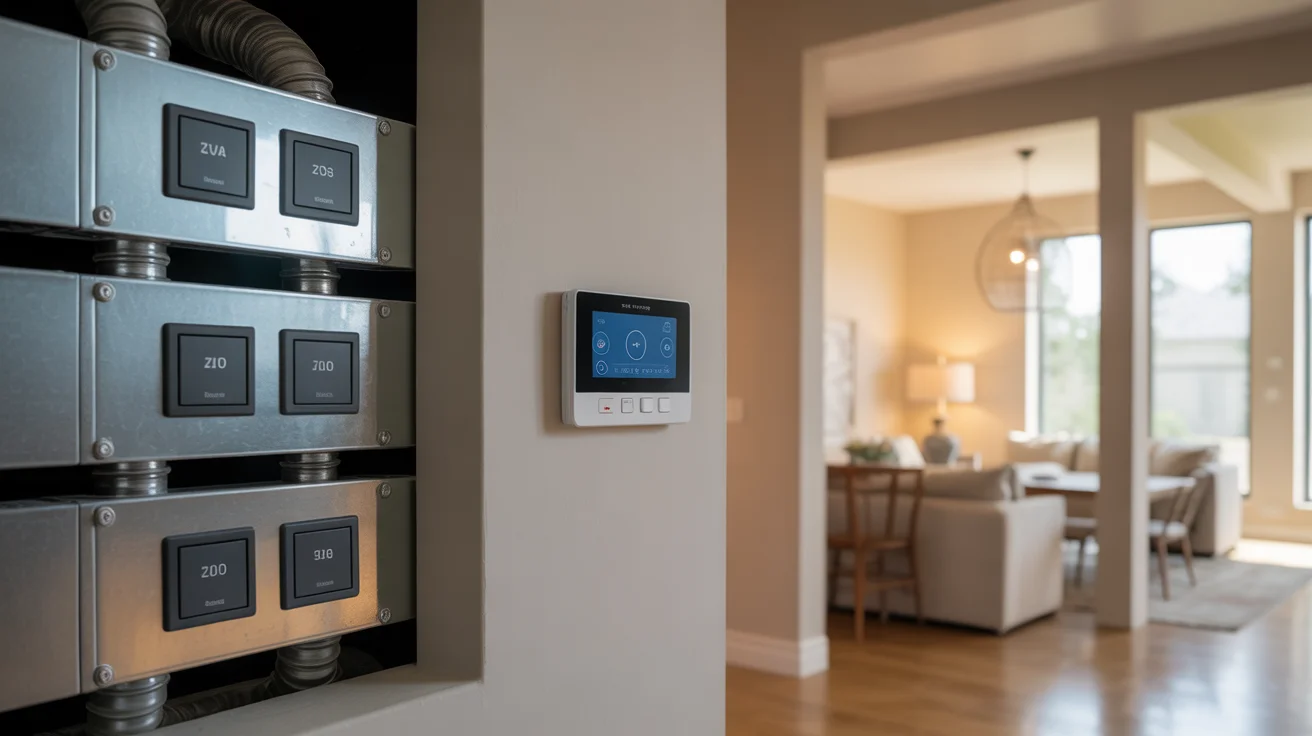
A zoned air conditioning system adds three components to your existing setup:
- Motorized dampers installed inside your ductwork. These are essentially gates that open and close to control airflow to each zone.
- Zone thermostats. Each zone gets its own thermostat. The master bedroom can be set to 73 while the guest rooms upstairs sit at 78.
- A zone control panel. This is the brain. It receives signals from each thermostat and tells the dampers which zones need airflow and which don’t.
When the upstairs thermostat calls for cooling, the control panel opens the dampers feeding the upstairs ductwork and closes (or partially closes) the dampers to zones that are already at their target temperature. Your AC runs, but all the cold air goes where it’s needed instead of being split evenly across the whole house.
A Real Example
In a 2,800 sq ft two-story Frisco home I zoned into three areas, here’s what happens: the upstairs reads 76 (set to 74), downstairs reads 73 (set to 74), bonus room reads 72 (set to 75). The control panel opens dampers fully to the upstairs, closes the bonus room, and partially opens downstairs. The AC runs 12 minutes, nearly all airflow goes upstairs, and every zone hits its target. Without zoning, that system would overcool the downstairs to 70 while the upstairs barely hit 75.
Why North Texas Homes Need Zoning More Than Most
I’ve worked in HVAC across different climates, and North Texas homes have specific characteristics that make multi zone HVAC especially valuable.
The Two-Story Temperature Gap
Heat rises. In a two-story home during a North Texas summer, the temperature difference between floors can be 6 to 10 degrees without zoning. Your single thermostat (usually located on the first floor) reads 74 and thinks everything is fine. Meanwhile, the upstairs bedrooms are 82 degrees at bedtime.
This isn’t a system problem. It’s physics. Zoning is the engineering solution to a physics problem that a single thermostat can never solve.
West-Facing Room Heat Gain
In the DFW suburbs, many homes have living rooms, game rooms, or bedrooms with large west-facing windows. From 3 PM to 7 PM in summer, those rooms absorb brutal afternoon sun. I’ve measured surface temperatures of 130 degrees on west-facing brick walls in Plano during July. The rooms behind those walls need significantly more cooling than the rest of the house.
A zoning system puts those sun-blasted rooms in their own zone. The dampers open when those rooms need extra cooling without overcooling the shaded north-facing rooms.
Open Floor Plans with Distant Bedrooms
Modern North Texas construction loves open floor plans. The kitchen, living room, and dining area flow together in one massive space. Then the bedrooms are down a long hallway or upstairs, separated by walls and doors. One thermostat in the open area has no idea what temperature the master bedroom is. Zoning bridges that gap.
Bonus Rooms, Media Rooms, and Above-Garage Spaces
These are the worst offenders for temperature inconsistency. Bonus rooms above garages share a floor with an uninsulated (or poorly insulated) garage that can hit 140 degrees in summer. Media rooms in the center of the house have no exterior walls and stay cool naturally. Trying to balance these with a single thermostat is impossible.
What HVAC Zoning Costs in North Texas (2026 Pricing)
Here’s what I charge and what you should expect from reputable companies in the DFW area:
| System Type | Zones | Cost Range | What’s Included |
|---|---|---|---|
| Basic retrofit (existing ductwork) | 2 zones | $2,000-$3,000 | Dampers, 2 thermostats, control panel, labor |
| Standard retrofit | 3-4 zones | $3,000-$4,500 | Dampers, thermostats, control panel, bypass damper, labor |
| Advanced retrofit (smart thermostats) | 3-4 zones | $3,500-$5,000 | Same as standard plus smart thermostats, WiFi panel |
| New construction (during HVAC install) | 2-4 zones | $1,500-$3,000 | Dampers and controls integrated during initial install |
Why the price range varies:
- Ductwork accessibility. If your ducts run through an accessible attic (common in North Texas single-story homes), damper installation is straightforward. If they’re buried in soffits, walls, or between floors, labor hours increase.
- Number of zones. Each zone needs a damper, thermostat, and wiring run. More zones mean more components and labor.
- Thermostat choice. Basic programmable thermostats cost $50 to $100 each. Smart thermostats (Ecobee, Honeywell T-series) with zone support run $150 to $250 each.
- Bypass damper. Most zoned systems need a bypass damper to relieve air pressure when some zones are closed. This prevents static pressure buildup that can damage ductwork or reduce efficiency. Add $200 to $400 for the bypass damper and installation.
What’s NOT Included
These costs assume your existing ductwork is in good condition and properly sized. If your ductwork has leaks, is undersized, or has poorly designed runs, those issues need to be fixed first. Duct repair or modification adds $500 to $2,000 depending on the scope.
Types of Zoning Systems
Not all zoning systems work the same way. Here’s what’s available and what I recommend for different situations.
Traditional Damper-Based Zoning
Motorized dampers install inside your ductwork trunk lines or branch runs. A central panel coordinates all dampers based on thermostat calls. This is what I install 80% of the time. It works with your existing HVAC system, it’s reliable, and it’s the most cost-effective option for most North Texas homes.
Ductless Mini-Split Zoning
Mini-splits are inherently zoned. Each indoor unit serves one room with its own thermostat. Best for additions, converted garages, or that one problem room your central system can’t handle. Cost is higher ($2,000 to $5,000 per indoor unit), but efficiency ratings up to 30 SEER2 make them worth it for the right application. Learn more about HVAC system types.
Smart Vent Systems
Products like Keen Home and Flair replace your existing register covers with motorized vents controlled by an app. Affordable ($200 to $600), no professional installation required, but limited compared to real dampers. I consider these a starting point, not a solution, for homes with serious temperature imbalances.
The Energy Savings (Real Numbers, Not Marketing Claims)
The U.S. Department of Energy estimates that HVAC zoning can reduce energy costs by up to 30%. That number gets thrown around a lot, but let me put it in North Texas context.
The average DFW household spends $200 to $350 per month on electricity during summer, with HVAC accounting for 50% to 60% of that bill. A 30% reduction on the HVAC portion means savings of $30 to $60 per month during the cooling season (roughly May through October in North Texas).
Annual savings estimate:
| Home Size | Monthly Summer Savings | Annual HVAC Savings | Payback Period (3-zone system) |
|---|---|---|---|
| 1,500-2,000 sq ft | $25-$40 | $200-$350 | 8-12 years |
| 2,000-3,000 sq ft | $35-$55 | $300-$500 | 6-10 years |
| 3,000-4,000 sq ft | $50-$75 | $450-$700 | 5-7 years |
| 4,000+ sq ft | $65-$100 | $600-$900 | 4-6 years |
These are conservative estimates based on homes I’ve zoned in the area. The actual savings depend on how you use the system. If you zone your home and then set every zone to 72 degrees, you’ll save very little. The savings come from letting unoccupied zones run warmer. Setting empty bedrooms to 78 during the day and only cooling them to 74 at night is where the real energy reduction happens. Read more about HVAC energy efficiency.
Zoning also reduces wear on your HVAC system. Shorter, more efficient cycles mean less compressor stress and a longer lifespan. I’ve seen zoned systems last 2 to 3 years longer than non-zoned systems in similar homes.
Which Homes Benefit Most from Zoning
Not every home needs zoning. Here’s my honest assessment of where it makes sense and where it doesn’t.
Zoning Is Worth It If:
- You have a two-story home. The upstairs/downstairs temperature gap is the single best case for zoning. If your bedrooms are upstairs and you’re fighting 80+ degree nights, zoning fixes it.
- Your home is over 2,500 sq ft. Larger homes have more temperature variation across zones. The ROI improves with square footage.
- You have rooms with heavy sun exposure. West-facing game rooms, sunrooms, or any room with large windows that bakes in the afternoon.
- You have a bonus room above the garage. These rooms are almost impossible to keep comfortable with a single-zone system.
- Different family members prefer different temperatures. If you and your spouse argue about the thermostat, zoning ends that argument.
- You have rooms that are rarely used. Guest bedrooms, formal dining rooms, home offices used only on weekdays. Why cool them to 74 when nobody’s in there?
Zoning Probably Isn’t Worth It If:
- Your home is under 1,500 sq ft and single-story. Temperature variation is usually only 2 to 3 degrees. Zoning won’t make a noticeable difference.
- Your ductwork is in bad condition. Fix leaks and sizing issues before adding zoning.
- You’re replacing your HVAC system soon. Have zoning installed at the same time. It’s cheaper and the installer can design ductwork around the zones.
- Your temperature issues are caused by insulation. If your attic has 4 inches instead of 14, adding insulation ($1,500 to $3,000) might solve the problem more effectively.
The Installation Process (What to Expect)
A typical zoning retrofit in North Texas takes 2 visits:
Visit 1: Assessment (1-2 hours). I walk through your home, identify 2 to 3 zones (main living areas, upstairs bedrooms, and optionally a problem area like a bonus room), inspect your ductwork, and plan damper placement.
Visit 2: Installation (4-8 hours). Install motorized dampers in the ductwork, mount zone thermostats, wire everything to the control panel, install the bypass damper, and test every scenario. I return 3 to 5 days later for a free fine-tuning visit based on real-world performance.
Common Zoning Mistakes (And How to Avoid Them)
Skipping the bypass damper. When zones close, the AC still pushes air into the ductwork. Without a bypass damper to redirect excess air, static pressure builds up, causes noise, and can damage ductwork seams. Skipping it to save $200 to $400 is a bad trade.
Too many zones. For most homes, 2 to 4 zones is the sweet spot. A 2,500 sq ft home with 6 zones means the system is constantly opening and closing dampers, and airflow management becomes erratic.
Zone imbalance. If Zone 1 covers 1,800 sq ft and Zone 2 covers a 200 sq ft bedroom, the system can’t balance airflow. Zones should be similar in thermal load, not just square footage. A good zone plan accounts for sun exposure, ceiling height, and window area.
Ignoring duct sizing. When dampers close some zones, remaining zones receive more air at higher velocity. If the ducts are too small, you get whistling and reduced comfort. Sometimes zoning requires modifying a trunk line to handle concentrated airflow.
Smart Thermostats and Zoning: A Powerful Combination
If you’re investing in zoning, pair it with smart thermostats. Ecobee room sensors detect occupancy and adjust zones automatically, so empty rooms drift toward energy-saving setpoints. Learning schedules pre-cool zones before you get home. Remote access lets you adjust from your phone. A zoning system with smart thermostats in a two-story Frisco home is, in my opinion, one of the best comfort and efficiency upgrades available for the money. Explore installation options.
FAQ
How many zones do I need for my home?
Most North Texas homes do well with 2 to 3 zones. A two-story home typically needs a minimum of 2 (upstairs and downstairs). Add a third zone if you have a bonus room, sunroom, or master suite that has different cooling needs. Homes over 4,000 sq ft might benefit from 4 zones. Going beyond 4 rarely provides additional benefit and adds unnecessary complexity.
Can I add zoning to my existing HVAC system?
Yes. Most forced-air HVAC systems with ductwork can be retrofitted with zoning. The key requirement is accessible ductwork where dampers can be installed. Attic-run ductwork (very common in North Texas) is the easiest to work with. The zoning system works with your existing furnace and AC. You don’t need to replace any major equipment.
Will zoning make my HVAC system last longer?
It can. When your system isn’t overworking to compensate for temperature imbalances, it runs more efficient cycles. Less strain on the compressor, blower motor, and electrical components translates to fewer breakdowns and a longer lifespan. I estimate zoned systems in North Texas last 2 to 3 years longer than comparable non-zoned systems under similar usage.
Does zoning work with heat pumps?
Yes, and particularly well. Heat pumps provide both heating and cooling, and zoning directs warm air where it’s needed in winter just as effectively as cool air in summer. If you’re considering a heat pump, adding zoning at installation is ideal.
How does zoning handle humidity in North Texas?
Zoning can improve humidity control. When your AC runs longer, more efficient cycles (instead of short cycling because the thermostat zone is already cool), it removes more moisture from the air. The key is proper system sizing and bypass damper configuration.
Is zoning noisy?
Properly installed zoning is essentially silent. The dampers make a quiet click when opening or closing. If you hear whistling or banging after installation, something was done wrong, usually a missing bypass damper or undersized ductwork.
Can I zone my home myself with smart vents?
Smart vents (Keen, Flair) work for minor temperature adjustments (2 to 3 degree differences), but can’t match properly installed ductwork dampers. If your imbalance is 5+ degrees between floors, smart vents won’t fully solve the problem. They’re a good starting point before investing in a full system.
If your upstairs bedrooms are roasting while the downstairs is comfortable, you don’t need a bigger AC. You need an HVAC zoning system that directs cooling where it’s actually needed. Call (940) 390-5676 for a zoning assessment. I’ll walk your home, design a zone plan, and give you a fixed-price quote. Serving Frisco, Plano, McKinney, Allen, Prosper, The Colony, Little Elm, and Addison.
Need Professional HVAC Service?
Our certified technicians are ready to help with any HVAC needs in North Texas