
HVAC Financing Options: How to Pay for a New System Without Going Broke
Compare HVAC financing options including 0% dealer plans, personal loans, HELOCs, and tax credits. Real advice from a North Texas HVAC installer.
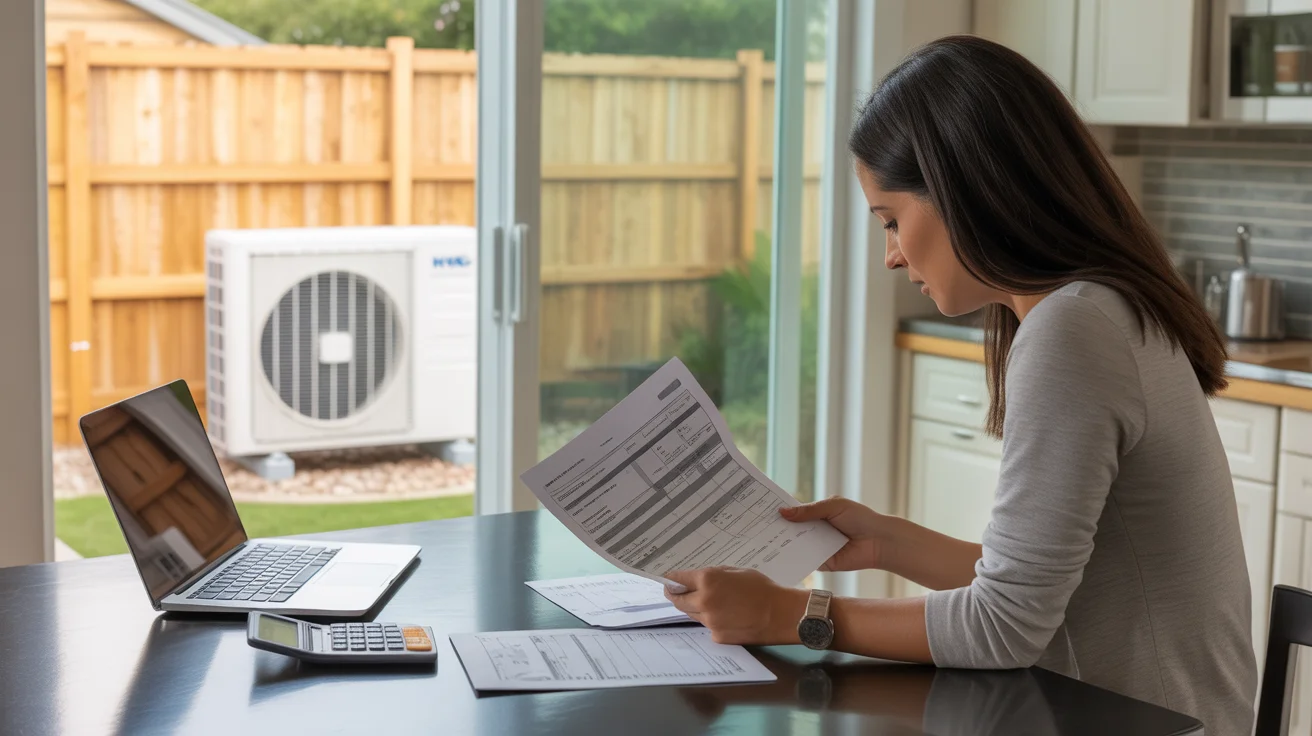
A new HVAC system in North Texas costs $5,500 to $12,000 for most homes, and up to $15,000 for premium equipment. You do not have to pay that all at once. Dealer financing, personal loans, HELOCs and credit cards spread the cost, and in Oncor territory the utility incentive your contractor passes through reduces it outright. The best option depends on your credit score, how fast you can pay it off, and which utility delivers your power.
I install systems across Frisco, Plano, McKinney, Allen, and the surrounding area. Financing questions come up on almost every job. Here is what I tell people when they ask how to pay for a new AC or heat pump.
Your HVAC Financing Options
Before we get into the details, here is a quick overview of every path I see homeowners take:
| Option | Typical APR | Best For |
|---|---|---|
| Dealer financing (promo) | 0% for 12-18 months | Paying off fast |
| Dealer financing (regular) | 9.99%-26.99% | Convenience |
| Personal loan (credit union) | 6%-12% | Best long-term rate |
| HELOC | 5%-9% | Lowest rate, large projects |
| Credit card (0% intro) | 0% for 15-21 months | Small systems, good credit |
| Federal tax credit | Ended after 31 Dec 2025 | Was up to $2,000 on heat pumps |
| Oncor incentive (Oncor territory only) | Contractor discount, capped $2,000-$3,400 by tonnage | Reduces the amount you finance |
Most of my customers use dealer financing or a personal loan. A few use credit cards for smaller repairs that turn into replacements. Everyone in Oncor territory should be checking that their contractor is enrolled in the program, because that alone decides whether the incentive exists on your job.
Dealer Financing
This is the most common option I see. When you get a quote from an HVAC company, they will almost always offer financing through a third-party lender like GreenSky, Service Finance, Synchrony, or Wells Fargo. The contractor does not lend you the money. They partner with these companies and you apply right there on the spot.
The good part: Many programs offer 0% interest for 12 to 18 months. Some push it to 24 months on higher-end systems. You get approved in minutes. The system goes in this week.
The part nobody mentions: If you do not pay off the full balance before that promotional period ends, the interest rate jumps to 9.99% on the low end and 26.99% on the high end. Some of these are deferred interest plans, which means they charge you interest on the entire original balance going back to day one. Not just the remaining balance. The entire thing.
I had a customer in Plano last summer who financed a $9,200 system at 0% for 18 months. Life happened, she still owed $3,100 when the promo expired. The lender hit her with 24.99% interest calculated on the full $9,200 from the original purchase date. That was roughly $3,400 in interest charges added to her account overnight.
My advice: Dealer financing at 0% is great if you can realistically pay it off in time. Divide the total by the number of months. If you can handle that monthly payment, go for it. If not, a personal loan at a fixed rate is safer.
Home Improvement Loans
A personal loan from a bank or credit union is often the smartest move for HVAC financing. You get a fixed interest rate, a fixed monthly payment, and no surprise charges at the end.
Credit unions are where I point most people. Places like Amplify Credit Union, EECU, or your local credit union often offer home improvement loans at 6% to 12% APR depending on your credit. That is significantly less than the 18% to 27% you might end up paying on dealer financing after the promo ends.
The process: You apply for a personal loan, get approved, and the money goes into your account. Then you pay the HVAC contractor directly. It takes a couple extra days compared to dealer financing, but the savings over the life of the loan can be thousands of dollars.
A HELOC (Home Equity Line of Credit) is another option if you have equity in your home. Rates are typically 5% to 9% right now, which makes it the cheapest borrowing option on this list. The catch is your house is the collateral. If something goes wrong and you cannot make payments, the bank can take action against your home. For a $7,000 HVAC system, most people do not want that kind of risk hanging over them.
HELOCs make more sense when you are doing a bigger project. If you are replacing HVAC, upgrading ductwork, and adding insulation all at once and the total is $15,000 or more, a HELOC starts to look reasonable.
Credit Cards
I am not going to tell you to never put HVAC work on a credit card. Sometimes it makes sense.
When it works: You have a card with a 0% introductory APR for 15 to 21 months. Your system costs $5,500 to $7,000. You can comfortably pay $350 to $450 per month. You pay it off before the intro period ends. Done.
Some cards also offer cash back or points. A 2% cash back card on a $8,000 purchase is $160 back in your pocket. That is not nothing.
When it does not work: You put $10,000 on a card at 22% APR because it is Tuesday and your AC just died in July. I get it. North Texas in July is no joke. But that $10,000 at 22% with minimum payments will cost you over $16,000 by the time you pay it off. That is $6,000 in interest.
If you are in an emergency and a credit card is your only option, use it to get the system installed and then immediately look into a balance transfer to a 0% card or refinance into a personal loan within 30 days.
Utility Payment Plans
If you are in North Texas, your power is delivered by either Oncor or CoServ. Which one you are on changes the financing math considerably, so check the delivery line on your bill rather than the retailer name.
Oncor runs the Home Energy Efficiency Standard Offer Program. The incentive on a system replacement is calculated from modeled kW and kWh savings and capped by tonnage: $2,000 on a 2-ton, $2,600 on a 3-ton, $3,200 on a 4-ton, $3,400 on a 5-ton. That is real money against a finance balance.
The catch for financing purposes is that Oncor pays your contractor, not you. Their program manual says Oncor pays the approved service provider within 45 days of approving the production report, and the provider is expected to pass it through by discounting the invoice. So the incentive reduces the amount you finance in the first place. It does not arrive later as a lump sum you can throw at the principal. Plan the loan around the discounted price, and get the incentive shown as a line item on the quote before you sign.
Your contractor also has to be an Oncor participating service provider. If they are not, there is no incentive on your job at all.
CoServ (parts of Frisco, Prosper, The Colony and Little Elm) offers no equipment rebates. Their own words: “CoServ does not currently offer incentives or rebates for solar or other energy efficiency upgrades.” CoServ is an electric cooperative, which puts it outside the state efficiency mandate that funds Oncor’s programs. If you are a CoServ member, finance the full price. Nothing is coming back to reduce it.
CoServ members do get a free home energy assessment worth over $100, which is worth booking before you commit to equipment sizing.
Ask your contractor to confirm the equipment clears the program floor before you buy: 11.6 EER or greater on new systems, 6.8 HSPF or greater on heat pumps.
Government Programs
This is where a lot of financing plans have gone wrong lately, because both federal routes people counted on are currently closed.
Energy Efficient Home Improvement Credit (25C): expired. The One Big Beautiful Bill Act terminated it for anything placed in service after December 31, 2025. If you completed an installation during 2025, you can still claim it on that year’s return using IRS Form 5695. For a 2026 install there is no federal credit, so do not build a repayment plan around a tax refund that is not coming.
Inflation Reduction Act rebates (HEAR and HOMES): not launched in Texas. SECO states plainly on its own site that “Rebates are not currently available.” The programs are still in planning and design with $690 million allocated and no launch date set. The headline figures you have read — up to $8,000 toward a heat pump for income-qualified households — are design targets, not something you can apply for.
This matters most for financing. SECO warns against entering agreements contingent on these rebates, and that warning is worth taking literally. If a salesperson offers to structure your loan on the assumption that $8,000 lands next year, you are being sold a payment plan built on money nobody can promise. Finance the job on what it costs today.
What this looks like in practice: a customer in Allen installed a 17 SEER2 heat pump last fall for $11,200. She claimed the $2,000 federal tax credit, which was still available for 2025 installs, bringing her real cost to $9,200. She financed the full $11,200 through a credit union at 7.5% over 60 months and put the credit toward early payoff.
The principle still holds even now that the credit is gone: finance the amount you actually need, take the contractor’s incentive pass-through as a lower balance up front, and throw anything else you recover at the principal early.
What I Tell Customers About Financing
I am an HVAC installer, not a financial advisor. But I have watched hundreds of customers go through this decision, and here is what I have learned:
Pay cash if you can. No interest, no monthly payments, no stress. If you have the money in savings and it will not wipe you out, just pay for it.
If you finance, know your payoff timeline. The single biggest mistake I see is people taking the 0% dealer financing and then not making a plan to pay it off. Write down the monthly amount you need to pay and set up auto-pay.
Do not let financing push you into a bigger system than you need. “It is only $40 more per month” is how people end up with a $14,000 system when a $9,000 system would have worked perfectly. I size systems based on your home, not your credit limit. Check out my HVAC sizing guide for more on this.
Always ask whether your contractor is an Oncor participating service provider before you sign anything. That one question decides whether there is an incentive on your job. If they are, ask to see it as a line on the quote rather than a promise made verbally.
How to Compare Financing Offers
When you are looking at two or three financing options side by side, focus on these numbers:
APR (Annual Percentage Rate): This is the true cost of borrowing. A 0% promo that jumps to 22% is not the same as a fixed 8% loan. Calculate what you will actually pay over the full term.
Total cost of the loan: Multiply your monthly payment by the number of months. That is what the system really costs you. A $9,000 system at 8% for 60 months costs you about $10,900 total. The same system at 22% for 60 months costs about $14,300.
Monthly payment: Can you actually afford it? Be honest. HVAC financing should not make your monthly budget tight. You still need to pay your electric bill (which should go down with a new efficient system, by the way).
Prepayment penalties: Some loans charge you a fee for paying early. Credit union loans almost never do. Dealer financing through GreenSky and Service Finance typically does not either. Always ask.
Deferred vs. waived interest: This is the big one. “Deferred” means they are tracking interest the whole time and will charge you all of it if you do not pay in full by the deadline. “Waived” means the interest truly does not exist during the promo period. Waived is better. Read the fine print.
Red Flags in HVAC Financing
After years in this business, I have seen some financing practices that should make you walk away:
“Don’t worry about the price, just look at the monthly payment.” Any contractor who steers the conversation away from the total price is hiding something. Always know the full cost of the equipment plus installation before you talk financing.
Pressure to decide today. Your AC might be broken, but you still have time to get a second quote and compare financing options. Any company that says “this price is only good today” is playing games. Read more about evaluating HVAC proposals.
In-house financing with no third-party lender. Legitimate HVAC companies use established lending partners. If the contractor wants to finance you directly, that is unusual and potentially risky.
No written terms before you sign. You should see the APR, term length, monthly payment, total cost, and any fees in writing before you agree to anything. If they cannot produce this, do not sign.
Mandatory financing through their lender only. You should always be able to pay with your own financing. If a company requires you to use their financing partner, they may be getting a kickback that is built into your price.
Frequently Asked Questions
Can I finance an HVAC system with bad credit?
Yes, but your options are limited and the rates will be higher. Some dealer financing programs approve scores as low as 580, but expect 15% to 25% APR. A better move might be to ask a family member with good credit to co-sign a credit union loan. You will get a much better rate and save thousands in interest.
Is 0% HVAC financing really free?
It can be, if you pay the full balance before the promotional period ends. The catch is deferred interest. If you still owe money when the promo expires, many programs charge you retroactive interest on the original full amount. Read the agreement carefully and make a payment plan that gets the balance to zero with at least one month to spare.
Should I finance or wait until I can pay cash?
If your current system still works but is old and inefficient, you can wait. But if it is already broken or costing you $300 or more per month in energy bills, waiting does not actually save you money. A new efficient system can cut your electric bill by 30% to 50%. Run the numbers. Sometimes financing at 8% still saves you money compared to running a dying system all summer. See my repair vs. replace guide for help with this decision.
Do HVAC tax credits apply to all systems?
It no longer applies to anything — 25C ended after 31 December 2025. It had applied to qualifying heat pumps that meet specific efficiency requirements (generally 16 SEER2 or higher for split systems). Standard air conditioners and gas furnaces do not qualify for the full $2,000 credit, though some may qualify for smaller credits up to $600. Check the Energy Star website or ask your installer to confirm before purchasing.
How long should I finance an HVAC system?
I recommend the shortest term you can comfortably afford. Most people do well with 36 to 60 months. Going beyond 60 months means you are still paying for a system that is aging and may need repairs while you are still making payments on it. A 36-month loan at 8% on a $9,000 system costs about $282 per month and $1,150 in total interest. A 72-month loan drops the payment to $158 but the interest jumps to $2,360.
Need a new HVAC system in North Texas? I am happy to walk you through the numbers and help you find the best financing option for your situation. No pressure, no games. Give us a call at (940) 390-5676 or fill out our contact form to get started.
Need Professional HVAC Service?
Our certified technicians are ready to help with any HVAC needs in North Texas