Evaporator Coil Problems: Cleaning, Repair, and Replacement Costs
Complete guide to evaporator coil issues including dirty coil symptoms, cleaning costs, leak repair, replacement pricing, and frozen coil fixes. Real North Texas pricing from a local HVAC tech.
- Your Evaporator Coil Does All the Heavy Lifting
- 5 Dirty Evaporator Coil Symptoms You Shouldn’t Ignore
- Evaporator Coil Cleaning: What It Costs and When You Need It
- Evaporator Coil Leak: Why It Happens and What to Do
- Evaporator Coil Replacement Cost: Full Breakdown
- Frozen Evaporator Coil: Causes and What to Do Right Now
- How to Prevent Evaporator Coil Problems
- Frequently Asked Questions
+ 1 more sections below...
- Your Evaporator Coil Does All the Heavy Lifting
- 5 Dirty Evaporator Coil Symptoms You Shouldn’t Ignore
- Evaporator Coil Cleaning: What It Costs and When You Need It
- Evaporator Coil Leak: Why It Happens and What to Do
- Evaporator Coil Replacement Cost: Full Breakdown
- Frozen Evaporator Coil: Causes and What to Do Right Now
- How to Prevent Evaporator Coil Problems
- Frequently Asked Questions
+ 1 more sections below...
Quick Answer: An evaporator coil cleaning costs $200-$400 (in-place) or $400-$700 (pulled out and deep cleaned). Leak repair runs $400-$1,500. Full evaporator coil replacement costs $1,000-$2,500 with an active warranty or $2,000-$3,200 without one. If your coil is frozen, turn the system OFF immediately and switch the fan to ON. A dirty coil is the #1 preventable cause of AC breakdowns I see in North Texas.
Your Evaporator Coil Does All the Heavy Lifting
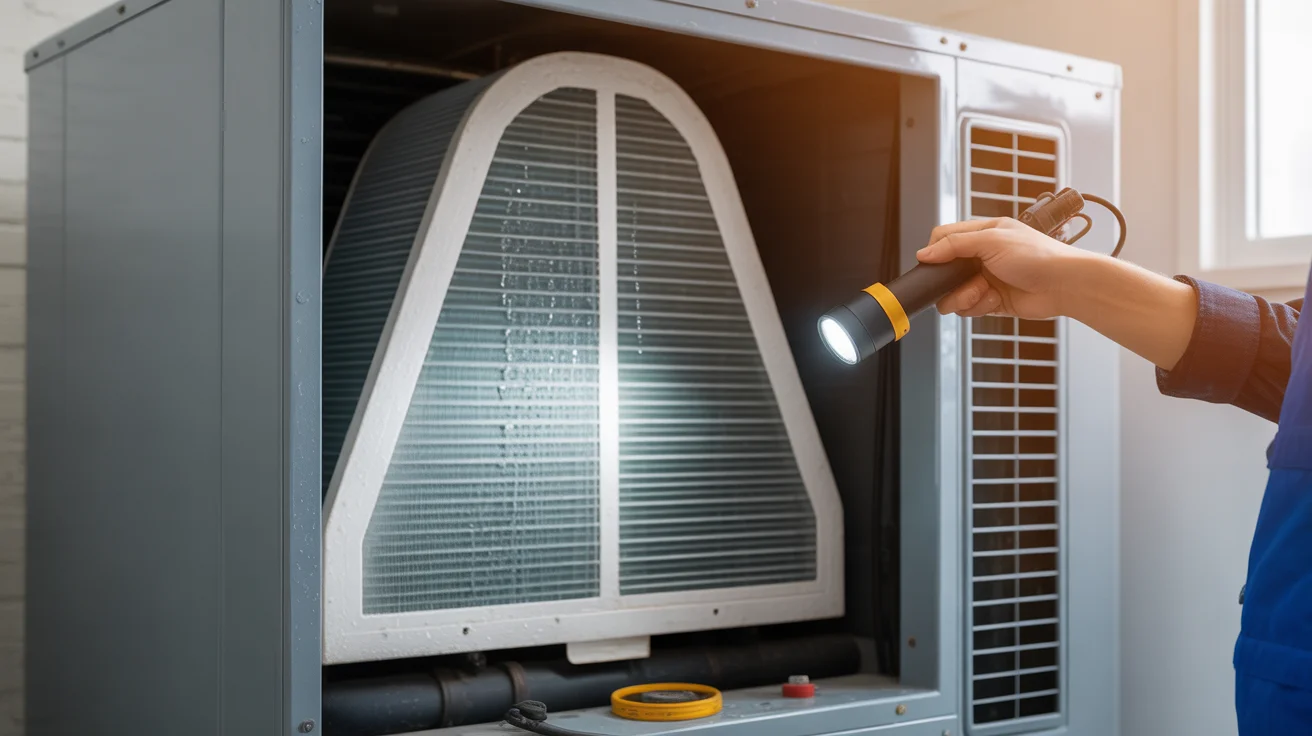
Every time your AC kicks on, refrigerant flows through a set of thin copper or aluminum tubes inside your air handler. That’s your evaporator coil. Warm air from your house passes over those tubes, the refrigerant absorbs the heat, and cooler air blows back into your rooms.
Simple concept. But in North Texas, this component takes a beating that most regions never deal with.
Your AC runs roughly 2,400 hours per year here. Compare that to 600 hours in a northern state. That means your evaporator coil handles four times the thermal cycling, four times the moisture exposure, and four times the opportunity for dirt and debris to coat its surface. Add Gulf Coast humidity that regularly pushes above 85% on summer mornings, and you have a recipe for corrosion, buildup, and failures that I deal with every single week across Frisco, Plano, McKinney, and Allen.
The good news: most evaporator coil problems are preventable or affordable to fix if you catch them early.
5 Dirty Evaporator Coil Symptoms You Shouldn’t Ignore
A dirty coil doesn’t fail overnight. It degrades slowly, costing you money every day before it finally causes a breakdown. Here’s what to watch for:
1. Weak or warm airflow from your vents. The dirt acts like insulation on the coil surface. Refrigerant can’t absorb heat efficiently, so the air coming from your vents feels lukewarm instead of cold. If your supply air used to feel icy and now barely feels cool, a dirty coil is the first thing I check.
2. Electric bills climbing with no explanation. A coil coated in grime forces your system to run longer cycles to reach the thermostat setting. I had a Plano customer last summer whose electric bill jumped $90 in one month. The coil hadn’t been cleaned in four years. After a professional cleaning, her next bill dropped back to normal.
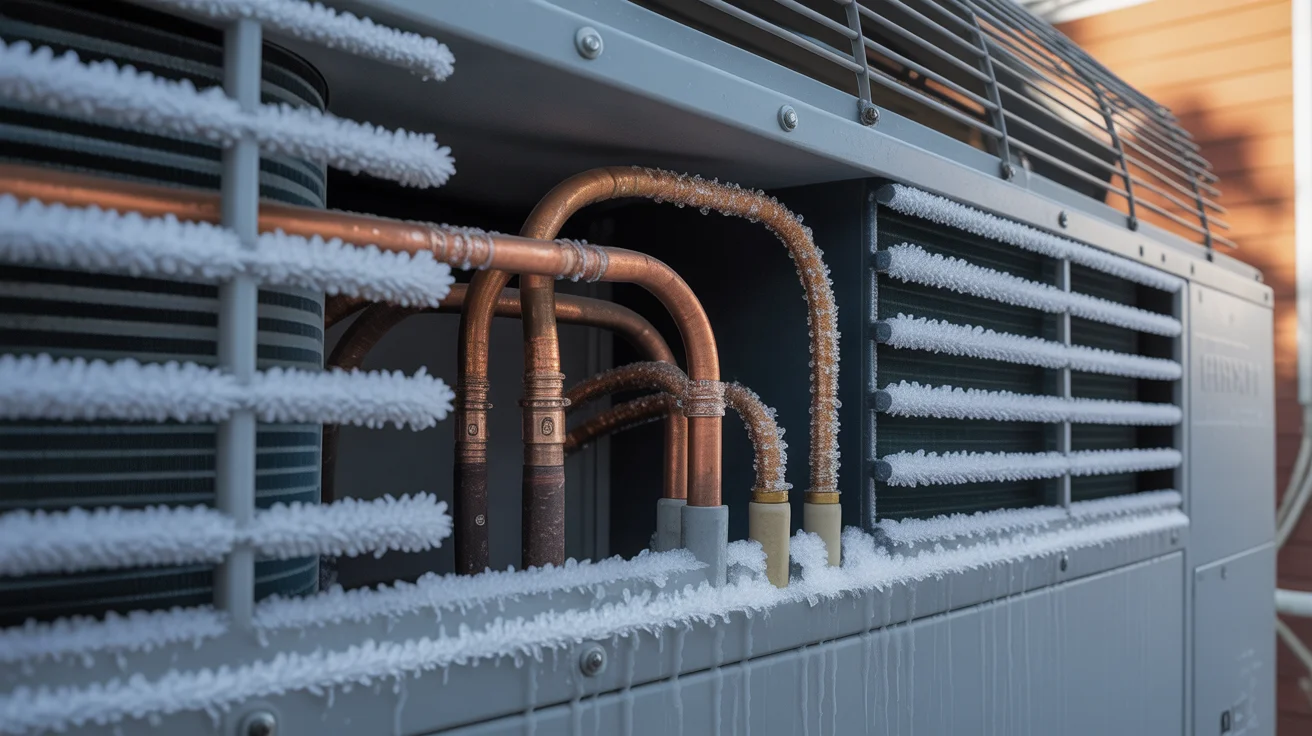
3. Ice forming on refrigerant lines or the coil itself. When dirt restricts heat transfer, the coil temperature drops below freezing and moisture in the air turns to ice. This is the beginning of a frozen evaporator coil situation, and running the system with ice on it can destroy your compressor.
4. Short cycling (system turns on and off rapidly). The system hits high-pressure safety limits because it can’t transfer heat properly. It shuts down, pressure drops, it restarts, and the cycle repeats every few minutes.
5. Musty or stale smell from your vents. A damp, dirty coil is a breeding ground for mold and bacteria. If your house smells musty when the AC runs, the coil is almost always the source.
If you’re noticing two or more of these dirty evaporator coil symptoms at the same time, don’t wait. The problem is getting worse every day your system runs.
Evaporator Coil Cleaning: What It Costs and When You Need It
Evaporator coil cleaning is one of the highest-value maintenance items you can invest in. Here’s what it typically costs in North Texas:
| Cleaning Type | Cost Range | What’s Involved |
|---|---|---|
| In-place cleaning | $200-$400 | Spray chemical cleaner on accessible coil surface, rinse, treat drain pan |
| Pull-and-clean (deep clean) | $400-$700 | Remove coil from air handler, soak and clean both sides, inspect for leaks |
| As part of annual tune-up | $150-$250 | Basic coil rinse included in maintenance service |
When do you need it? At minimum, once per year before summer starts. If you have pets, run your system year-round, or live in a home with older ductwork that sheds dust, twice per year is better.
Can you clean it yourself? You can spray down the accessible side of an A-coil with a no-rinse foaming cleaner from the hardware store. That costs about $10-$15 and handles light surface dust. But the backside of the coil (where most of the buildup collects) is impossible to reach without pulling it out. And if you spray too aggressively, you can bend the delicate aluminum fins and make airflow worse.
For anything beyond light surface dust, professional cleaning pays for itself. A clean coil runs 15-20% more efficiently than a dirty one, according to the U.S. Department of Energy. On a system that costs $200-$400 per month to run during a North Texas summer, that efficiency gain covers the cleaning cost in one season.
Evaporator Coil Leak: Why It Happens and What to Do
An evaporator coil leak is the repair I hate giving homeowners bad news about. It’s not cheap, the options aren’t great, and the cause is often invisible until the damage is done.
What Causes Coil Leaks in North Texas
The #1 cause is formicary corrosion. This is a type of microscopic pitting that eats through copper tubing from the outside in. It’s caused by a combination of moisture and volatile organic compounds (VOCs) found in household cleaning products, paint fumes, air fresheners, and adhesives.
North Texas humidity accelerates the process. The coil surface is constantly wet during cooling season because it’s pulling moisture from the air. That moisture mixes with airborne chemicals and slowly corrodes the copper tubes from the inside of your air handler, where you can’t see it happening.
Newer coils made with aluminum tubing resist formicary corrosion better, but they’re more fragile and susceptible to vibration damage.
Leak Repair vs. Replacement
| Option | Cost | When It Makes Sense |
|---|---|---|
| Leak sealant (stop-leak) | $200-$400 | Tiny leak, system under 8 years old, single leak point |
| Braze repair | $500-$1,500 | Accessible leak location, coil in otherwise good condition |
| Coil replacement | $1,000-$3,200 | Multiple leaks, severe corrosion, coil over 10 years old |
Here’s my honest take: if your coil has one small leak and the rest of the coil looks clean and healthy, a braze repair can buy you several more years. But if I find corrosion across multiple tubes or your system is already 10+ years old, patching one leak just means another one shows up in six months.
I always show customers the coil condition before recommending a path. If you’re getting quotes, any reputable AC repair service should be willing to show you photos or let you see the coil yourself.
Evaporator Coil Replacement Cost: Full Breakdown
When cleaning or repair won’t solve the problem, you’re looking at a full evaporator coil replacement. Here’s what it actually costs in North Texas in 2026:
Cost by System Size
| System Size | Coil Only (Under Warranty) | Coil + Labor (No Warranty) |
|---|---|---|
| 2 ton | $600-$1,000 | $1,800-$2,400 |
| 2.5 ton | $700-$1,200 | $2,000-$2,600 |
| 3 ton | $800-$1,400 | $2,200-$2,800 |
| 3.5 ton | $900-$1,600 | $2,400-$3,000 |
| 4-5 ton | $1,000-$2,000 | $2,600-$3,200 |
“Under warranty” means the manufacturer covers the coil itself but you pay for labor, refrigerant, and miscellaneous parts. That labor portion typically runs $600-$1,200 depending on accessibility and refrigerant costs.
What Drives the Price Up
Refrigerant type matters. Systems using R-410A (most units installed after 2010) have lower refrigerant costs. Older R-22 systems face refrigerant charges of $100-$200 per pound because R-22 has been phased out. A coil replacement on an R-22 system can cost $500-$1,000 more just in refrigerant.
Brand affects parts cost. A Carrier or Lennox replacement coil costs more than a Goodman coil. Premium brands run $800-$1,400 for the part alone. Mid-range brands are $500-$900.
Accessibility is a factor. If your air handler is in a tight attic, a cramped closet, or a hard-to-reach basement corner, labor time increases. Attic replacements in North Texas summers are brutal work, and the time it takes is real.
When to Replace the Coil vs. Replace the Whole System
This is the critical decision. Here’s the framework I use with customers:
- Coil replacement makes sense if your system is under 10 years old, the compressor and outdoor unit are healthy, and this is the first major repair.
- Full system replacement makes sense if your system is 12+ years old, you’ve already spent $1,000+ on repairs in the last two years, or you’re still running R-22 refrigerant.
The math is straightforward. If a new coil costs $2,500 and your system has maybe three good years left, that’s $833 per year for a declining asset. A new system at $8,000-$12,000 with a 15-year lifespan costs $533-$800 per year with better efficiency and a full warranty.
For the full picture on repair costs and the repair-vs-replace decision, see our AC repair cost guide for North Texas.
Frozen Evaporator Coil: Causes and What to Do Right Now
A frozen evaporator coil is one of the most common emergency calls I get from May through September. Ice on your coil or refrigerant lines means something is seriously wrong, and running the system with ice on it risks destroying your compressor ($1,500-$3,000 to replace).
The Three Causes I See Most Often
Restricted airflow (60% of cases). A clogged air filter is the usual culprit. When not enough warm air passes over the coil, the refrigerant temperature drops below 32 degrees and moisture freezes on the coil surface. This is a $5 filter fix that prevents a $3,000 problem.
Low refrigerant from a leak (30% of cases). When refrigerant levels drop, pressure inside the coil drops, and the remaining refrigerant gets too cold. The coil freezes even with normal airflow. This one always means there’s a leak somewhere that needs to be found and fixed.
Dirty evaporator coil (10% of cases). Same principle as the filter issue. The dirt insulates the coil, prevents heat absorption, and the coil temperature drops below freezing. A professional cleaning solves it.
Immediate Steps
- Turn the system OFF at the thermostat.
- Switch the fan setting to ON (not AUTO) to blow warm air across the coil and thaw the ice.
- Check your air filter. Replace it if it looks dirty.
- Wait 2-4 hours for the ice to fully melt. Don’t chip it off or pour water on it.
- Turn the system back on. If it freezes again within 24 hours, call a pro.
For a deeper breakdown of all the causes and fixes, read our full guide on why your AC is freezing up.
How to Prevent Evaporator Coil Problems
Most coil issues are preventable with basic maintenance. Here’s what actually makes a difference:
Change your air filter every 30-60 days during cooling season. This is the single most important thing you can do for your AC system. A $5 filter protects a $2,500 coil. Set a phone reminder.
Schedule annual maintenance before summer. A professional tune-up includes coil inspection, cleaning, and refrigerant level checks. Catching a small leak or light buildup in April is a fraction of the cost of an emergency replacement in July. Our AC maintenance service covers all of this.
Consider a UV light for the coil. A UV-C germicidal light installed near the evaporator coil kills mold and bacteria before they can build up on the surface. It costs $300-$600 installed and keeps the coil cleaner between professional cleanings. For homes with allergy concerns or high humidity, it’s one of the best upgrades you can make.
Keep your return vents unblocked. Furniture, rugs, and curtains covering return air vents restrict airflow to the coil, just like a dirty filter. Walk through your house and make sure every return vent has at least 6 inches of clearance.
Frequently Asked Questions
How often should an evaporator coil be cleaned?
At minimum, once per year as part of a pre-summer tune-up. Homes with pets, smokers, or older ductwork benefit from cleaning twice per year. A clean coil runs 15-20% more efficiently than a dirty one, so the cleaning pays for itself in lower energy bills.
Can I clean my evaporator coil myself?
You can spray the accessible side with a no-rinse foaming cleaner ($10-$15 at any hardware store). But the back side of the coil, where most buildup collects, requires removing the coil from the air handler. That’s a job for a professional with the right tools and EPA certification to handle refrigerant.
How do I know if my evaporator coil is leaking?
The most obvious sign is your AC losing cooling power gradually over weeks, even with a clean filter. You might also hear a hissing sound near the indoor unit or notice the system freezing up repeatedly. A professional leak detection test using electronic sensors or UV dye confirms the exact location. Refrigerant leaks don’t fix themselves and get worse over time.
Is it worth replacing just the evaporator coil or should I replace the whole AC?
If your system is under 10 years old, the outdoor unit is healthy, and the coil is the only problem, replacement makes financial sense. If your system is 12+ years old or uses R-22 refrigerant, the coil replacement cost is often better applied toward a new system with a full warranty and higher efficiency.
How long does an evaporator coil last?
Most evaporator coils last 10-15 years. In North Texas, the combination of extreme heat, high humidity, and heavy use tends to push coils toward the lower end of that range. Annual maintenance and regular filter changes are the two things that extend coil life the most.
Need help with your evaporator coil? Whether it’s a cleaning, leak diagnosis, or full replacement, Jupitair HVAC provides honest pricing and same-day service across Frisco, Plano, McKinney, Allen, Prosper, The Colony, Little Elm, and Addison. Call (940) 390-5676 for a fast, no-pressure diagnosis.
Jupitair HVAC - Your Local North Texas AC Experts. Licensed, Bonded & Insured. Serving the DFW suburbs since 2008.
Last Updated: March 2026
Sources & References
- U.S. Department of Energy - Maintaining Your Air Conditioner - Coil maintenance and efficiency data
- EPA Section 608 - Refrigerant Regulations - Refrigerant handling requirements
- ENERGY STAR - Heating and Cooling - Efficiency standards and maintenance guidelines
- Trane - Frozen Evaporator Coil Causes - Manufacturer technical reference
Need Professional HVAC Service?
Our certified technicians are ready to help with any HVAC needs in North Texas