Why Is My AC Freezing Up? 6 Causes and What to Do About Each One
Your AC is freezing up and you need answers. Here are the 6 real causes of a frozen AC unit, what you can fix yourself, and when to call a pro. Real costs and North Texas specific advice.
- It’s 100 Degrees and Your AC Has Ice on It. That Makes No Sense.
- How Your AC Makes Ice (the 30-Second Science Version)
- 1. Dirty Air Filter (The #1 Cause, and the Cheapest Fix)
- 2. Low Refrigerant (Usually Means a Leak)
- 3. Dirty Evaporator Coil
- 4. Blower Motor Problems
- 5. Thermostat Issues
- 6. Running the AC When It’s Too Cool Outside
+ 5 more sections below...
- It’s 100 Degrees and Your AC Has Ice on It. That Makes No Sense.
- How Your AC Makes Ice (the 30-Second Science Version)
- 1. Dirty Air Filter (The #1 Cause, and the Cheapest Fix)
- 2. Low Refrigerant (Usually Means a Leak)
- 3. Dirty Evaporator Coil
- 4. Blower Motor Problems
- 5. Thermostat Issues
- 6. Running the AC When It’s Too Cool Outside
+ 5 more sections below...
Quick Answer: If your AC is freezing up, turn the system OFF at the thermostat immediately, then switch the fan to ON to help thaw the ice. The most common cause is a dirty air filter restricting airflow (a $5 fix). Other causes include low refrigerant from a leak ($400-$1,200 to fix), a failing blower motor ($300-$800), or a dirty evaporator coil ($200-$500 to clean). Do not keep running a frozen AC. That’s how a $200 problem becomes a $3,000 compressor replacement.
Need emergency help RIGHT NOW? Skip the causes and go straight to our frozen coil emergency steps for the step-by-step shutdown and thaw procedure.
It’s 100 Degrees and Your AC Has Ice on It. That Makes No Sense.
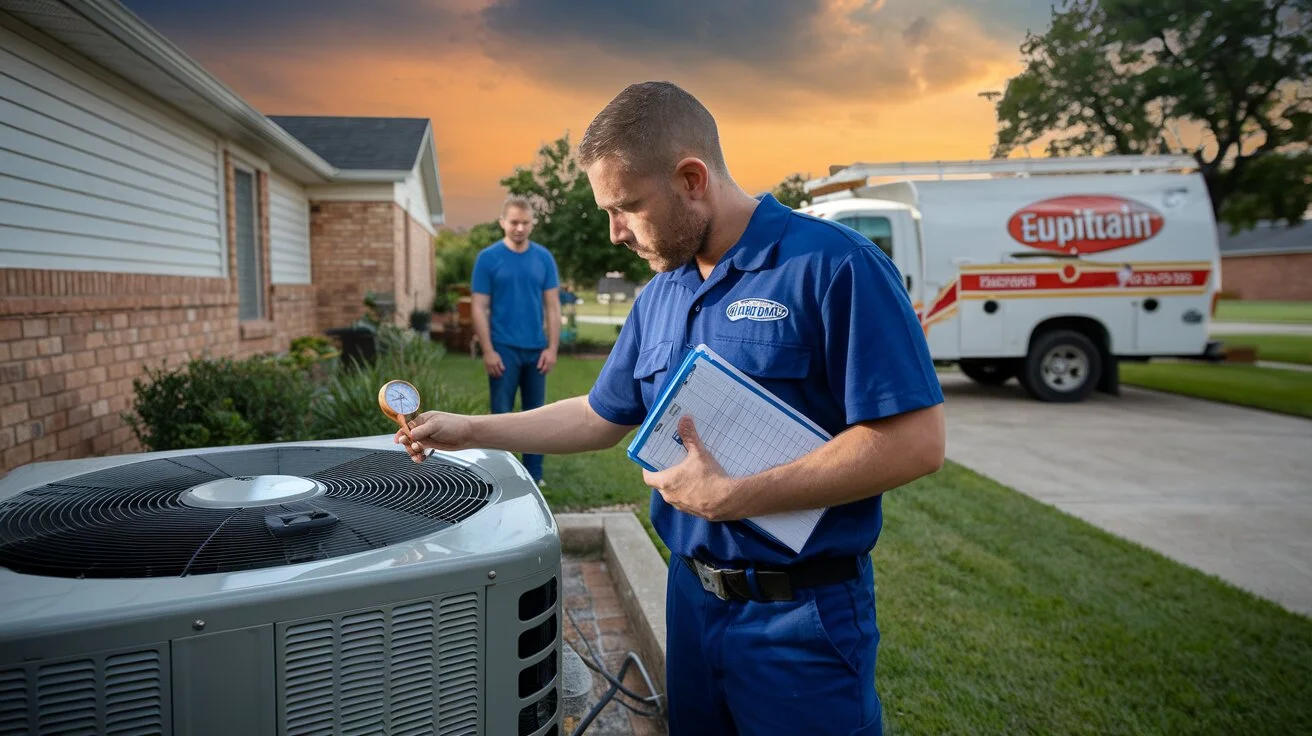
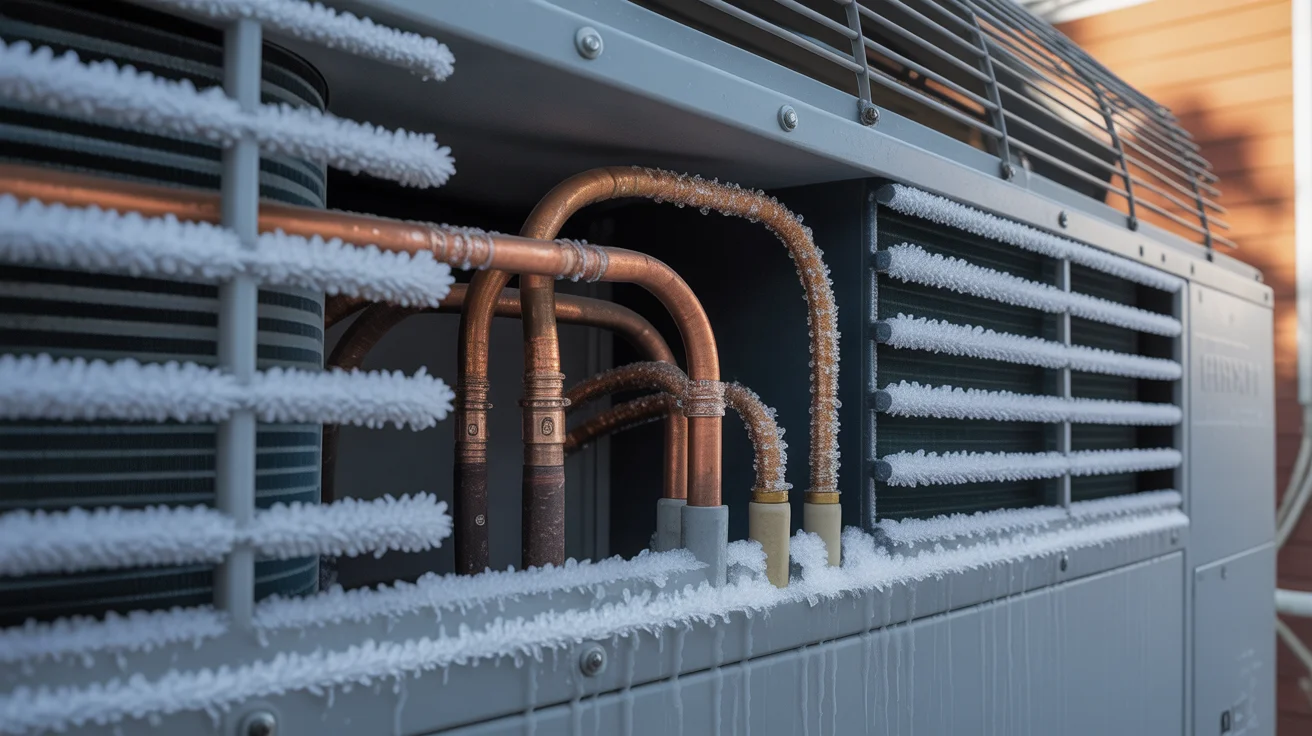
I get this call at least twice a week during North Texas summers. A homeowner looks at their AC unit and sees ice forming on the copper lines, the indoor coil, or even the outdoor unit itself. Their first reaction is always the same: “How is my AC freezing when it’s 107 outside?”
It sounds backwards, but an ac freezing up is actually one of the most common problems I deal with in Frisco, Plano, and McKinney. And the frustrating part is that it usually starts as a cheap, simple fix. The problem is that most people don’t catch it early enough.
Here’s what’s actually happening inside your system, the six causes I see most often, and exactly what each one costs to fix.
How Your AC Makes Ice (the 30-Second Science Version)
Your air conditioner works by pushing warm indoor air across a cold evaporator coil filled with refrigerant. The refrigerant absorbs heat from the air, the air comes out cool, and the cycle repeats.
The system is designed so the coil stays cold but never reaches freezing. That balance depends on two things:
- Enough warm air flowing across the coil to keep it above 32 degrees
- The right amount of refrigerant at the correct pressure
When either of those conditions breaks down, the coil temperature drops below freezing. Moisture from the air condenses on the coil and turns to ice. More ice blocks more airflow. Less airflow drops the temperature further. It’s a snowball effect (literally) that gets worse by the minute.
That’s why a frozen AC never fixes itself. Once ice starts forming, it accelerates until you shut the system off.
1. Dirty Air Filter (The #1 Cause, and the Cheapest Fix)
I’d estimate 70% of the frozen AC calls I respond to in North Texas come down to a clogged air filter. It’s almost embarrassing how often this is the answer.
A dirty filter chokes airflow across the evaporator coil. Less air means less heat transfer. The coil gets too cold. Ice forms.
How to check: Pull your filter out and hold it up to a light. If you can’t see light through it, that’s your problem.
The fix: Replace the filter. A standard 1-inch pleated filter costs $5-$12 at Home Depot or Lowe’s. If you have a 4-inch media filter, those run $20-$40.
North Texas timing: During summer, I tell my customers to check their filter every 30 days. Our dust, pollen, and construction debris (especially in Frisco and Prosper where new homes are going up constantly) clog filters faster than the manufacturer’s “90-day” recommendation suggests. I’ve pulled filters that were solid brown after 3 weeks in July.
After replacing the filter: Turn the system off, set the fan to ON, and let it thaw for 2-4 hours before restarting. If the AC freezes up again with a clean filter, you have a different problem.
2. Low Refrigerant (Usually Means a Leak)
This is the second most common cause and the one that costs real money. When your system is low on refrigerant, the pressure inside the evaporator coil drops. Lower pressure means lower temperature. The coil gets cold enough to freeze.
Signs of a refrigerant leak:
- Ice on the refrigerant lines (the copper pipes running to your outdoor unit)
- Hissing or bubbling sounds near the indoor unit
- The system runs constantly but barely cools
- Your electric bill has been climbing for no obvious reason
What this costs: Leak detection, repair, and a refrigerant recharge typically runs $400-$1,200 depending on where the leak is and how much refrigerant you need. R-410A refrigerant prices have been climbing, so expect the higher end of that range in 2026.
The bigger risk: If the leak is in the evaporator coil itself, you’re looking at a coil replacement. That’s $800-$2,000 installed, depending on the coil size and your system type. I wrote a full breakdown in my AC repair cost guide for North Texas.
Can you DIY this? No. Refrigerant work requires EPA certification. Anyone who adds refrigerant without finding and fixing the leak first is just wasting your money. The system will freeze up again in a few weeks.
3. Dirty Evaporator Coil
Even with regular filter changes, dust and grime build up on the evaporator coil over time. That layer of crud acts like insulation, preventing the warm air from making proper contact with the coil surface.
The result is the same as a dirty filter: not enough heat transfer, coil drops below freezing, ice forms.
How to spot it: You usually can’t see the evaporator coil without removing panels on your air handler. But if your filter has been clean and your AC is still freezing, a dirty coil is a strong possibility. This is especially common in homes that went years without regular AC maintenance.
What this costs: A professional coil cleaning runs $200-$500. I use a commercial-grade foam cleaner and rinse, which takes about 45 minutes. Some companies charge separately for the access panel removal, so ask upfront.
How often it’s needed: In North Texas, I recommend a coil cleaning as part of your annual tune-up. Every spring, before the summer rush. Systems that skip maintenance for 3+ years almost always have coil buildup issues.
4. Blower Motor Problems
The blower motor is the fan inside your air handler that pushes air across the evaporator coil. If it’s failing, running slow, or has a bad capacitor, airflow drops. You know where this is going.
Signs of a blower motor issue:
- Weak airflow from your vents (even with a clean filter)
- The indoor unit makes a humming sound but barely moves air
- The blower runs intermittently, turning on and off
- A burning smell from the air handler (this means stop the system immediately)
What this costs: A blower motor capacitor replacement is $150-$300. A new blower motor installed runs $300-$800 depending on whether it’s a standard or variable-speed motor. Variable-speed motors (common in newer Carrier, Trane, and Lennox systems) are at the higher end.
North Texas factor: Blower motors in our area work harder than almost anywhere else in the country. Your system runs 2,400+ hours per year here compared to 600 hours in a place like Portland. Components rated for 10-year lifespans regularly fail after 5-7 years in the DFW heat.
5. Thermostat Issues
A malfunctioning thermostat can cause the compressor to run longer than it should or prevent the system from cycling off. When the compressor runs nonstop, the evaporator coil gets progressively colder until it freezes.
Common thermostat problems that cause freezing:
- Set too low (below 68 degrees in cooling mode puts extra strain on the system)
- Faulty temperature sensor reading the room as warmer than it actually is
- Wiring issues causing the compressor to run continuously
- Dead batteries in wireless thermostats causing erratic behavior
Quick test: Set your thermostat to 75 degrees. If the system runs for more than 20 minutes straight without the compressor cycling off, something is wrong.
What this costs: Thermostat replacement runs $150-$400 for the part and installation. If it’s just a calibration or wiring issue, that’s typically covered under a standard service call ($89-$149).
One thing I see a lot: Homeowners in Plano and Allen set their thermostat to 65 during a heat wave, thinking it’ll cool the house faster. It won’t. Your AC cools at the same rate regardless of the setpoint. All you’re doing is forcing the system to run continuously, which is exactly how you end up with an ac coil frozen solid.
6. Running the AC When It’s Too Cool Outside
This one surprises people. If outdoor temperatures drop below 60 degrees and you’re running your AC (common during North Texas spring nights when days hit 85 but nights drop to 55), the system can freeze up.
The refrigerant needs outdoor heat to complete the cooling cycle. When there’s not enough heat outdoors, the pressure balance shifts and the evaporator coil gets too cold.
The fix: Don’t run your AC when it’s below 60 degrees outside. Open your windows instead. If your system has a low-ambient kit installed, it can handle cooler outdoor temperatures, but most residential units in North Texas don’t come with one.
This is mostly a spring and fall issue. During summer when overnight lows stay above 75, this cause is off the table.
What to Do Right Now If Your AC Is Frozen
If you’re reading this because your AC has ice on it right now, here’s your step-by-step plan:
Step 1: Turn the thermostat to OFF. Not to a higher temperature. OFF.
Step 2: Switch the fan setting to ON. This circulates warm air across the frozen coil and speeds up thawing. Leave it running.
Step 3: Do NOT chip or scrape the ice. I know it’s tempting. But those coil fins are delicate aluminum, and poking at the ice can puncture a refrigerant line. That turns a $200 problem into a $1,500 problem.
Step 4: Check your air filter while you wait. If it’s dirty, replace it now.
Step 5: Wait 2-4 hours for complete thawing. Put some towels around the base of your air handler because melting ice means water.
Step 6: Restart the system. Turn it back to COOL and set it to 74-76 degrees. Monitor it for the next hour.
Step 7: If it freezes again, call a pro. A repeat freeze means it’s not a filter issue. You likely have a refrigerant leak, a blower problem, or a dirty coil that needs professional attention.
For the full emergency procedure with photos, check out my frozen AC emergency steps guide.
The Real Cost of Ignoring a Frozen AC
The worst thing you can do is keep running a frozen system. I’ve seen homeowners ignore the ice, thinking it’ll sort itself out. It won’t. And here’s what happens:
Compressor damage. Liquid refrigerant that should be gas gets pulled back into the compressor. Compressors are designed to compress gas, not liquid. The result is called “liquid slugging,” and it destroys the compressor’s internal valves. A compressor replacement costs $1,500-$3,200 installed.
Water damage. When that ice finally melts, you get a massive water dump. I’ve seen ceilings ruined and mold start growing within 48 hours in North Texas humidity.
Higher electric bills. A frozen AC runs constantly but produces zero cooling. I’ve seen customers with $400+ electric bills from a system that was frozen for a week.
The sooner you deal with a frozen AC, the less it costs. A $5 filter change today prevents a $3,000 compressor replacement next month.
When to Fix It Yourself vs. Call a Professional
| Problem | DIY? | Cost If DIY | Cost If Pro |
|---|---|---|---|
| Dirty air filter | Yes | $5-$40 | N/A |
| Blocked vents | Yes | $0 | N/A |
| Thermostat set too low | Yes | $0 | N/A |
| Running AC below 60°F outside | Yes | $0 | N/A |
| Dirty evaporator coil | No | N/A | $200-$500 |
| Low refrigerant / leak | No | N/A | $400-$1,200 |
| Blower motor failure | No | N/A | $300-$800 |
| Bad blower capacitor | No | N/A | $150-$300 |
| Evaporator coil replacement | No | N/A | $800-$2,000 |
| Compressor damage from ice | No | N/A | $1,500-$3,200 |
My honest advice: Start with the filter. If that doesn’t fix it after a full thaw cycle, call for a professional diagnosis. Most of the time, the issue is one of the six causes above and a good tech can identify it within 15 minutes.
Need help? Call (940) 390-5676 for same-day AC repair service throughout Frisco, Plano, McKinney, Allen, Prosper, The Colony, Little Elm, and Addison.
How to Prevent Your AC From Freezing Up
Prevention costs pennies compared to the repair. Here’s what I tell every customer:
Change your filter on schedule. Every 30 days during summer in North Texas. Set a phone reminder. Buy a 4-pack so you always have one ready.
Schedule annual maintenance. A spring tune-up catches dirty coils, low refrigerant, and weak blower motors before they cause a freeze. Our AC maintenance service includes a full inspection and coil cleaning.
Keep vents open and unblocked. I visit homes where furniture is pushed against return vents, closing off 30-40% of the system’s airflow. Every blocked vent increases freeze risk.
Don’t set the thermostat below 70 in cooling mode. The lower you go, the harder the system works and the closer the coil gets to freezing temperature.
Watch for warning signs. Gradually weakening airflow, higher electric bills, or the system running longer than usual are early signals that something is off. Catching a problem early means a $150 fix instead of a $1,500 fix.
FAQ
Why does my AC freeze up only at night?
Two likely causes: outdoor temperatures dropping below 60 degrees (common in North Texas spring and fall), or a slow refrigerant leak that only shows up after the system has been running for hours straight.
Can a frozen AC damage my compressor?
Yes. When ice forms on the evaporator coil, liquid refrigerant can flow back to the compressor instead of gas. Compressors are designed to compress gas, not liquid. This “liquid slugging” cracks internal valves and destroys the compressor, costing $1,500-$3,200 to replace.
How long does it take for a frozen AC to thaw?
With the system off and the fan set to ON, most systems thaw in 2-4 hours. Heavily frozen systems can take 6-8 hours. Do not use a hair dryer or heat gun to speed things up. Uneven heating can damage the coil.
Will adding refrigerant fix a frozen AC?
Only if low refrigerant was the cause, and only if the leak gets repaired first. Adding refrigerant without fixing the leak is like putting air in a tire with a nail in it. Any tech who just tops off and leaves without checking for a leak is not doing the job right.
My AC freezes up every summer. Is my system too small?
Possibly. An undersized system runs constantly in extreme heat, which can push the evaporator coil below freezing. Rule out the simpler causes first (filter, refrigerant, coil condition). If those all check out, a Manual J load calculation can determine whether your unit is properly sized. Undersized systems are common in North Texas, especially in homes built after 2010 where builders installed the minimum-spec unit.
Is ice on the outside AC unit normal?
No. Ice anywhere on your AC system is a problem. Light condensation on refrigerant lines on a humid day is normal, but actual frost or ice formation means the system needs attention. Shut it down and start the thawing process.
AC freezing up and need help fast? Call (940) 390-5676 for same-day service across North Texas. I’ll diagnose the cause, give you an honest price, and get your cooling back. No upsells, no runaround.
Gary Musaraj, Owner & EPA-Certified HVAC Professional, Jupitair HVAC. Serving Frisco, Plano, McKinney, Allen, Prosper, The Colony, Little Elm, and Addison since 2008.
Need Professional HVAC Service?
Our certified technicians are ready to help with any HVAC needs in North Texas