
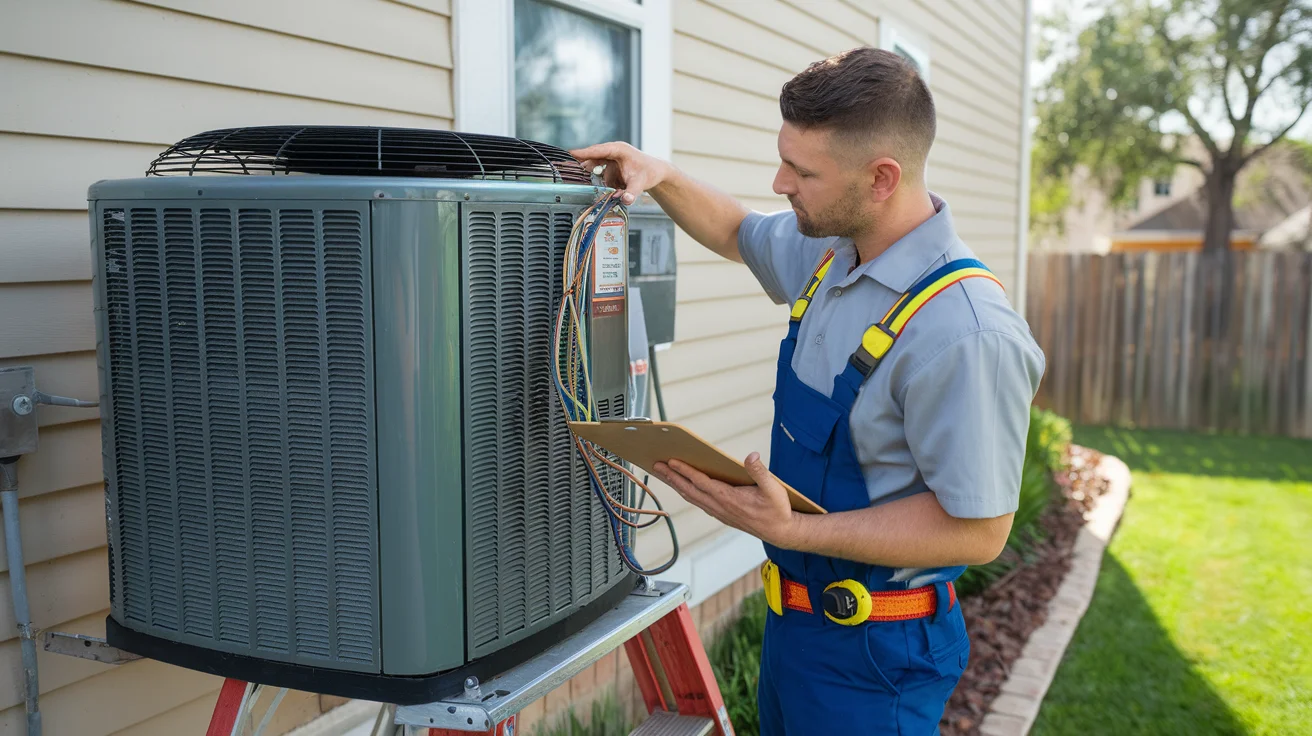
When to Repair vs Replace Your AC: Texas Decision Guide
A 10-year-old air conditioner in North Texas has experienced wear equivalent to a 13-15-year-old system in moderate climates. Use this data-driven framework to make the right repair or replacement decision.
Dallas-Fort Worth's 2,756 cooling degree days—2.3 times the national average—means North Texas AC systems run seven months per year instead of four. This extended operation accelerates every form of equipment degradation: compressor wear, refrigerant leaks, coil corrosion, and efficiency loss.
The optimal repair-versus-replace decision hinges on three quantifiable factors: current repair cost relative to system age, cumulative efficiency degradation, and remaining useful life probability. For North Texas homeowners, the math often favors replacement earlier than national guidelines suggest.
Repair Costs by Component
Understanding typical repair costs provides the foundation for replacement calculations. The following data reflects 2025-2026 DFW market rates.
Major Component Repairs
| Component | Parts Only | Total with Labor | Notes |
|---|---|---|---|
| Compressor | $400-$1,500 | $1,350-$3,000 | Most expensive; often triggers replacement |
| Evaporator coil | $630-$1,700 | $1,000-$3,700 | Varies by size and refrigerant |
| Condenser coil | $700-$2,000 | $1,200-$4,200 | High-SEER units cost more |
| Blower motor (variable) | $500-$1,200 | $1,000-$2,300 | ECM motors cost 2x standard |
| Blower motor (standard) | $200-$500 | $500-$1,000 | PSC motors more affordable |
| Condenser fan motor | $100-$400 | $400-$1,200 | Common failure point |
| TXV (expansion valve) | $150-$400 | $400-$900 | Requires refrigerant recovery |
Minor Component Repairs
Texas Labor Rates
North Texas HVAC technician wages average $27-31/hour (Bureau of Labor Statistics). Consumer-facing service rates:
Source: HomeAdvisor/Angi DFW market data, January 2026
Industry Decision Rules
Two primary formulas guide professional replacement recommendations across the HVAC industry.
The $5,000 Rule
Multiply system age by repair cost. If the result exceeds $5,000, replacement becomes the financially sound choice:
| System Age | Repair Cost | Calculation | Decision |
|---|---|---|---|
| 6 years | $700 | 6 × $700 = $4,200 | Repair acceptable |
| 8 years | $500 | 8 × $500 = $4,000 | Repair acceptable |
| 8 years | $800 | 8 × $800 = $6,400 | Replace |
| 10 years | $500 | 10 × $500 = $5,000 | Borderline |
| 10 years | $600 | 10 × $600 = $6,000 | Replace |
| 12 years | $400 | 12 × $400 = $4,800 | Borderline |
| 12 years | $500 | 12 × $500 = $6,000 | Replace |
| 15 years | $350 | 15 × $350 = $5,250 | Replace |
The 50% Rule
If repair cost exceeds 50% of a new system's value AND the unit is past mid-life, replacement is recommended.
Example calculation:
- New system cost: $10,000
- 50% threshold: $5,000
- System age: 9 years (past mid-life of 7-8 years)
- Proposed repair: $4,500
Decision: At $4,500, the repair is below threshold but close. Combined with being past mid-life, replacement should be seriously considered.
ENERGY STAR Guidance
"If your heat pump or air conditioner is more than 10 years old, consider replacing it with a unit that has earned the ENERGY STAR label. Installed correctly, these high-efficiency units can save up to 20 percent on heating and cooling costs."
ENERGY STAR further recommends: "If either your heating or central air unit is over 15 years old and one needs replacement, replace both at the same time."
Automatic Replacement Triggers
Certain situations warrant replacement regardless of system age:
System uses R-22 refrigerant
Repair costs will only increase; R-22 production banned
Refrigerant leak on out-of-warranty coil
Leak-and-recharge cycle is expensive and recurring
Compressor failure on system 8+ years old
Major expense on equipment with limited remaining life
Cumulative repairs exceeding $500/year
Pattern indicates systemic decline
Multiple repairs within 24 months
Equipment entering failure cascade
Texas AC Systems Fail Sooner Than National Averages
ASHRAE establishes the national median lifespan for residential split AC systems at 15 years. However, Texas systems experience accelerated wear due to extended cooling seasons and extreme operating conditions.
Lifespan Comparison by Climate
| Climate | Expected AC Lifespan | Annual Operating Hours |
|---|---|---|
| Mild (Pacific Northwest) | 18-25 years | ~400 hours |
| Moderate (Midwest) | 15-20 years | ~1,200 hours |
| National Average | 15-20 years | ~1,200 hours |
| Hot-humid (Texas) | 10-15 years | ~2,300 hours |
| Extreme (Arizona) | 12-15 years | ~2,000 hours |
Source: ASHRAE Equipment Life Expectancy data, HVAC.com Texas lifespan analysis
Why Texas Systems Fail Earlier
Extended Operating Season
North Texas AC systems run April through October—seven months of continuous or near-continuous operation versus four months in moderate climates.
Extreme Temperature Exposure
Dallas-Fort Worth averages 17-20 days above 100°F annually. Recent years exceeded this: 55 days in 2023, 47 days in 2022, 71 days in 2011.
Continuous High-Load Operation
During 95°F+ days, systems often run continuously for 12+ hours. This maximum-load operation accelerates compressor wear and component fatigue.
Humidity Stress
North Texas's humid subtropical climate creates additional load on evaporator coils and accelerates corrosion throughout the system.
Age-Equivalent Calculation
A North Texas AC system experiences approximately 1.3-1.5x the wear of the same system in a moderate climate:
| Texas System Age | Equivalent Age (Moderate Climate) |
|---|---|
| 5 years | 6.5-7.5 years |
| 8 years | 10-12 years |
| 10 years | 13-15 years |
| 12 years | 15-18 years |
| 15 years | 19-22 years |
Failure Probability Increases After Year 10
HVAC equipment follows the classic "bathtub curve" reliability pattern, with failure rates accelerating significantly in later years.
Failure Rate by Equipment Age
A Florida Solar Energy Center study tracking 46 homes over 4.5 years documented equipment degradation:
| Age Range | Annual Degradation | Failure Characteristics |
|---|---|---|
| 0-5 years | 3.4% | Mostly installation defects, electrical failures |
| 5-10 years | 8.3% | Refrigerant leaks begin, bearing wear |
| 10-15 years | 6.8% | Major component failures accelerate |
| 15+ years | 12.5% | Cascading failures, compressor burnout |
Key Finding: 26% of systems (12 of 46 units) required complete replacement during the 4.5-year study period, with median replacement occurring at 13.5-14 years of age.
Common Failure Points by Age
| Age Range | Primary Failure Points | % of Service Calls |
|---|---|---|
| 0-5 years | Electrical (contactors, fuses, wiring) | 31% |
| 5-10 years | Refrigerant leaks, blower motor bearings | 28% |
| 10-15 years | Compressor, condenser fan motor | 26% |
| 15+ years | Compressor burnout, cascading failures | 15% |
Compressor Failure: The Replacement Trigger
Compressor failure represents the most expensive and consequential AC repair. Expected lifespan: 10-15 years with proper maintenance.
Percentage of all AC failures
14-16%
Repair cost range
$1,350-$3,000
Preventable failures
Up to 80%
Primary causes
Refrigerant issues, electrical problems, lack of maintenance
When compressor failure occurs on a system older than 8-10 years, replacement typically proves more economical than repair.
R-22 Systems Require Replacement, Not Repair
The EPA completed the R-22 (Freon) production and import ban on January 1, 2020. Any remaining R-22 available comes exclusively from recycled, reclaimed, or stockpiled quantities.
R-22 Phase-Out Timeline
R-22 Cost Impact
R-22 prices have increased over 500% since the phase-out began:
| Refrigerant | Cost Per Pound | Full Recharge Cost |
|---|---|---|
| R-410A | $50-$150/lb | $300-$800 |
| R-22 | $90-$250/lb | $800-$1,500+ |
R-410A Transition Beginning
Under the AIM Act, manufacture and import of R-410A for new residential equipment was prohibited as of January 1, 2025. Existing R-410A systems can continue operating, but refrigerant costs will increase.
New equipment uses lower-GWP refrigerants: R-454B (GWP ~466) and R-32 (GWP ~675) vs. R-410A's GWP of 2,088.
Recommendation
Any R-22 system requiring refrigerant-related repair should be replaced rather than repaired. A single R-22 recharge on a system with a leak often approaches or exceeds the 50% replacement threshold—and the leak will likely recur. The economics only worsen as R-22 supplies continue depleting.
Efficiency Degradation Adds Hidden Costs
Air conditioning efficiency degrades over time, even with regular maintenance. This degradation creates hidden operating costs that factor into replacement decisions.
NREL/DOE Degradation Formula
Where M (maintenance factor) equals:
- 0.01 (1% annual loss) with regular professional maintenance
- 0.03 (3% annual loss) with minimal or no maintenance
Texas DHCA Weatherization Program uses 2% annual degradation. Florida Solar Energy Center research found median annual degradation of 5.2% in intensive cooling climates.
Cumulative Efficiency Loss
Starting from SEER 14 system:
| Equipment Age | Efficiency Loss | Effective SEER |
|---|---|---|
| 5 years | ~20% | 11.2 |
| 8 years | ~32% | 9.5 |
| 10 years | ~40% | 8.4 |
| 12 years | ~48% | 7.3 |
| 15 years | ~60% | 5.6 |
Cost of Running Degraded Equipment
15-year-old, minimally maintained SEER 10 system vs. alternatives (16¢/kWh, 2,200 cooling hours, 3.5-ton system):
| Condition | Annual kWh | Annual Cost |
|---|---|---|
| Original SEER 10 | 9,240 | $1,478 |
| Degraded to SEER 6.3 | 14,667 | $2,347 |
| New SEER 16 system | 5,775 | $924 |
| New SEER 20 system | 4,620 | $739 |
Key Insight: A degraded 15-year-old system consumes 57% more energy than its original rating and 154% more than a modern SEER 16 replacement—that's $1,423/year in excess costs.
ROI Calculations Favor Proactive Replacement
The basic payback formula oversimplifies the decision. Comprehensive analysis must account for avoided repairs, degradation trajectory, incentives, and reliability value.
Payback Calculation Example
Replacing degraded 12-year-old SEER 10 (actual ~SEER 7.5) with new SEER 18:
15-Year Total Cost of Ownership Comparison
Option A: Keep Old System 3 More Years
Option B: Replace Now with SEER 18
15-Year Savings from Proactive Replacement: $14,641
Financing Impact
Financing often makes replacement the superior monthly cash flow decision:
| Scenario | Monthly Cost |
|---|---|
| Keep degraded system (electricity only) | $196 |
| New system financed (60 months, 7.9% APR) + electricity | $220 |
| New system financed (84 months, 8.9% APR) + electricity | $184 |
After financing payoff, monthly costs drop to electricity only ($72), creating long-term savings of $124/month.
Decision Framework Summary
Immediate Replacement Indicators
Replace if ANY ONE of these conditions exists:
R-22 refrigerant system needing refrigerant repair
R-22 costs only increase; repair is temporary
Compressor failure on system 8+ years old
Major expense on limited-life equipment
System Age × Repair Cost exceeds $5,000
Industry-standard replacement threshold
Repair cost exceeds 50% of replacement on mid-life system
Poor ROI on repair investment
Third repair call in 24 months
Equipment entering failure cascade
Strong Replacement Consideration
Consider replacement if TWO OR MORE of these conditions exist:
Repair Likely Appropriate
Repair makes sense when:
System under 8 years old with clean history
Substantial useful life remaining
Minor component failure under $500
Low cost, high remaining value
Equipment still under manufacturer warranty
Reduced repair cost
System properly sized and matched
Good foundation worth maintaining
Strong maintenance documentation
Equipment likely in better condition
Seasonal Timing Considerations
| Season | Advantages | Disadvantages |
|---|---|---|
| Fall/Winter (Oct-Feb) | Better scheduling, potential price flexibility, no emergency pressure | None significant |
| Spring (Mar-May) | Moderate demand, good availability | Rising demand |
| Summer (Jun-Sep) | Immediate need addressed | Peak demand, higher prices, scheduling delays |
The Maintenance Factor
Annual professional maintenance reduces efficiency degradation from 3% to 1% annually and can extend equipment lifespan by 50-100%. A Jones Lang LaSalle study documented 545% ROI on preventive maintenance programs. See our month-by-month maintenance checklist for what to do each season.
Maintenance Impact on Decision Threshold
For a system approaching the repair-or-replace threshold: documented maintenance history suggests slower degradation (supporting repair), while lack of maintenance history suggests faster degradation (supporting replacement).
How We Sourced This Data
Federal Government
- U.S. Department of Energy (energy.gov)
- U.S. Environmental Protection Agency (epa.gov)
- ENERGY STAR (energystar.gov)
- National Renewable Energy Laboratory (nrel.gov)
State Government
- Texas DHCA (tdhca.texas.gov)
Academic Research
- Florida Solar Energy Center, University of Central Florida
Industry
- ASHRAE Equipment Life Expectancy data
- Air Conditioning Contractors of America (ACCA)
- HomeAdvisor/Angi market pricing data
Need Help Deciding?
Our NATE-certified technicians will provide an honest assessment of your system's condition and help you make the right repair or replacement decision.
Serving Frisco, Plano, McKinney, Allen, Prosper, The Colony, Little Elm & Addison