Whole House Dehumidifier: Do You Need One in North Texas?
Find out if a whole house dehumidifier is worth it for your North Texas home. Real signs, costs ($1,800-$3,500), and honest advice from a local HVAC pro.
- 5 Signs Your North Texas Home Needs a Whole House Dehumidifier
- Why Your AC Is Not a Dehumidifier (Even Though It Removes Moisture)
- Whole House Dehumidifier vs. Portable Units: The Real Comparison
- What Installation Actually Looks Like
- The Real Costs: Equipment, Installation, and Long-Term
- Before You Buy: Try These Cheaper Fixes First
- Brands I Install and Recommend
- FAQ
+ 1 more sections below...
- 5 Signs Your North Texas Home Needs a Whole House Dehumidifier
- Why Your AC Is Not a Dehumidifier (Even Though It Removes Moisture)
- Whole House Dehumidifier vs. Portable Units: The Real Comparison
- What Installation Actually Looks Like
- The Real Costs: Equipment, Installation, and Long-Term
- Before You Buy: Try These Cheaper Fixes First
- Brands I Install and Recommend
- FAQ
+ 1 more sections below...
Whole House Dehumidifier: Do You Need One in North Texas?
A McKinney homeowner called me last April, convinced his AC was broken. The house felt clammy and heavy even though the thermostat read 72 degrees. His windows had condensation every morning. He figured the system was dying.
His AC was fine. The problem was humidity. Indoor readings hit 68% in the living room and 74% in the master bedroom. A whole house dehumidifier would have solved it. But here is the thing I want to be honest about: not every North Texas home actually needs one.
I have installed hundreds of these systems across Frisco, Plano, McKinney, and the surrounding cities. Some were game changers. A few were unnecessary. This guide will help you figure out which camp your home falls into before you spend $1,800 to $3,500 on equipment you may not need.
5 Signs Your North Texas Home Needs a Whole House Dehumidifier
Your body notices humidity problems before your brain does. That “something feels off” sensation when you walk inside? That is your skin detecting excess moisture. Here are the specific indicators I look for during home assessments.
Window condensation on mild days. If you see fog or water droplets on the inside of your windows when the outdoor temperature is above 50 degrees, indoor humidity is almost certainly above 60%. This is the number one complaint I hear from Plano and Frisco homeowners between March and June.
Musty smells that cleaning won’t fix. You scrub the bathrooms, clean the carpets, and the smell comes back within days. That is mold or mildew feeding on moisture trapped in walls, carpet pads, or ductwork. Air fresheners are covering up a moisture problem.
Your AC runs constantly but the house still feels sticky. Air conditioning removes some moisture as a byproduct of cooling. But when North Texas humidity spikes above 70% outdoors (and it does, roughly 180 days per year), your AC cannot keep up with both jobs.
Allergies or respiratory issues that worsen indoors. Dust mites thrive above 50% relative humidity. Mold spores multiply rapidly above 60%. If your family’s symptoms get worse at home than outside, indoor air quality may be the culprit.
Peeling paint, warped wood, or bubbling wallpaper. These are late-stage humidity symptoms. If you are seeing physical damage to your home’s finishes, moisture has been too high for months. A hygrometer reading will almost certainly confirm 65%+ indoor humidity.
If three or more of these apply to your home, a dehumidifier for house-wide humidity control is probably worth the investment. One or two symptoms? Start with the cheaper fixes I cover below.
Why Your AC Is Not a Dehumidifier (Even Though It Removes Moisture)
Every AC system pulls some water out of the air. That is how the cooling process works. Warm, humid air passes over cold evaporator coils, moisture condenses, and water drips into a drain pan. You have probably seen the condensate line dripping outside your house on summer afternoons.
So why isn’t that enough?
The timing problem. North Texas humidity is highest in spring and fall, when outdoor temperatures sit between 65 and 80 degrees. Your AC barely runs during those months because it does not need to cool much. Less runtime means less dehumidification. Meanwhile, Gulf moisture pushes indoor humidity above 60% with no defense.
The efficiency problem. When your AC does run in summer, it removes moisture as a side effect of cooling. But it is optimized for temperature, not humidity. Running your AC colder to dry the air costs roughly $40 to $60 more per month in electricity and leaves your house uncomfortably cold.
The cycling problem. Modern variable-speed systems help, but standard single-stage ACs cycle on and off based on temperature. During “off” cycles, humidity rebounds quickly. You end up with a home that bounces between comfortable and clammy all day long.
A whole home dehumidifier operates independently of your AC. It pulls moisture out of the air regardless of temperature, running whenever humidity exceeds your target (usually 45 to 50%). Your AC handles temperature. The dehumidifier handles moisture. Each system does the job it was designed for.
Whole House Dehumidifier vs. Portable Units: The Real Comparison
Portable dehumidifiers are the first thing most people buy. I get it. They are $250 to $500 at Home Depot, no installation needed, and you can plug one in tonight. For a single problem room like a master bathroom or a laundry room, portables work fine.
But for whole-home humidity issues, the math changes fast.
| Factor | Portable Units (3 needed) | Whole House System |
|---|---|---|
| Upfront cost | $750 - $1,500 | $1,800 - $3,500 installed |
| Monthly electric | $40 - $60 | $15 - $25 |
| Maintenance | Empty tanks daily, clean filters weekly | Change filter annually |
| Noise | 50-55 dB each (noticeable) | Silent (installed in utility area) |
| Coverage | One room per unit | Entire home via ductwork |
| Lifespan | 3-5 years | 8-12 years |
| 5-year total cost | ~$4,500 | ~$3,200 |
That last row surprises people. The “cheap” option costs more over time because portables eat electricity, burn out faster, and you need three of them to cover a 2,000+ square foot home. One Allen homeowner I worked with was running four portable units and spending $65 per month in added electricity. His whole-house installation paid for itself in under three years.
The real advantage of a whole home system goes beyond cost, though. It ties into your existing HVAC ductwork and treats every cubic foot of air in your home. No hot spots, no forgotten rooms, no water tanks to dump at 2 AM.
What Installation Actually Looks Like
I want to demystify this because “whole house dehumidifier installation” sounds like a major construction project. It is not. Most installs take 4 to 6 hours and do not require any demolition or structural changes.
Where It Goes
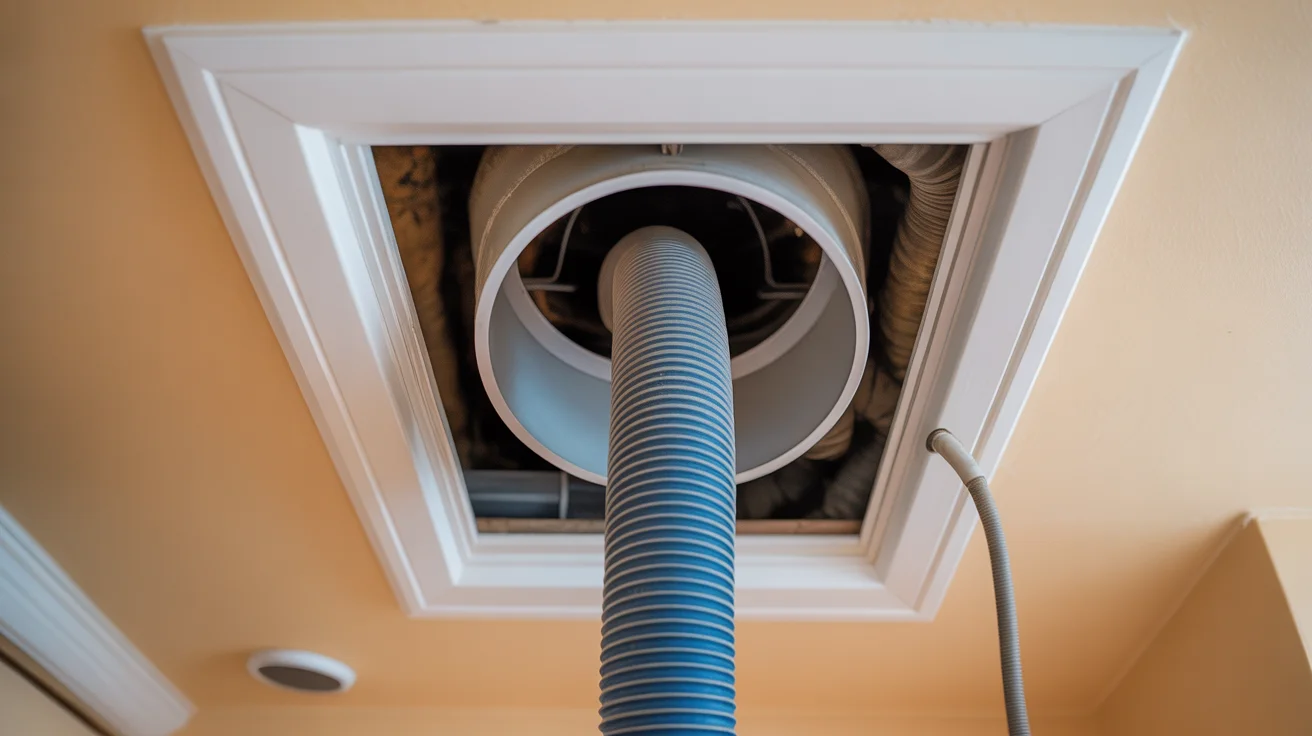
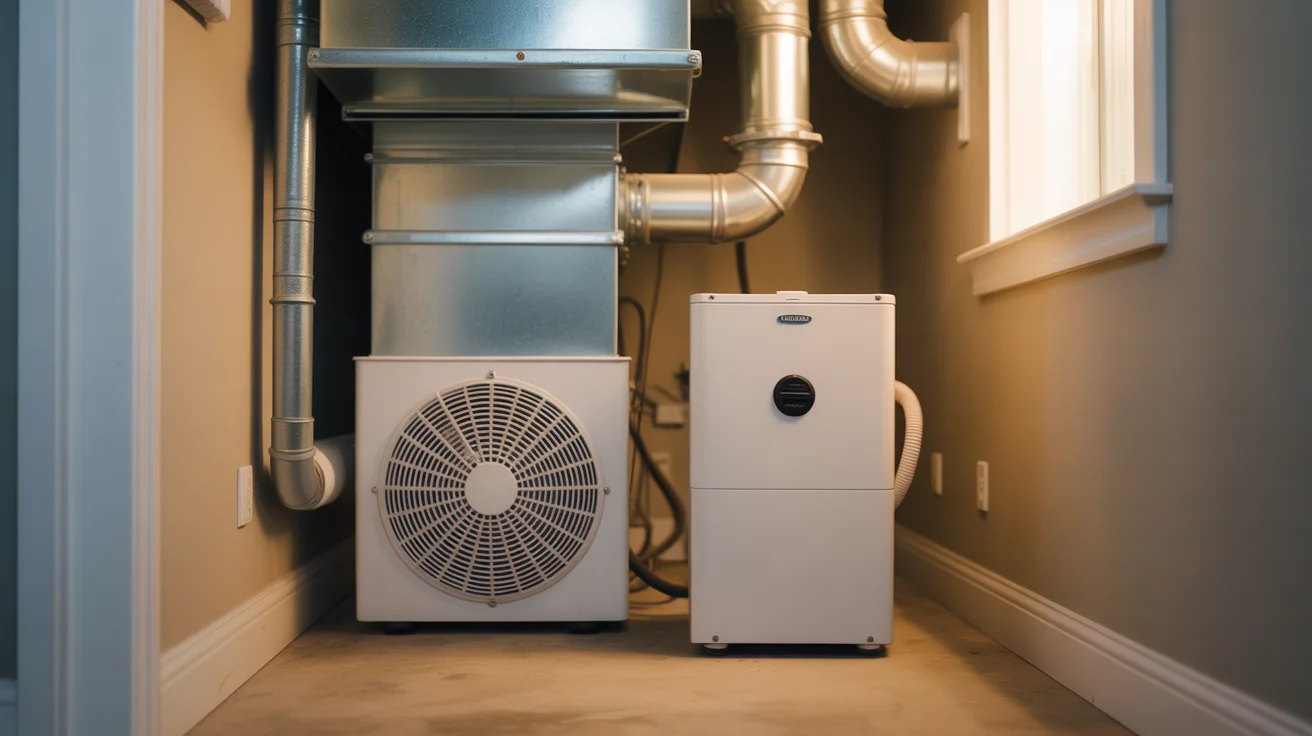
The unit mounts near your existing HVAC system, usually in a utility closet, garage, or attic space. It connects to your supply and return ductwork so it can pull air from the house, remove moisture, and push dry air back through your existing vents.
The Installation Steps
-
Assessment and sizing. I measure your home, check current humidity levels in multiple rooms, and identify moisture sources. (For the sizing math, check my dehumidifier sizing guide where I break down the calculations room by room.)
-
Ductwork connection. The dehumidifier taps into your existing return air duct with a small bypass. This is sheet metal work, not carpentry. No walls come down.
-
Condensate drainage. The unit needs a drain for the water it pulls from the air. If your utility closet already has a condensate drain from your AC (most do), the installation connects to that same line. If not, we run a new drain line to the nearest plumbing access point.
-
Electrical connection. Most whole house dehumidifiers run on a standard 120V outlet. Some larger units (130+ pint capacity) need a dedicated 20-amp circuit.
-
Humidistat setup. A humidity sensor installs in your main living area, usually a hallway or central room. You set your target humidity (I recommend 48% for North Texas homes), and the system manages itself from there.
What Won’t Work
Homes without central ductwork cannot use a ducted whole-house dehumidifier. If you have a ductless mini-split system, standalone dehumidifiers (larger than portable, smaller than whole-house) are the better option. I install those too, and they run $1,200 to $2,000.
The Real Costs: Equipment, Installation, and Long-Term
Transparency matters here. I have seen too many contractors quote a low number for the unit and then surprise homeowners with installation costs. Here is the full picture for North Texas in 2026.
Equipment Cost by Capacity
| Capacity | Best For | Unit Cost | Installed Cost |
|---|---|---|---|
| 70 pints/day | 1,500 - 2,000 sq ft | $800 - $1,200 | $1,800 - $2,400 |
| 90 pints/day | 2,000 - 2,800 sq ft | $1,000 - $1,500 | $2,200 - $2,800 |
| 130 pints/day | 2,800 - 3,500+ sq ft | $1,400 - $2,000 | $2,800 - $3,500 |
These prices include the dehumidifier, ductwork connections, condensate drain, electrical, and humidistat. The range depends on how accessible your ductwork is and whether you need a new drain line or dedicated circuit.
What Affects the Price
Easy installs (utility closet next to HVAC, existing drain, nearby outlet): bottom of the range. This covers about 60% of the homes I work in across Frisco and Plano.
Harder installs (attic unit, long condensate run, new electrical circuit): top of the range. Older homes in Allen and McKinney with original ductwork sometimes fall here.
Operating Costs
A properly sized whole house dehumidifier costs $15 to $25 per month to run during peak humidity season (March through October in North Texas). During winter months, it barely runs at all. Annual electricity cost: roughly $120 to $180. Compare that to running your AC 2 degrees colder all summer ($300 to $500 extra) or maintaining three portable units ($480 to $720 per year).
Before You Buy: Try These Cheaper Fixes First
Not every humidity problem requires a $2,000+ solution. I would rather you try these first and call me if they don’t work.
Check your AC maintenance. A dirty evaporator coil reduces your system’s ability to remove moisture by up to 30%. If you have not had AC maintenance in over a year, start there. A $150 tune-up might solve the problem.
Fix bathroom and kitchen ventilation. Run exhaust fans for 20 minutes after every shower and while cooking. Vented to the attic does not count. Fans must exhaust outside. I find improperly vented exhaust fans in about 40% of the homes I inspect.
Check your crawl space or slab. Ground moisture wicking through concrete is a massive humidity source that no amount of dehumidification will permanently fix. If your slab lacks a vapor barrier, address that first.
Seal duct leaks. Leaky return ducts in unconditioned attic spaces pull in hot, humid air every time your system runs. Duct sealing costs $300 to $600 and often reduces indoor humidity by 5 to 10 percentage points on its own.
Use your thermostat’s fan setting wisely. Running the fan on “ON” instead of “AUTO” recirculates moisture that condensed on the evaporator coil back into your home. Switch to AUTO and see if conditions improve within a few days.
If you have tried all of these and your indoor humidity still sits above 55%, a whole house dehumidifier is the right call.
Brands I Install and Recommend
After 15+ years of installing HVAC dehumidifiers across North Texas, I have settled on three brands that hold up in our climate.
AprilAire is my top recommendation for most homes. The 800 series (95 pints/day) handles 90% of the homes I work in. Reliable, quiet, and the warranty is solid (5 years parts, 1 year labor). AprilAire units integrate cleanly with most furnace and air handler setups.
Honeywell (Resideo) makes the DR series that I install when ductwork access is tight. Compact footprint, good performance, and the controls are straightforward. Slightly lower capacity ceiling than AprilAire, so I reserve these for homes under 2,500 square feet.
Santa Fe is the premium option for homes with extreme moisture loads (pools, basements, high-occupancy households). Higher price point but the Ultra series pulls 155 pints per day and is built like a tank. I recommend Santa Fe when the sizing math (covered in detail in my sizing guide) points to 120+ pints of daily capacity.
FAQ
How long does a whole house dehumidifier last?
Most whole house dehumidifiers last 8 to 12 years with annual filter changes and occasional coil cleaning. The compressor is the component most likely to fail first. In North Texas, where units run 7 to 8 months per year, expect closer to 8 to 10 years of reliable operation.
Will a whole house dehumidifier lower my electric bill?
Not directly, but it often reduces total energy costs. When indoor humidity drops to 48%, your home feels comfortable at 76 degrees instead of 73. That 3-degree thermostat bump saves roughly $15 to $25 per month on cooling, which offsets most or all of the dehumidifier’s operating cost.
Can I install a whole house dehumidifier myself?
Technically yes, if you are comfortable with sheet metal ductwork, condensate plumbing, and electrical connections. Realistically, a bad ductwork connection creates pressure imbalances that reduce your entire HVAC system’s efficiency. I have fixed enough DIY installations to recommend professional installation for this one.
What humidity level should I set it to?
I recommend 48% for most North Texas homes. Below 40% causes dry skin, static electricity, and can crack wood furniture or flooring. Above 55% allows dust mites and mold growth. The 45 to 50% range is the sweet spot where comfort and health overlap.
Does a whole house dehumidifier work in winter?
It can, but most North Texas homes do not need dehumidification in winter. Our winter air is naturally drier, and your heating system further reduces indoor moisture. I set systems to activate only when humidity exceeds the target, which means they go dormant from November through February in most homes.
How noisy is a whole house dehumidifier?
Installed in a utility closet or attic, you will not hear it. The unit itself produces about 45 to 50 dB (similar to a refrigerator), but the closet or attic space absorbs nearly all of that. Nothing like the constant drone of a portable unit sitting in your living room.
The Bottom Line
A whole house dehumidifier is one of the best investments a North Texas homeowner can make, if the home actually needs one. The key word is “if.” Start with the free and cheap fixes. Measure your indoor humidity with a $15 hygrometer from Amazon. If you are consistently above 55% despite good AC maintenance and proper ventilation, dedicated dehumidification is the answer.
The cost ($1,800 to $3,500 installed) pays for itself through lower AC bills, fewer allergy symptoms, and protection against mold damage that costs thousands to remediate. Most of my customers in Frisco, Plano, and McKinney tell me the comfort difference alone was worth it. Their homes finally feel right.
If you want to know what size system your home needs, read my dehumidifier sizing guide for the full breakdown. Or if you just want someone to assess your home and give you a straight answer, call me at (940) 390-5676. I will measure your humidity levels, check your ductwork, and tell you honestly whether you need a whole house dehumidifier or just a $150 tune-up.