
New AC Unit Cost Installed: Real Prices for North Texas (2026)
New AC unit costs $3,800-$12,500 installed in North Texas. Real pricing by size, brand, and home type from a local HVAC installer. No mystery markups.
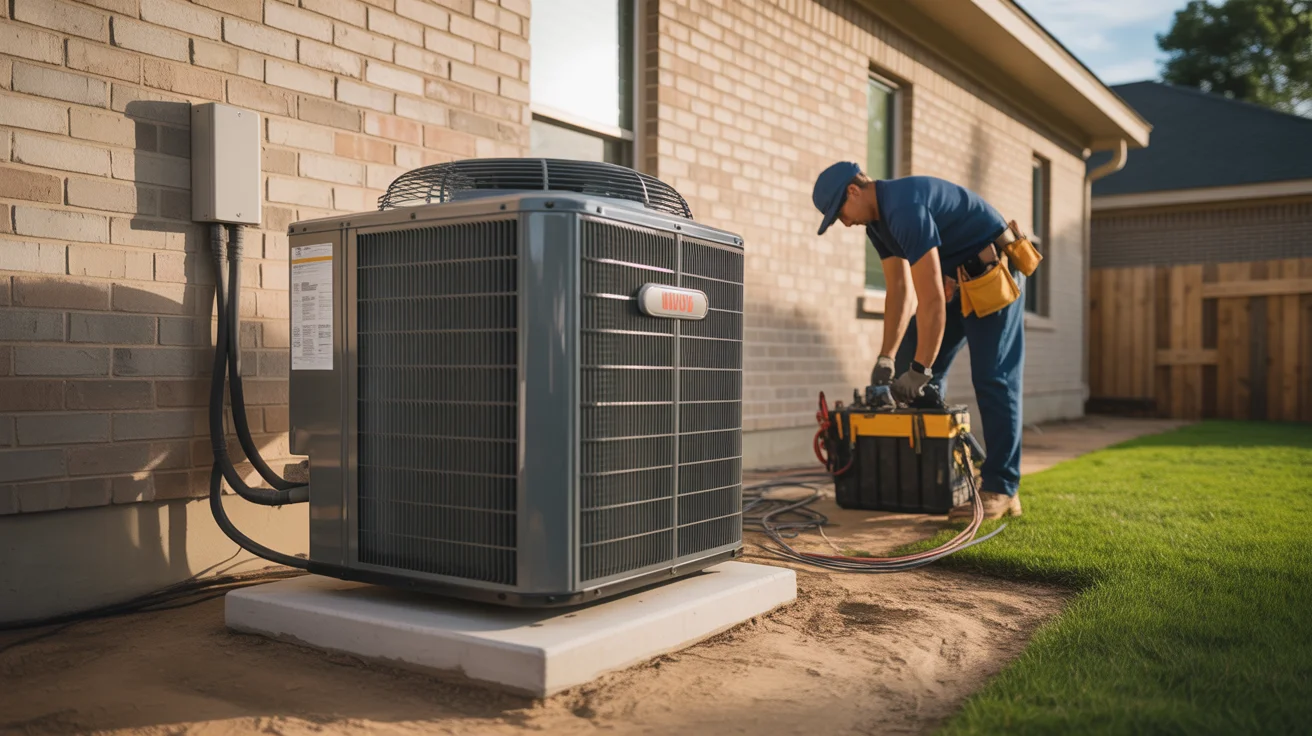
A new AC unit costs $5,500 to $8,000 installed for most North Texas homes. The full range runs $3,800 for a small 1.5-ton system up to $12,500 for a large 5-ton unit. Premium variable-speed systems add $3,000 to $6,000 on top of that. Your actual price depends on system size, brand, ductwork condition, and how easy your home is to work on. Federal tax credits through 2032 can knock $300 to $2,000 off qualifying high-efficiency units.
I’m Gary Musaraj, owner of Jupitair HVAC. I install AC systems across Frisco, Plano, McKinney, Allen, and the surrounding North Texas area. I wrote this guide because the #1 question I get is “how much is this going to cost me?” and I think you deserve a straight answer before anyone shows up at your door with a clipboard.
New AC Cost by System Size
System size is measured in tons. One ton does not mean the unit weighs a ton. It refers to cooling capacity. Most North Texas homes need between 2.5 and 4 tons depending on square footage, insulation, and how many windows face west (that afternoon sun is brutal here).
Here is what a standard efficiency AC system costs fully installed in North Texas in 2026:
| System Size | Home Size (approx.) | Installed Cost |
|---|---|---|
| 1.5-ton | 600-900 sq ft | $3,800 - $5,200 |
| 2-ton | 900-1,200 sq ft | $4,200 - $6,000 |
| 2.5-ton | 1,200-1,500 sq ft | $4,800 - $6,800 |
| 3-ton | 1,500-1,800 sq ft | $5,400 - $7,800 |
| 3.5-ton | 1,800-2,200 sq ft | $6,200 - $8,900 |
| 4-ton | 2,200-2,800 sq ft | $7,000 - $10,200 |
| 5-ton | 2,800-3,500 sq ft | $8,500 - $12,500 |
These prices include the outdoor condenser unit, the indoor evaporator coil, labor, refrigerant, standard thermostat, permit, and a 10-year parts warranty. They assume your existing ductwork and electrical are in decent shape.
Why the wide ranges? A 3-ton AC in a single-story 2015 ranch home in Plano with easy attic access might land at $5,400. That same 3-ton system in a two-story 1992 home in McKinney with a cramped attic and outdated wiring could hit $7,800. Same equipment. Different install.
Want a variable-speed or high-SEER system? Add $3,000 to $6,000 to the prices above. I will cover why you might want that in the brands section below.
What Affects the Price
I have installed AC systems that took four hours and systems that took two full days. The difference is almost never the equipment. It is everything around it.
Your Existing Ductwork
If your ducts are old, leaky, or undersized, you cannot just bolt on a new AC and expect it to work right. I see this constantly in older Allen and McKinney neighborhoods. The previous installer used flex duct that is now crushed, sagging, or disconnected in the attic.
Ductwork modifications add $500 to $2,000. A full duct replacement runs $3,000 to $6,000 depending on home size. I only recommend it when the existing ductwork is truly shot.
Electrical Requirements
Newer high-efficiency systems sometimes need a different breaker size or upgraded wiring. If your electrical panel is already full, you might need a sub-panel. That is $800 to $1,500 and requires a licensed electrician.
Attic and Equipment Access
If I can walk upright to your air handler, the install goes faster. If I am belly-crawling through a 100-degree attic in July to reach equipment crammed into a corner, it takes longer and costs more. Homes built before 1995 tend to have tighter spaces.
Location of Equipment
Ground-level condenser pads are standard. Rooftop units (common on some Addison commercial properties and townhomes) require crane equipment and additional labor. That adds $500 to $1,500.
Permits and Inspections
The City of Frisco, Plano, McKinney, and most North Texas municipalities require a mechanical permit for AC replacement. Permit fees run $75 to $250 depending on the city. Any contractor who says “we do not need a permit” is cutting corners. The permit protects you.
AC Brands and What They Cost in North Texas
I install every major brand. Here is what they actually cost for a typical 3-ton system installed. This is the most common size I put in across Frisco and Plano.
Carrier
Carrier has been around since 1915. They literally invented modern air conditioning. Their equipment is solid and parts are easy to get in North Texas.
- Carrier Comfort Series (14 SEER2): $5,400 - $6,800
- Carrier Performance Series (17 SEER2): $7,200 - $8,800
- Carrier Infinity Series (variable-speed, 19+ SEER2): $9,500 - $12,000
Trane
Trane is popular in Texas for a reason. Their systems handle extreme heat well. I install a lot of Trane XR and XV series.
- Trane XR Series (14.3 SEER2): $5,600 - $7,000
- Trane XR17 (17 SEER2): $7,500 - $9,200
- Trane XV Series (variable-speed, 20+ SEER2): $10,000 - $12,500
Lennox
Lennox is headquartered in Richardson, about 30 minutes from most of my service area. Good equipment, though some of their high-end parts can take longer to source.
- Lennox Merit Series (14 SEER2): $5,200 - $6,600
- Lennox Elite Series (17 SEER2): $7,000 - $8,600
- Lennox Signature Series (variable-speed, 21+ SEER2): $10,500 - $13,000
Goodman
Goodman is made in Houston. They are the value pick and I install a lot of them in rental properties and budget-conscious homes. Do not let the lower price fool you. Goodman units run great when installed correctly.
- Goodman GSX14 (14.3 SEER2): $4,800 - $6,000
- Goodman GSXC18 (18 SEER2): $6,800 - $8,200
- Goodman GVXC20 (variable-speed, 20 SEER2): $8,500 - $10,500
Rheem
Rheem is another solid mid-range option. Their warranty support has gotten better in the last few years.
- Rheem Classic (14 SEER2): $5,000 - $6,200
- Rheem effort (17 SEER2): $6,800 - $8,400
- Rheem Prestige (variable-speed, 19 SEER2): $9,000 - $11,200
For a deeper comparison of the top three brands, read my Carrier vs Trane vs Lennox comparison.
Installation Costs Nobody Tells You About
The quote you get should be all-inclusive. But some companies give you a low number and then add fees on install day. Here is what should be included and what might get added.
Should Be Included in Every Quote
- Permit fees ($75-$250): Any legitimate contractor pulls a permit. If it is not in the quote, ask why.
- Old system removal and disposal: Hauling away your old condenser and coil is standard. Some companies charge $150-$300 extra for this. I include it.
- Refrigerant charge: Your new system needs refrigerant. This should be part of the installed price, not a line item surprise.
- Basic thermostat: A standard programmable thermostat should be included. Upgrading to an Ecobee or Nest adds $150-$250.
Common Add-Ons (Legitimate Extra Costs)
- Electrical disconnect upgrade: $150-$300. Required if your current disconnect box does not meet code.
- Thermostat wire replacement: $100-$200. Older homes often have thermostat wire that cannot handle new communicating systems.
- Concrete condenser pad: $75-$150. If your existing pad is cracked or too small.
- Drain line modification: $100-$250. Condensate drain lines sometimes need rerouting with new equipment.
- UV light or air purifier add-on: $300-$800. Optional but I recommend it for allergy-heavy households.
Red Flags in a Quote
If a quote includes a vague line item like “miscellaneous materials: $500” or “additional labor: TBD,” ask for specifics. You should know exactly what you are paying for before anyone starts work.
When to Replace vs Repair
This is the decision I help homeowners make every week. Here is the simple version.
Replace your AC if:
- It is 12-15+ years old AND needs a repair over $1,500
- Repair cost is more than 50% of what a new system costs
- It uses R-22 refrigerant (phased out, costs $75-$150 per pound to recharge)
- It breaks down more than twice per cooling season
- Your electricity bills keep climbing even after maintenance
Repair your AC if:
- It is under 10 years old
- The repair is under $800
- It has been reliable and this is the first major issue
- Your ductwork and insulation are the real problem, not the unit
Need help deciding? Check our emergency AC repair page or read my full repair vs replace guide.
I never push a replacement when a repair makes more sense. That $280 capacitor swap keeps your system running for years. But I also will not keep patching a 16-year-old system that is going to leave you sweating in August.
Rebates and Tax Credits That Lower Your Cost
This is money people leave on the table all the time because nobody tells them about it.
Federal Tax Credits (Through 2032)
The Energy Efficient Home Improvement Credit gives you up to $2,000 back on qualifying high-efficiency systems. To qualify, your new AC needs to meet ENERGY STAR Most Efficient criteria or CEE Tier 1 requirements. Most variable-speed systems and units rated 16+ SEER2 qualify.
This is a tax credit, not a deduction. It directly reduces what you owe the IRS dollar for dollar.
Utility Rebates
Oncor (the company that delivers electricity for most North Texas electric providers) offers rebates on qualifying HVAC equipment. Typical rebates run $200 to $500 for high-efficiency AC systems. Check with your electricity provider too. Some retail electric companies offer additional incentives.
Manufacturer Rebates
Carrier, Trane, Lennox, and others run seasonal promotions, usually in spring and fall. These range from $100 to $1,000+ off depending on the system. I will always let you know if there is an active promotion when I write your quote.
Total Potential Savings
On a qualifying high-efficiency system, you could save:
- Federal tax credit: up to $2,000
- Utility rebate: $200-$500
- Manufacturer rebate: $100-$1,000
That is potentially $2,300 to $3,500 back on a premium system. A $10,000 variable-speed AC could net out at $6,500 to $7,700 after all credits and rebates.
How to Get an Honest Quote
I have been in this business since 2008. Here is what I tell every homeowner before they start calling around.
Get at least three quotes. Not to play companies against each other, but to understand the range. If one quote is wildly lower than the others, something is missing. If one is way higher, ask what they are including that others are not.
Make sure they do a load calculation. A proper Manual J load calculation determines what size system your home needs. If a contractor walks in, looks around for five minutes, and says “you need a 3.5-ton,” that is a guess. Guesses lead to oversized systems that short-cycle and undersized systems that cannot keep up.
Ask what is included. Permit? Old system removal? Thermostat? Refrigerant? Warranty labor? Get it in writing.
Check their license. Texas requires HVAC contractors to hold a TDLR (Texas Department of Licensing and Regulation) license. Ask for the number and verify it at TDLR’s website. No license, no hire.
Read the warranty details. Most manufacturers offer 10-year parts warranties, but only if the system is registered within 60 days of installation. Your contractor should handle this. Labor warranties vary. Ours is 2 years on labor, 10 years on parts.
For more tips on reading quotes, check my guide on how to read HVAC proposals.
Frequently Asked Questions
How long does AC installation take?
Most residential AC installations take 4 to 8 hours. A straightforward swap on a newer home can be done in 4 hours. Older homes or systems that need ductwork modifications can take a full day or stretch into two days.
What is the best time of year to buy a new AC?
Late winter and early spring (February through April) before the summer rush. Manufacturers run more promotions, scheduling is easier, and you are not making this decision in a panic when it is 105 degrees outside. That said, I install systems year-round and the price difference between seasons is not dramatic.
Can I install just the outside unit and keep my old indoor coil?
Technically yes, but I do not recommend it. Mismatched systems lose efficiency, void some manufacturer warranties, and often do not meet current SEER2 rating requirements. The cost savings is usually only $800 to $1,200 and you lose much more in efficiency and warranty coverage.
How long does a new AC last in North Texas?
With proper maintenance, 12 to 18 years. North Texas systems work harder than units in milder climates because we run our AC from April through October. Annual tune-ups, clean filters, and keeping your condenser clear of debris all add years to the system.
Is financing available for a new AC?
Yes. Most reputable HVAC companies offer financing with approved credit. We offer options from 0% for 12 months to low-interest plans up to 60 months. A $7,000 system at 60 months comes out to roughly $120 to $140 per month depending on the rate.
Do I need a new furnace when I replace my AC?
Not always. If your furnace is under 10 years old and working well, you can replace just the AC and outdoor unit. However, if both are aging, replacing them together saves money on labor since the systems share components. Bundling typically saves $500 to $1,000 versus doing them separately.
Get Your Free Quote
I give free, no-pressure estimates across Frisco, Plano, McKinney, Allen, The Colony, Prosper, Little Elm, and Addison. I will do a proper load calculation, show you options at different price points, and give you a written quote that includes everything.
No mystery fees. No high-pressure sales tactics. Just honest numbers from someone who does this work himself.
Call (940) 390-5676 or request your free quote online. I usually respond within an hour during business hours and same-day for everything else.
Need Professional HVAC Service?
Our certified technicians are ready to help with any HVAC needs in North Texas