Commercial HVAC Maintenance: What Every North Texas Business Owner Needs to Know
Complete guide to commercial HVAC maintenance for North Texas businesses. Real costs, RTU maintenance schedules, restaurant and office building requirements, and when to repair vs. replace.
- What Commercial HVAC Maintenance Actually Involves
- The Real Cost of Commercial HVAC Maintenance in North Texas
- RTU Maintenance: The #1 Thing North Texas Businesses Overlook
- Restaurant HVAC: A Completely Different Animal
- Office Building HVAC: Comfort Drives Productivity
- When to Repair vs. Replace Commercial Equipment
- Frequently Asked Questions
- Protect Your Investment with Proactive Maintenance
- What Commercial HVAC Maintenance Actually Involves
- The Real Cost of Commercial HVAC Maintenance in North Texas
- RTU Maintenance: The #1 Thing North Texas Businesses Overlook
- Restaurant HVAC: A Completely Different Animal
- Office Building HVAC: Comfort Drives Productivity
- When to Repair vs. Replace Commercial Equipment
- Frequently Asked Questions
- Protect Your Investment with Proactive Maintenance
Your commercial HVAC system is probably the most expensive piece of equipment in your building. A single rooftop unit can cost $15,000 to $50,000 to replace. Yet I see business owners across Frisco, Plano, and McKinney who haven’t had their commercial HVAC maintenance done in two or three years. They call me when it’s 104 degrees outside and their customers are walking out the door.
I’ve been servicing commercial systems across North Texas since 2008. Restaurants, office buildings, retail spaces, warehouses. The businesses that budget for maintenance spend $500 to $2,000 a year on upkeep. The ones that skip it spend $5,000 to $15,000 on emergency repairs and premature replacements. That pattern holds for every single building type I work on.
This guide covers what commercial HVAC service actually includes, what it should cost, and the specific requirements for different types of businesses. If you own or manage a commercial property in the Dallas-Fort Worth area, this is the maintenance knowledge you need to protect your investment.
What Commercial HVAC Maintenance Actually Involves
Commercial maintenance is not the same as residential. Your home has one system, maybe two. A small office building might have four rooftop units. A restaurant has RTUs plus kitchen exhaust and makeup air. A retail strip center could have a dozen units across multiple tenants.
The scope changes everything about how maintenance gets done.
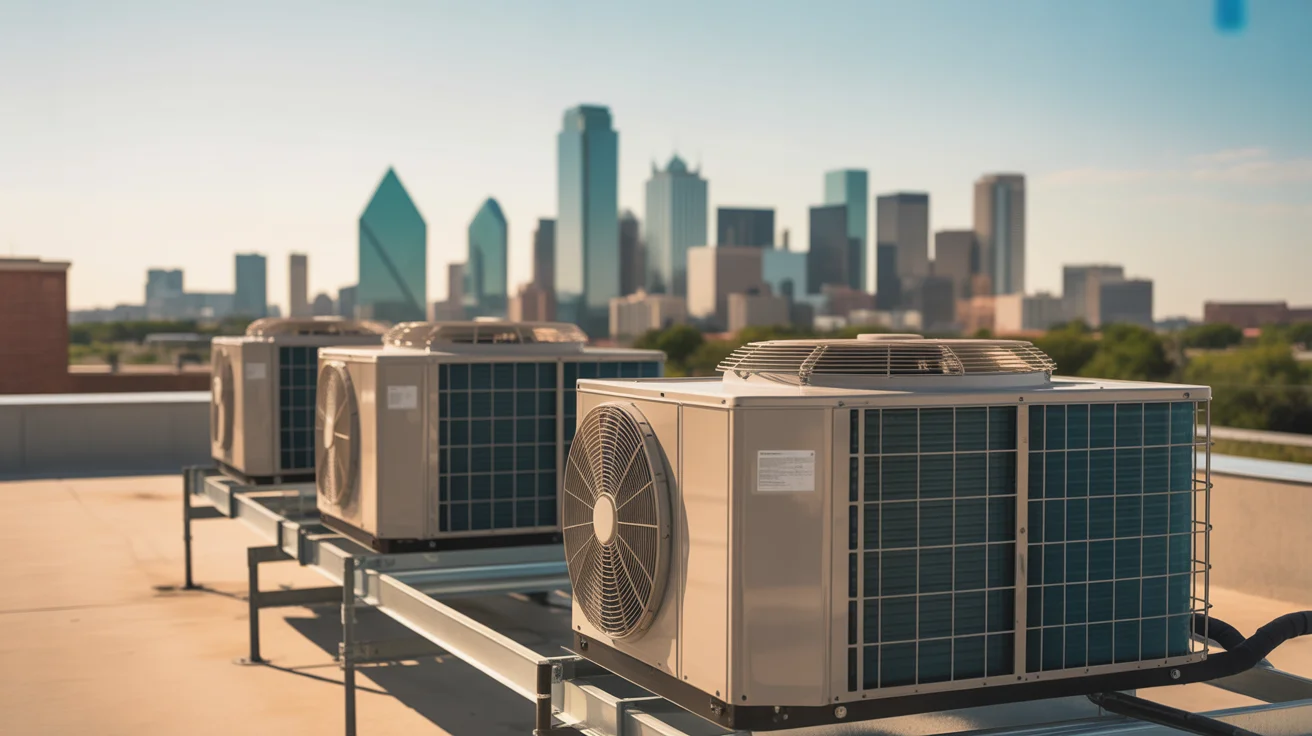
Rooftop units (RTUs) are the most common commercial HVAC equipment in North Texas. These packaged units sit on your roof and handle heating, cooling, and ventilation in a single box. Most of the commercial buildings I service between Allen and Addison run RTUs ranging from 3 tons to 25 tons.
Beyond RTUs, commercial buildings may use split systems (similar to residential but larger), VRF systems (variable refrigerant flow, common in newer office buildings), or chiller systems for large facilities. Each type has its own maintenance requirements, but RTUs make up about 80% of the commercial HVAC work I do in this area.
Quarterly, Semi-Annual, and Annual Tasks
A proper commercial HVAC maintenance program breaks down into three tiers:
Monthly or quarterly tasks:
- Filter inspection and replacement
- Belt inspection and tension adjustment
- Condensate drain clearing
- Basic operational check (thermostat response, airflow, unusual noises)
Semi-annual tasks (spring and fall):
- Full coil cleaning (condenser and evaporator)
- Refrigerant level check and leak inspection
- Electrical connection tightening and testing
- Motor and bearing lubrication
- Economizer calibration and testing
Annual tasks:
- Complete electrical system inspection
- Heat exchanger inspection (gas-fired units)
- Full control system calibration
- Ductwork inspection for leaks
- Equipment efficiency measurements and documentation
Skipping the quarterly stuff is where problems start. A $5 filter left unchanged for six months can cause a $3,000 compressor failure. I see it constantly.
The Real Cost of Commercial HVAC Maintenance in North Texas
Business owners always want a straight answer on cost. Here’s what I charge and what you should expect from any reputable commercial HVAC service provider in the DFW area.
| Building Type | Typical Equipment | Annual Maintenance Cost | Per-Visit Cost |
|---|---|---|---|
| Small office (2,000-5,000 sq ft) | 1-2 RTUs (5-10 tons) | $600-$1,200 | $200-$400 |
| Restaurant | 2-3 RTUs + kitchen exhaust | $1,500-$3,000 | $400-$800 |
| Retail space (5,000-10,000 sq ft) | 2-4 RTUs | $1,000-$2,000 | $300-$500 |
| Office building (10,000-25,000 sq ft) | 4-8 RTUs or VRF | $2,000-$5,000 | $500-$1,000 |
| Warehouse/industrial | 1-2 large RTUs + unit heaters | $800-$1,500 | $250-$500 |
The industry standard is roughly $50 to $120 per cooling ton per year for a full preventive maintenance contract. A 10-ton RTU on a Plano office building runs about $500 to $1,200 a year for complete coverage.
Maintenance Contract vs. Pay-Per-Visit
Most commercial clients save money with a maintenance contract. Here’s the comparison:
Maintenance contract benefits:
- 10-20% discount on per-visit pricing
- Priority scheduling (critical in North Texas summer when everyone’s AC breaks at once)
- Consistent technician who knows your equipment
- Scheduled visits so nothing gets forgotten
- Minor repairs often included in the contract price
Pay-per-visit makes sense when:
- You have a single small unit
- Your building is seasonal or part-time use
- You’re already planning to replace the equipment within a year
I’ll be direct: for any business running year-round in North Texas, a maintenance contract is almost always the better deal. The priority scheduling alone is worth it. When it’s August and 107 degrees, the difference between a same-day visit and a three-day wait is the difference between keeping your doors open and losing revenue.
The ROI Math
The U.S. Department of Energy estimates that proper maintenance saves 5-20% on energy costs. For a mid-size office building spending $2,000 a month on electricity in summer, that’s $100 to $400 per month in savings.
Add in the avoided emergency repairs (average commercial ac repair for a failed compressor runs $2,500 to $5,000) and extended equipment life (15-20 years maintained vs. 8-12 years neglected), and the return on a $1,500 annual maintenance investment is significant.
RTU Maintenance: The #1 Thing North Texas Businesses Overlook
If your business has a flat roof, you almost certainly have at least one rooftop unit. And if you’re like most of my commercial clients in Frisco and McKinney, you’ve probably never been up there to look at it.
Out of sight, out of mind. That’s the problem with RTU maintenance. These units sit in direct North Texas sun, enduring 150-degree-plus surface temperatures on the roof in July. They collect debris, bird nests, hail damage, and general neglect that you’d notice immediately on a ground-level unit.
The RTU Quarterly Checklist
Every quarter, your commercial HVAC maintenance provider should be checking:
- Filters: Commercial RTUs use larger filter banks than residential systems. A clogged filter on a 15-ton unit doesn’t just reduce airflow. It can freeze the evaporator coil and burn out the compressor motor.
- Belts: RTUs with belt-driven blowers need belt tension checks. A loose belt squeals. A broken belt shuts down airflow entirely while the compressor keeps running.
- Condensate drains: Clogged drains cause water to back up into the unit. In North Texas humidity, I’ve seen condensate flood ceiling tiles and damage inventory in retail spaces.
- Electrical connections: Heat cycling loosens electrical connections over time. Loose connections create hot spots that can trip breakers or, worse, cause electrical fires.
The Economizer: Your Hidden Energy Saver
Most RTUs have an economizer, a damper system that brings in cool outside air instead of running the compressor when conditions are right. In North Texas, that means free cooling on those 65-degree spring and fall mornings.
The problem? Economizers fail constantly. Actuators seize up. Damper blades get stuck. Temperature sensors drift out of calibration. I estimate 60% of the RTUs I inspect have economizers that aren’t working properly.
A malfunctioning economizer means your compressor runs when it doesn’t need to. On a 10-ton unit, that’s roughly $30 to $50 per month in wasted electricity. Across four units, you’re burning $120 to $200 a month for no reason.
Annual economizer inspection and calibration should be part of every RTU maintenance program. It’s one of the highest-ROI maintenance tasks I perform.
Restaurant HVAC: A Completely Different Animal
I service about a dozen restaurants across the North Texas area, and I tell every new restaurant HVAC client the same thing: your system works three times harder than an office building’s, and it needs three times the attention.
Here’s why restaurant HVAC is in its own category:
Grease is the enemy. Kitchen exhaust pulls airborne grease through your HVAC system. It coats condenser coils, clogs filters, and gums up fan motors. A restaurant RTU filter that would last three months in an office needs replacement every four to six weeks.
Heat load is extreme. Commercial kitchens generate massive amounts of heat. Fryers, ovens, flat tops, all of them pump BTUs into the space that your AC has to remove. I’ve measured kitchen temperatures above 110 degrees with the AC running full blast. The cooling load in a restaurant kitchen can be two to three times higher per square foot than a standard office.
Makeup air units are critical. Your kitchen exhaust hood pulls air out of the building. That air has to be replaced, or you create negative pressure that makes doors hard to open, pulls in unconditioned air through every crack, and messes with your exhaust hood’s effectiveness. Makeup air units (MAUs) need their own maintenance schedule.
Health code compliance. Proper ventilation isn’t optional in a restaurant. North Texas health inspectors check that kitchen exhaust systems work correctly. A failed HVAC system can shut down your kitchen during the dinner rush.
My recommendation for restaurants: quarterly professional maintenance at minimum, with monthly filter checks between visits. Budget $1,500 to $3,000 per year for a restaurant with two to three RTUs and kitchen exhaust.
Office Building HVAC: Comfort Drives Productivity
Office HVAC maintenance is less intense than restaurant work, but the stakes are different. In a restaurant, a broken AC means customers leave. In an office, it means employees can’t focus, complaints pile up, and tenants start looking at their lease terms.
Zoning matters. Most office buildings have multiple zones controlled by separate thermostats. Conference rooms, server rooms, and open floor plans all have different cooling needs. During maintenance visits, I verify that each zone responds correctly and that the system balances airflow across the building.
Indoor air quality is non-negotiable. Stuffy air, CO2 buildup, and stale odors in an office environment lead to headaches, fatigue, and reduced productivity. The American Society of Heating, Refrigerating, and Air-Conditioning Engineers (ASHRAE) sets ventilation standards that your system should meet. Proper filter maintenance and economizer operation are the two biggest factors in office building HVAC air quality.
After-hours scheduling saves money. If your office runs 8 AM to 6 PM, your HVAC shouldn’t run at full capacity all night. Programmable thermostats or building automation systems can setback temperatures during unoccupied hours and pre-cool before staff arrives. I’ve helped Allen and Plano offices cut their energy bills by 15-25% just by optimizing their runtime schedules.
Server rooms need their own plan. If you have a server closet or data room, it needs dedicated cooling that runs 24/7 regardless of the building schedule. I’ve seen server rooms hit 95 degrees over a weekend because someone programmed the whole building to shut down. One overheated server rack costs more to replace than a year of HVAC maintenance.
When to Repair vs. Replace Commercial Equipment
Every commercial system reaches a point where maintenance isn’t enough. Knowing when to stop repairing and start replacing saves you from pouring money into dying equipment.
The 15-year rule for RTUs. Most commercial rooftop units have a useful life of 15 to 20 years with proper maintenance. After 15 years, repair costs accelerate, parts become harder to find, and efficiency drops significantly compared to modern equipment. If your RTU was installed before 2011, it’s time to start planning for replacement.
The 50% rule. If a single repair costs more than 50% of the replacement cost, replace the unit. A $4,000 compressor replacement on a unit that costs $12,000 new? That repair makes sense. A $7,000 repair on the same unit? Replace it.
The R-22 factor. Older commercial units still running on R-22 refrigerant face a hard deadline. R-22 production ended in 2020, and remaining supplies are expensive and dwindling. If your commercial system uses R-22, a refrigerant recharge that cost $300 five years ago now costs $800 to $1,200. This alone can tip the math toward replacement.
Efficiency gains pay for themselves. A new RTU with a high IEER (Integrated Energy Efficiency Ratio) rating can cut cooling costs by 30-40% compared to a 15-year-old unit. On a 10-ton commercial unit in North Texas, that translates to $1,500 to $3,000 per year in energy savings. Many businesses see full payback on a replacement within four to six years.
When you’re weighing the decision, I’m happy to run the numbers for your specific situation. Call me at (940) 390-5676 and I’ll give you an honest assessment of whether repair or replacement makes more financial sense.
Frequently Asked Questions
How often should commercial HVAC systems be serviced?
At minimum, twice per year (spring and fall) with quarterly filter checks between visits. Restaurants and high-use buildings should have quarterly professional maintenance. The more hours your system runs, the more frequently it needs attention. In North Texas, where commercial AC runs 8-10 months per year, quarterly service is the standard I recommend for most businesses.
What’s included in a commercial HVAC maintenance visit?
A standard visit includes filter replacement, belt inspection, coil inspection and cleaning (semi-annual), condensate drain clearing, electrical connection checks, thermostat calibration, refrigerant level check, and a full operational test. For RTUs, add economizer inspection and roof curb/flashing check. A complete visit takes 1 to 3 hours per unit depending on size and condition.
Can I do any commercial HVAC maintenance myself?
You can check and replace filters (if you can safely access the unit), keep the area around outdoor equipment clear of debris, and monitor thermostat settings. But commercial systems involve high-voltage electrical work, refrigerant handling (which requires EPA certification), and rooftop access with fall protection. For liability and safety reasons, professional commercial HVAC service is the standard for commercial properties.
How do I choose a commercial HVAC maintenance provider?
Look for EPA-certified technicians with specific commercial experience (not just residential techs doing commercial work on the side). Ask about their experience with your equipment type. Request references from similar businesses. Verify they carry commercial general liability insurance. And make sure they provide detailed documentation of every visit, because you’ll want records for warranty claims, insurance, and property management purposes.
Will a maintenance contract reduce my energy bills?
Yes. The U.S. Department of Energy estimates 5-20% energy savings from proper HVAC maintenance. For a North Texas commercial building spending $1,500 to $3,000 per month on electricity during summer, that’s $75 to $600 per month in savings. Clean coils, proper refrigerant levels, calibrated controls, and functioning economizers all contribute to lower energy consumption. Most businesses see their maintenance contract pay for itself through energy savings alone within the first year.
Protect Your Investment with Proactive Maintenance
Commercial HVAC equipment represents a significant capital investment for any North Texas business. Whether you run a restaurant in Frisco, manage an office building in Plano, or own retail space in McKinney, the math is clear: scheduled maintenance costs a fraction of what emergency repairs and premature replacements cost.
The best time to start a commercial maintenance program is before something breaks. The second best time is today.
Call me at (940) 390-5676 to schedule a commercial HVAC assessment. I’ll inspect your equipment, give you an honest evaluation of its condition, and build a maintenance plan that fits your building and your budget. No pressure, no upsells, just straight talk from someone who’s been keeping North Texas businesses comfortable for over 17 years.
Need Professional HVAC Service?
Our certified technicians are ready to help with any HVAC needs in North Texas