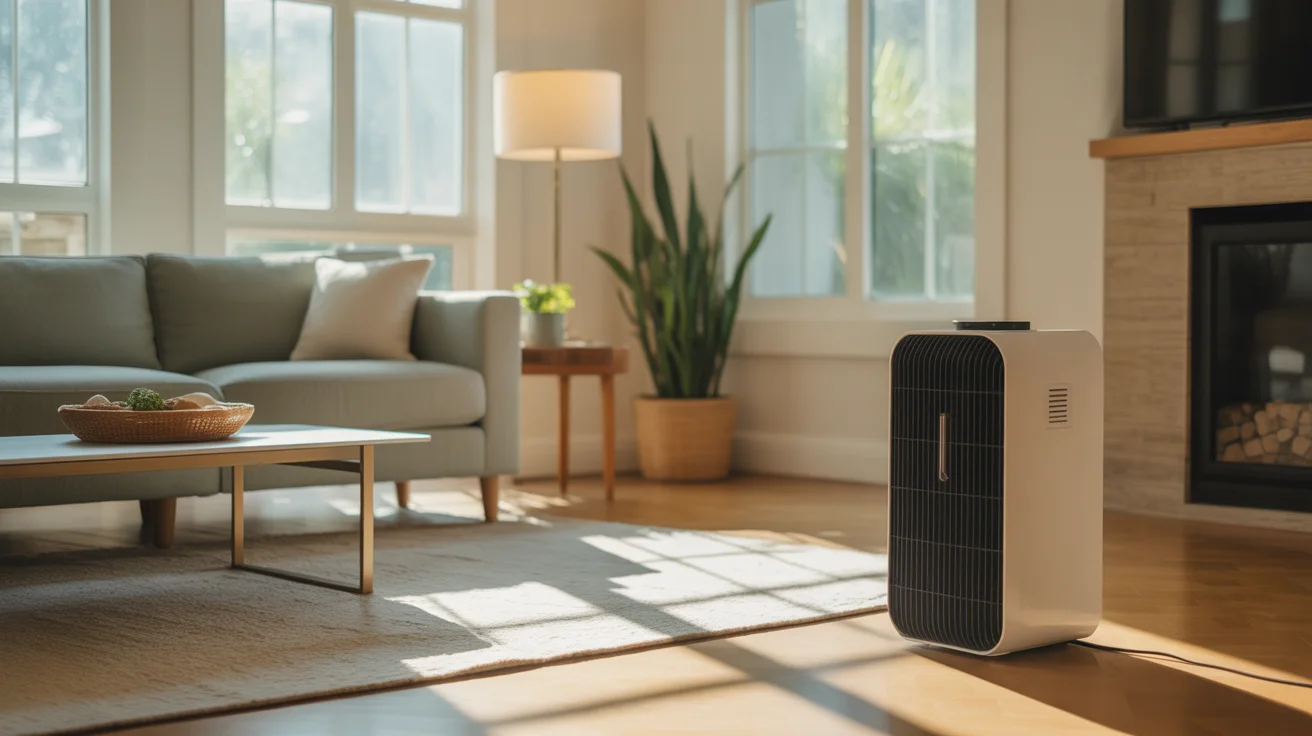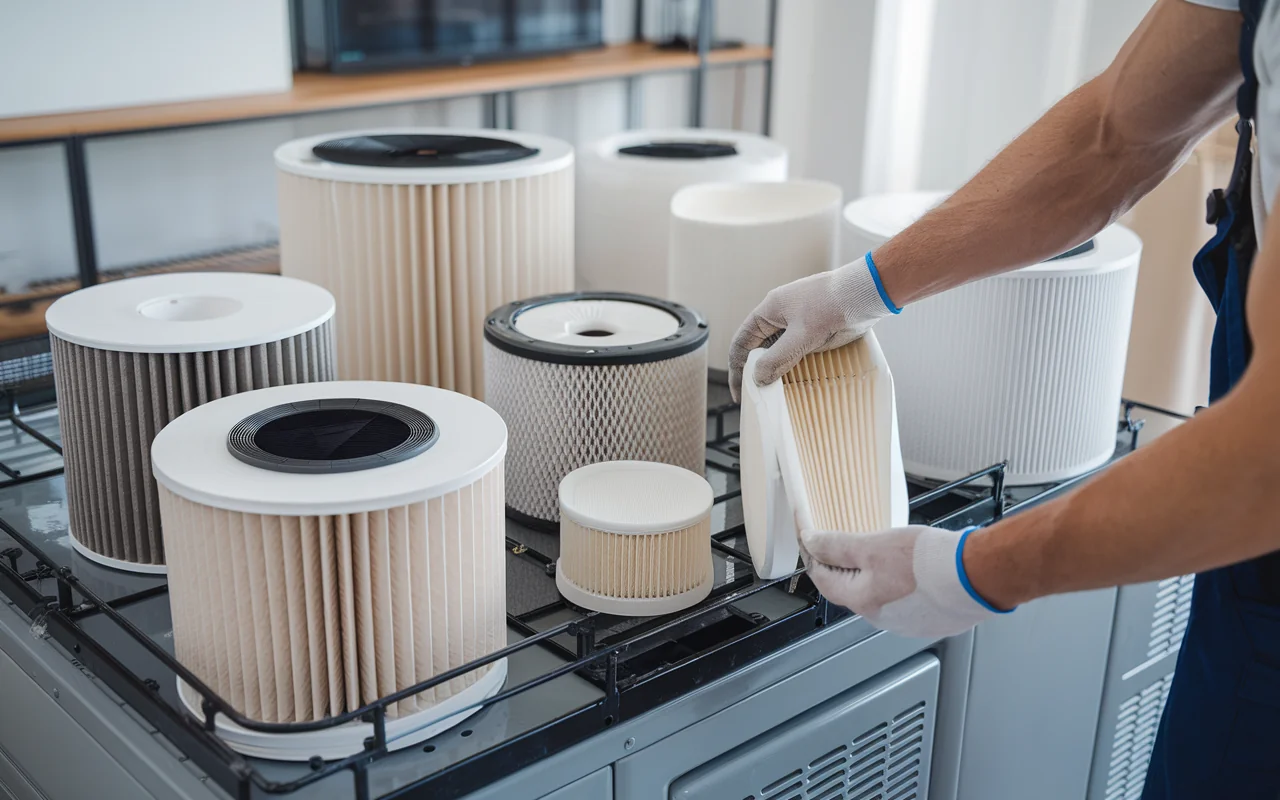
"Hospital-Grade" Air Purification for Homes: What That Actually Means
What hospital air systems really do, what parts of it can go in a North Texas house, and what the equipment can and cannot do for your family's health.
- What Hospitals Actually Do
- The Filter Numbers, Straight
- The Airflow Problem, Before Anything Else
- UV-C: What It Does and What It Doesn’t
- Ionization, Plasma and PCO
- What the Health Research Actually Shows
- Realistic Packages and What They Cost
- Frequently Asked Questions
+ 2 more sections below...
“Hospital-grade” is a marketing phrase, not a rating. Hospitals get clean air from ventilation rate and filtration working together, and the ventilation half does not fit in a house. What does transfer is the filtration: a deep-pleat MERV 13-16 media cabinet, or a fan-powered HEPA bypass, plus a UV-C lamp on the evaporator coil. Budget $2,500-$15,000 depending on scope. Get static pressure measured first, because the filters that catch the most are also the ones that can choke a residential blower.
What Hospitals Actually Do
ANSI/ASHRAE/ASHE Standard 170 is the ventilation standard for health care facilities, and it specifies rooms by air change rate, pressure relationship and filter efficiency. An operating room runs a minimum of 20 air changes per hour, at least 4 of them outdoor air, held at positive pressure relative to the corridor, with filtration of MERV 14 or better. The 2021 edition raised the final filter requirement for operating rooms again. There is no particle-count spec you buy your way to, and there is no requirement for HEPA in a standard OR.
Your house does about half an air change per hour of natural infiltration, and your air handler is sized to move heat, not to flush the room 20 times an hour. Nobody is putting an OR in a Frisco two-story. Anyone who tells you otherwise is selling a box.
So the honest version of this job is: take the part of the hospital approach that works in a house, which is filtration and coil hygiene, and size it so it does not wreck the equipment.
The Filter Numbers, Straight
The two numbers that get thrown around are 99.97% and MERV, and both get misread constantly.
99.97% is a filter media rating, not a house result. A HEPA filter, per EPA, can “theoretically remove at least 99.97% of dust, pollen, mold, bacteria, and other airborne particles with a size of 0.3 microns.” That is efficiency of the media, measured on a test rig, on the air that goes through it. It is not the share of allergen removed from your home. What you actually get in a house depends on how much air moves through the filter, how many hours a day the blower runs, how much air leaks around the filter frame, and how much pollen is coming in the back door. A perfect filter on a system that runs four hours a day does less than a MERV 13 on a system that circulates continuously.
The 0.3 micron figure is also the hardest case, not the smallest thing a filter catches. EPA calls it “the most penetrating particle size” and notes that “particles that are larger or smaller are trapped with even higher efficiency.” So the old sales line that dangerous particles are “smaller than 0.3 microns and slip right through” has it backwards.
MERV is a range of efficiencies, not one number. Under ASHRAE 52.2 each MERV level is defined across three particle size bands:
| MERV | 0.3-1.0 µm | 1.0-3.0 µm | 3.0-10 µm |
|---|---|---|---|
| 8 | not rated | ≥20% | ≥70% |
| 11 | ≥20% | ≥65% | ≥85% |
| 13 | ≥50% | ≥85% | ≥90% |
| 16 | ≥95% | ≥95% | ≥95% |
That table is the whole argument for MERV 13 in a North Texas house. Pollen, dander and most dust live in the upper two bands, where a MERV 13 is at 85-90%. Bacteria in indoor air are large enough that MERV 13 handles the bulk of them too.
The Airflow Problem, Before Anything Else
True HEPA is roughly MERV 17-20 equivalent. It does not go in a furnace filter slot. The pressure drop across HEPA media will starve a residential blower, drop your airflow, and freeze the evaporator coil. I have been called out to systems where a homeowner “upgraded” the filter and iced the coil solid inside a week.
Two ways around it:
Bypass HEPA. A HEPA cabinet on a parallel loop off the return, so only a portion of the return air is routed through the HEPA and the main airstream is untouched.
Fan-powered HEPA. The cabinet has its own blower to push air through the dense media, so your furnace motor never sees the restriction.
Same caution applies at the top of the media range. Jumping from a 1-inch MERV 8 to a MERV 16 in a house with undersized returns, which I see constantly in 1990s Plano and Allen builds, can cut airflow enough to hurt both efficiency and comfort. That is why the assessment starts with a static pressure reading. If the system is already at 0.5 in. w.c. or higher, the ductwork gets fixed before anything more restrictive goes in.
UV-C: What It Does and What It Doesn’t
UV-C at 254 nm damages the DNA of microorganisms so they cannot reproduce. That part is real. Where it gets oversold is where it works.
On the coil, it works. The evaporator coil is dark, wet and continuously in front of the lamp. Prolonged exposure is exactly the condition UV needs. One study cited by EPA measured a 99 percent reduction in microbial contaminants growing on exposed HVAC surfaces. A clean coil also transfers heat better, so you get an efficiency and odor benefit alongside the hygiene one. This is the reason I install UV lamps.
In the airstream, it mostly doesn’t. Air moves past an in-duct lamp in a fraction of a second. EPA’s technical summary is blunt about it: “Typical UVGI air cleaners designed for use in homes do not deliver sufficient UV doses to effectively kill or deactivate most airborne microorganisms because the exposure period is too short and/or the intensity is too low. Thus, UVGI does not appear to be effective as a sole control device.” The same study that found a 99 percent reduction on HVAC surfaces found airborne bacteria dropped only 25 to 30 percent. EPA also notes that adding UVGI to HEPA or MERV 13-and-above filtration “offers only minimal infection control benefits over those provided by the filters alone.”
So a “kills 99.9% of airborne pathogens” number on an in-duct lamp is a lab chamber result being reported as if it were duct performance. It is not.
One more thing to specify: ask for an ozone-free lamp. Uncoated UV-C lamps at 254 nm and below generate ozone by splitting oxygen, which is why manufacturers coat the quartz on ozone-free models. Ozone is a lung irritant. There is no version of this where you want it in your supply air.
Ionization, Plasma and PCO
These are the categories where the marketing has run furthest ahead of the evidence, so here is the plain read.
Bipolar ionization. EPA’s position: “This is an emerging technology, and little research is available that evaluates it outside of lab conditions,” and it “has the potential to generate ozone and other potentially harmful by-products indoors, unless specific precautions are taken in the product design and maintenance.” If a customer wants one, EPA’s own guidance is the spec to hold it to: use a device certified to UL 2998, the validation procedure for zero ozone emissions from air cleaners. I will install one on that condition. I will not sell it as a substitute for filtration.
Plasma. Same family, same caution. EPA notes plasma air cleaners perform well in controlled laboratory tests, but “a number of harmful byproducts are known to form, including particles, ozone, carbon monoxide, and formaldehyde,” and “very little information exists on the performance of these systems in real indoor settings.”
Photocatalytic oxidation. PCO puts UV on a titanium dioxide catalyst to break down VOCs. The problem is incomplete oxidation. EPA: PCO air cleaners “are often ineffective in completely transforming gaseous pollutants in indoor air and are also known to generate harmful byproducts such as formaldehyde, acetaldehyde, nitrogen dioxide, and carbon monoxide.” Formaldehyde is one of the compounds a chemically sensitive person is usually trying to get away from, so PCO is the wrong first move for that household. Source control plus activated carbon is the better answer, and carbon does not generate byproducts.
Ozone generators. Never in an occupied space. EPA is unambiguous, and no federal agency has approved the use of air cleaners that intentionally emit ozone in occupied spaces.
What the Health Research Actually Shows
This matters more than any spec sheet, because it is where this industry gets its worst reputation.
The best evidence on home air filtration and asthma is a systematic review in Chest that pooled 10 randomized controlled trials, 216 patients total. It found air filters were associated with significantly lower total symptom scores, a weighted mean difference of 0.47 on a 10-point scale, and lower sleep disturbance scores. It found no difference in medication use and no difference in morning peak expiratory flow. The authors flagged heterogeneity across the trials and called for larger studies.
That is the real result: a measurable improvement in how people feel and sleep, not a transformation. Anyone quoting you a percentage drop in asthma attacks or a dollar figure in avoided medical costs is making it up. I have had customers tell me they sleep better and dust less. I believe them. I am not going to convert that into a number.
For households with a genuinely immunocompromised member, the same rule applies with more weight, not less: filtration is one layer among several, and the clinical plan belongs to the physician. What I can commit to is equipment that does what the spec says, installed so it does not compromise the system, and serviced on schedule.
Realistic Packages and What They Cost
$2,500-$5,000. Deep-pleat MERV 13-16 media cabinet sized to the blower, or an entry bypass HEPA cabinet, plus a coil-mounted UV-C lamp and basic monitoring. This handles most of what a North Texas allergy household is dealing with.
$5,000-$10,000. Fan-powered HEPA bypass, activated carbon stage for VOCs and odors, continuous particle and humidity monitoring, and duct modifications where the returns are undersized. This is the tier where the ductwork usually gets corrected as part of the job.
$10,000-$15,000. Multi-stage with ULPA in place of HEPA, zoned treatment for a specific room, return duct rework and full controls integration. ULPA is genuinely overkill for a house. I have installed it a handful of times, all for specific medical situations, and I say the same thing every time: the incremental capture over HEPA is small and the pressure drop is not.
Ongoing: pre-filters every 3-6 months, HEPA cartridges every 12-24 months, UV lamps annually, electronic cleaner plates washed monthly. A UV lamp at 18 months is still glowing and is no longer doing much.
Frequently Asked Questions
Q: Can a residential HVAC system handle true HEPA filtration? A: Not in the filter slot. HEPA media will starve a residential blower and can freeze the coil. It goes in a bypass or a fan-powered cabinet with its own motor so the furnace blower never pushes through it.
Q: Are UV-C systems safe in an occupied home? A: In-duct lamps are sealed inside the ductwork with no occupant exposure. Specify an ozone-free lamp. Uncoated 254 nm and shorter-wavelength lamps generate ozone.
Q: Do these systems protect against COVID-19 and other viruses? A: Filtration is one layer, not protection on its own. EPA’s guidance is direct: “By itself, air cleaning or filtration is not enough to protect people from COVID-19.” A MERV 13 or better filter captures a share of the particles that carry respiratory viruses, and it works alongside ventilation and the public health measures your doctor and CDC recommend, not instead of them. In-duct UV does not close that gap at residential doses.
Q: Will this eliminate allergies? A: No. It removes airborne particles that pass through the filter. Allergens settled in bedding, carpet and upholstery, contact allergens and food allergens are untouched by anything in your ductwork.
Q: Is “hospital-grade” a real certification? A: No. There is no hospital-grade rating for residential equipment. The real specs are MERV under ASHRAE 52.2 for filters, and the DOE HEPA definition for HEPA media. Ask any contractor using the phrase which of those two they mean.
Get an Honest Assessment
If someone in your house has asthma, severe allergies, or a condition that makes air quality a real clinical concern, the first visit should be measurement, not a proposal. We check static pressure, look at return sizing, and see what the existing system can actually support before recommending anything.
Call (940) 390-5676 or schedule an air quality assessment at jupitairhvac.com/contact.
Jupitair HVAC: Licensed & Insured, serving Plano, Frisco, McKinney, Allen, The Colony, Little Elm, and surrounding North Texas communities. See also our air purifier buying guide and HVAC filter guide.
Sources & References
- EPA — Residential Air Cleaners: A Technical Summary, 3rd Edition — UVGI dose limitations, PCO and plasma byproducts, ozone from air cleaners
- EPA — Air Cleaners, HVAC Filters, and Coronavirus (COVID-19) — bipolar ionization, UL 2998, limits of air cleaning
- EPA — What is a HEPA filter? — 99.97% at 0.3 µm and most penetrating particle size
- EPA — What is a MERV rating? — ASHRAE 52.2 efficiency bands
- McDonald E, et al. Effect of air filtration systems on asthma: a systematic review of randomized trials. Chest. 2002;122(5):1535-42 — 10 RCTs, symptom and sleep outcomes, no change in medication use
- ANSI/ASHRAE/ASHE Standard 170, Ventilation of Health Care Facilities — operating room air change and filtration requirements
Last Updated: August 2026
Need Professional HVAC Service?
Our certified technicians are ready to help with any HVAC needs in North Texas